AAC vs AAAC vs ACSR: Guía Completa de Comparación para Conductores de Transmisión Aérea
AAC vs AAAC vs ACSR: Guía Completa de Comparación para Conductores de Transmisión Aérea
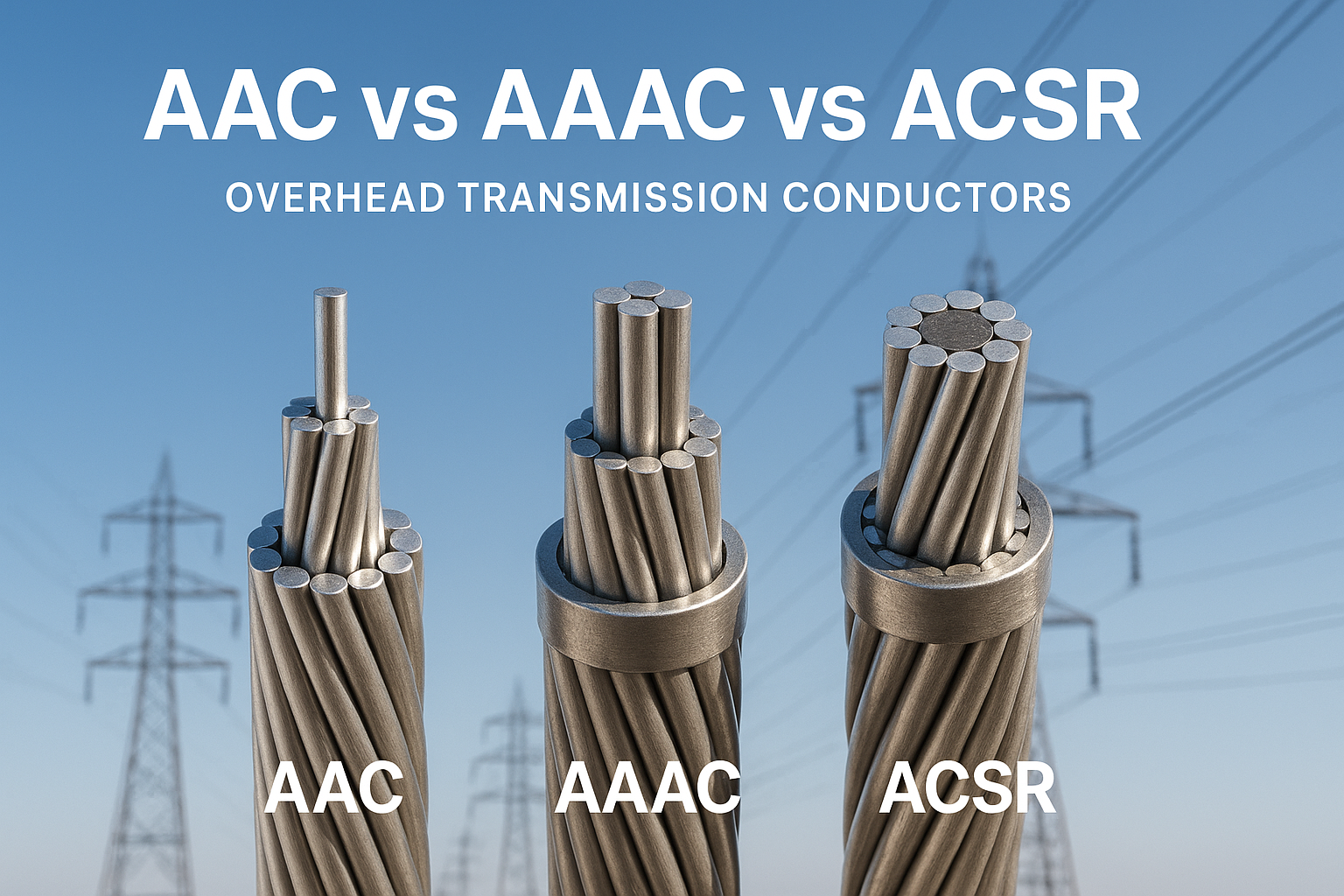
Al diseñar o actualizar líneas de transmisión y distribución aéreas, una de las decisiones más críticas que enfrentan los ingenieros es seleccionar el tipo de conductor adecuado. Los tres conductores aéreos desnudos más utilizados en todo el mundo son AAC (Conductor de Aluminio), AAAC (Conductor de Aleación de Aluminio) y ACSR (Conductor de Aluminio con Alma de Acero). Cada uno tiene características mecánicas, eléctricas y económicas distintas que lo hacen adecuado para aplicaciones específicas.
Esta guía completa proporciona una comparación detallada de AAC, AAAC y ACSR en parámetros técnicos clave, ayudándole a tomar una decisión informada para su próximo proyecto.
1. Descripción General de los Tres Tipos de Conductores
AAC (Conductor de Aluminio)
El AAC, también conocido como Conductor de Aluminio, consiste en múltiples hilos de aluminio de grado eléctrico (grado EC) trenzados. Según ASTM B231 y BS 215 Parte 1, el AAC es el más ligero y el más conductor de los tres tipos, con una conductividad mínima del 61% IACS (Estándar Internacional de Cobre Recocido).
Los conductores AAC están compuestos completamente de hilos de aleación de aluminio 1350-H19. Al no tener alma de acero, el AAC ofrece la relación conductividad-peso más alta de cualquier conductor aéreo. Sin embargo, también tiene la resistencia a la tracción más baja, lo que lo hace más adecuado para aplicaciones de vanos cortos donde las cargas mecánicas son mínimas.
Estándares comunes para AAC: - ASTM B231 (Especificación para Conductores de Aluminio 1350 Trenzados Concéntricamente) - BS 215 Parte 1 (Conductores de Aluminio para Líneas Aéreas) - IEC 61089 (Conductores Eléctricos Aéreos Trenzados Concéntricamente de Hilo Redondo) - DIN 48201 (Conductores de Aluminio Trenzados)
AAAC (Conductor de Aleación de Aluminio)
El AAAC está fabricado con aleación de aluminio-magnesio-silicio de alta resistencia (típicamente aleación 6201-T81). Regido por ASTM B399 y BS 3242, el AAAC ofrece aproximadamente 53% IACS de conductividad — ligeramente inferior al AAC — pero con una resistencia a la tracción significativamente mayor.
La ventaja clave del AAAC es su excelente relación resistencia-peso. Proporciona aproximadamente un 30% más de resistencia a la tracción que el AAC mientras pesa solo un 10% más. El AAAC también ofrece una resistencia a la corrosión superior en comparación con el ACSR, ya que no tiene alma de acero que pueda corroerse, y funciona excepcionalmente bien en entornos costeros e industriales.
Para obtener una visión detallada de las especificaciones y selección del AAAC, visite nuestra página de producto del Conductor AAAC.
Estándares comunes para AAAC: - ASTM B399 (Conductores de Aleación de Aluminio 6201-T81 Trenzados Concéntricamente) - BS 3242 (Conductores de Aleación de Aluminio Trenzados para Transmisión de Energía Aérea) - IEC 61089 - DIN 48201 / EN 50183
ACSR (Conductor de Aluminio con Alma de Acero)
El ACSR es uno de los tipos de conductores aéreos más antiguos y más utilizados. Consiste en un alma central de acero (acero galvanizado o acero revestido de aluminio) rodeada por una o más capas de aluminio de grado EC trenzado. El alma de acero proporciona resistencia mecánica, mientras que los hilos de aluminio transportan la carga eléctrica.
Según ASTM B232 y BS 215 Parte 2, el ACSR ofrece la mayor resistencia a la tracción de los tres tipos, lo que lo convierte en la opción preferida para vanos largos, zonas de carga de hielo pesada y cruces de ríos. El alma de acero puede soportar hasta el 50–60% de la carga mecánica total, dependiendo de la relación acero-aluminio (que varía según la configuración de cableado, ej. 6/1, 18/1, 30/7, 54/7).
Para especificaciones de ACSR, configuraciones de cableado y datos de ingeniería, visite nuestra página de producto del Conductor ACSR.
Estándares comunes para ACSR: - ASTM B232 (Conductores de Aluminio Trenzados Concéntricamente, Reforzados con Acero) - BS 215 Parte 2 (Conductores de Aluminio Reforzados con Acero para Líneas Aéreas) - IEC 61089 - DIN 48204
2. Comparación Técnica Directa
2.1 Conductividad Eléctrica
| Parámetro | AAC | AAAC | ACSR |
|---|---|---|---|
| Conductividad (% IACS) | 61% | 53% | 61% (solo hilos de Al) |
| Conductividad efectiva total | 61% | 53% | 40–55% (el alma de acero casi no conduce) |
El AAC y la porción de aluminio del ACSR comparten la misma conductividad del 61% IACS. Sin embargo, debido a que el alma de acero en el ACSR prácticamente no transporta corriente, la capacidad de transporte de corriente por unidad de peso del ACSR es menor que la del AAC. El AAAC se sitúa entre ambos en términos de ampacidad.
2.2 Resistencia a la Tracción
| Parámetro | AAC | AAAC | ACSR |
|---|---|---|---|
| Resistencia a la tracción (MPa) | 170–200 | 295–325 | 250–400 (según cableado) |
| Relación resistencia-peso | Baja | Alta | Muy alta |
El ACSR ofrece la mayor resistencia a la tracción absoluta, lo que lo hace indispensable para aplicaciones de vanos largos. El AAAC ofrece la mejor relación resistencia-peso, crucial para torres donde la distancia de seguridad y la reducción de carga estructural son prioridades.
2.3 Peso y Comportamiento de Flecha
El AAC es el conductor más ligero (densidad de aluminio aprox. 2.7 g/cm³), resultando en la mayor flecha para una longitud de vano dada. El AAAC es solo ligeramente más pesado pero ofrece una flecha significativamente reducida debido a su mayor módulo de tracción. El ACSR, con su alma de acero (densidad del acero aprox. 7.8 g/cm³), es el más pesado pero exhibe la menor flecha en condiciones similares.
Rendimiento de flecha: ACSR > AAAC > AAC (de menor a mayor flecha)
2.4 Resistencia a la Corrosión
| Entorno | AAC | AAAC | ACSR |
|---|---|---|---|
| Costero/Marino | Excelente | Excelente | Moderada (requiere alma galvanizada/AW) |
| Industrial/Contaminado | Excelente | Muy buena | Moderada |
| Rural/Seco | Excelente | Excelente | Excelente |
| Alta humedad | Excelente | Excelente | Buena (con galvanizado adecuado) |
El AAAC y el AAC son inherentemente resistentes a la corrosión ya que están hechos completamente de aleaciones de aluminio. El ACSR requiere almas de acero galvanizado o revestido de aluminio (AW) para protección en entornos agresivos.
2.5 Comportamiento de Fluencia
La fluencia (alargamiento permanente bajo carga sostenida) es una consideración importante para el rendimiento de la flecha a largo plazo. El AAC exhibe la mayor tasa de fluencia, seguido por el AAAC, mientras que el ACSR muestra la menor fluencia debido a su alma de acero. Para líneas donde la tensión se mantiene cerca de los niveles de instalación durante décadas, el ACSR es la opción más dimensionalmente estable.
3. Recomendaciones por Aplicación
Cuándo Elegir AAC
- Vanos cortos (típicamente menos de 100 m) en redes de distribución urbana
- Entornos costeros y marinos donde la resistencia a la corrosión es primordial
- Aplicaciones en subestaciones y barras colectoras donde el peso ligero facilita la instalación
- Líneas de distribución de baja tensión con cargas mecánicas mínimas
- Bajo costo de instalación como factor principal
Cuándo Elegir AAAC
- Vanos medios a largos (100–300 m) que requieren buena relación resistencia-peso
- Entornos costeros, industriales o contaminados que necesitan resistencia a la corrosión sin sacrificar resistencia
- Proyectos de aumento de capacidad donde las torres existentes deben manejar cargas mayores
- Zonas de carga de hielo ligera donde no se requiere la resistencia del alma de acero
- Proyectos que requieren bajas pérdidas eléctricas con capacidad mecánica moderada
Cuándo Elegir ACSR
- Cruces de vanos largos (ríos, valles, autopistas) que requieren máxima resistencia a la tracción
- Zonas de hielo pesado y viento extremo con cargas mecánicas severas
- Líneas de transmisión de extra alta tensión (EHV) en largas distancias
- Operación a alta temperatura con el alma de acero proporcionando estabilidad de flecha (ACSR estándar hasta 100°C; diseños especiales hasta 150°C)
- Reemplazo de infraestructura existente donde la compatibilidad con las cargas de torres existentes es esencial
Para una comparación detallada de los conductores AAC y sus especificaciones, visite nuestra página de producto del Conductor AAC.
4. Comparación de Costos y Consideraciones Económicas
Al evaluar el costo total de propiedad de conductores aéreos, deben considerarse varios factores más allá del precio de compra inicial:
| Factor | AAC | AAAC | ACSR |
|---|---|---|---|
| Costo de material por metro | Bajo | Moderado | Bajo a moderado |
| Costo de instalación | Más bajo (más ligero) | Moderado | Más alto (más pesado, requiere herrajes especializados) |
| Pérdidas de transmisión durante la vida útil | Más bajas | Moderadas | Moderadas a altas |
| Costo de mantenimiento | Bajo | Bajo | Moderado (inspección de corrosión) |
| Vida útil esperada | 40+ años | 40+ años | 35–50 años (según el entorno) |
El AAC ofrece el costo de instalación y material inicial más bajo, pero puede requerir ajustes de flecha más frecuentes durante su vida útil. El AAAC proporciona el mejor equilibrio entre costo y rendimiento en muchos escenarios. El ACSR, aunque tiene costos de instalación más altos, sigue siendo la solución más rentable para vanos largos donde se necesita su resistencia mecánica.
5. Referencia de Estándares y Cumplimiento
Al especificar conductores aéreos, siempre consulte los estándares internacionales o nacionales aplicables:
Estándares Internacionales: - IEC 61089 — Conductores eléctricos aéreos trenzados concéntricamente de hilo redondo (cubre AAC, AAAC, ACSR) - IEC 61597 — Conductores eléctricos aéreos — Métodos de cálculo para conductores desnudos trenzados - IEC 61284 — Líneas aéreas — Requisitos y ensayos para herrajes
Estándares Norteamericanos (ASTM): - ASTM B231 — AAC - ASTM B232 — ACSR - ASTM B399 — AAAC - ASTM B524 — Conductores de aluminio trenzados concéntricamente, reforzados con aleación de aluminio (ACAR)
Estándares Británicos: - BS 215 Parte 1 — AAC - BS 215 Parte 2 — ACSR y AAAC - BS EN 50182 — Conductores para líneas aéreas — Conductores trenzados concéntricamente de hilo redondo
Estándares Chinos (GB): - GB/T 1179 — Conductores aéreos trenzados concéntricamente de hilo redondo - GB/T 17048 — Alambre de aluminio estirado en frío para conductores aéreos - GB/T 17937 — Alambre de aleación de aluminio para conductores aéreos
Verifique siempre que el conductor seleccionado cumpla con el código de red local y los requisitos reglamentarios del país del proyecto.
6. Preguntas Frecuentes (FAQ)
P1: ¿Qué tipo de conductor tiene la mayor capacidad de transporte de corriente — AAC, AAAC o ACSR?
Para áreas transversales idénticas, el AAC tiene la ampacidad más alta con un 61% IACS. El AAAC le sigue con aproximadamente un 53% IACS. La ampacidad efectiva del ACSR es menor que la del AAC para el mismo diámetro total porque el alma de acero no conduce electricidad. Sin embargo, el ACSR puede diseñarse con capas de aluminio más gruesas para igualar o superar la ampacidad de otros tipos.
P2: ¿Puede el AAAC reemplazar directamente al ACSR?
No sin verificación de ingeniería. Si bien el AAAC ofrece una mejor relación resistencia-peso y resistencia superior a la corrosión, el ACSR proporciona una mayor resistencia a la tracción absoluta. En muchos casos, el AAAC puede reemplazar al ACSR si la longitud del vano y las cargas mecánicas lo permiten, pero se requiere un análisis completo de flecha y tensión.
P3: ¿Cuál es la vida útil típica de los conductores AAC, AAAC y ACSR?
Con una instalación y mantenimiento adecuados, los tres tipos pueden durar más de 40 años. El AAC y el AAAC son particularmente duraderos en entornos corrosivos debido a su construcción totalmente de aluminio, mientras que el ACSR en áreas costeras puede requerir una inspección más frecuente del alma de acero para verificar la degradación del galvanizado.
P4: ¿Cómo calculo la flecha y la tensión para cada tipo de conductor?
Los cálculos de flecha y tensión siguen los métodos de catenaria o parábola estándar según IEC 61597 o IEEE 738 para la clasificación térmica. Cada tipo de conductor tiene diferentes coeficientes de expansión lineal, módulo elástico y comportamiento de fluencia que deben ingresarse en el cálculo. La mayoría de las empresas de servicios públicos utilizan software especializado como PLS-CADD, SAG10 o TOWER para el diseño detallado de líneas.
P5: ¿Se pueden usar AAC, AAAC y ACSR en la misma línea de transmisión?
Sí, pero las transiciones deben diseñarse cuidadosamente. Los diferentes tipos de conductores tienen diferentes propiedades mecánicas, que afectan la carga de las torres, los perfiles de flecha y la compatibilidad del herraje. Se requieren torres de transición o estructuras de anclaje donde cambien los tipos de conductores.
Conclusión
Elegir entre AAC, AAAC y ACSR requiere equilibrar el rendimiento eléctrico, la resistencia mecánica, las condiciones ambientales y el presupuesto. AAC sobresale en aplicaciones de vanos cortos y baja tensión con máxima conductividad. AAAC ofrece el mejor rendimiento general con alta relación resistencia-peso y excelente resistencia a la corrosión. ACSR sigue siendo el caballo de batalla de las líneas de transmisión de larga distancia y alta tensión en todo el mundo.
Para especificaciones detalladas de productos, hojas de datos descargables y soporte técnico, visite las páginas de productos de SiTong Cable o comuníquese con nuestro equipo de ventas técnicas.