ACSR Conductor (Aluminum Conductor Steel Reinforced) Complete Technical Guide: BS 215, IEC 61089 & ASTM B232 Standards — Specifications, Selection & Overhead Power Line Applications
ACSR Conductor (Aluminum Conductor Steel Reinforced) Complete Technical Guide: BS 215, IEC 61089 & ASTM B232 Standards — Specifications, Selection & Overhead Power Line Applications
ACSR (Aluminum Conductor Steel Reinforced) is the most widely used overhead conductor worldwide, combining high-purity aluminum strands with a galvanized steel core for an optimal balance of conductivity, strength, and cost. This comprehensive guide covers ACSR construction, international standards (BS 215, IEC 61089, ASTM B232), code-word designations, electrical and mechanical specifications, selection methodology, and real-world applications in transmission and distribution networks.
Introduction
ACSR (Aluminum Conductor Steel Reinforced) has been the backbone of global overhead power transmission and distribution since its introduction in the early 20th century. Its concentric-lay stranding design — with electrical-grade (EC) aluminum outer layers carrying current and a galvanized steel core providing mechanical strength — delivers an unrivaled combination of high conductivity, excellent strength-to-weight ratio, and economic efficiency.
According to industry data, ACSR accounts for approximately 70% of all overhead conductors installed worldwide, with annual consumption exceeding 2.5 million metric tons. From rural distribution lines operating at 11 kV to Extra High Voltage (EHV) transmission lines at 765 kV, ACSR remains the default choice for utilities, EPC contractors, and grid operators across every continent.
SiTong Cable manufactures ACSR conductors in full compliance with BS 215 (British Standard), IEC 61089 (International Electrotechnical Commission), and ASTM B232 (American Society for Testing and Materials), covering code-word designations from the popular "Rabbit," "Dog," and "Goat" series through "Lapwing," "Partridge," "Dove," "Drake," and beyond. This guide provides engineers, procurement professionals, and project managers with a complete technical reference for ACSR conductor selection and application.
ACSR Conductor Construction
Stranding Configuration
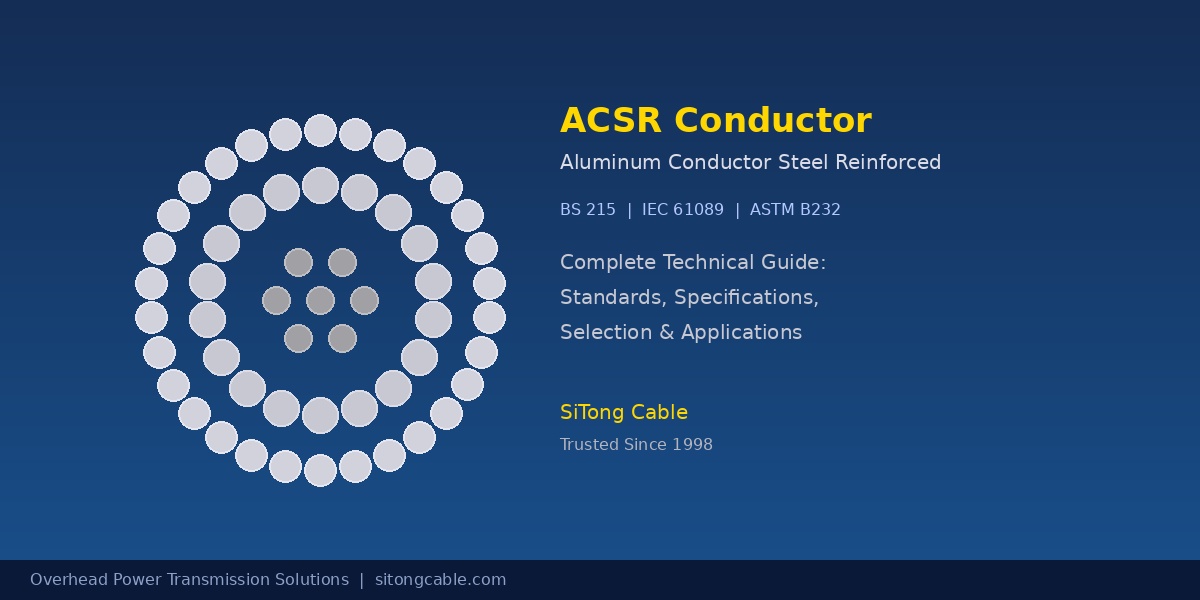
ACSR consists of two distinct material components arranged in a concentric-lay configuration:
- Aluminum Strands (1350-H19 EC-grade): One or more layers of hard-drawn electrical conductivity (EC) grade aluminum, minimum 61.0% IACS conductivity. These strands carry the vast majority of electrical current.
- Steel Core (Galvanized): One or more strands of high-strength galvanized steel (Class A, B, or C zinc coating) providing mechanical reinforcement. The steel core carries the majority of tensile load.
Common stranding configurations include:
| Code-Word | Total Strands | Aluminum | Steel | Common Applications |
|---|---|---|---|---|
| 6/1 (e.g., Rabbit, Dog, Goat) | 7 | 6 | 1 | Distribution, sub-transmission |
| 18/1 (e.g., Lapwing) | 19 | 18 | 1 | Medium-voltage transmission |
| 26/7 (e.g., Partridge, Dove) | 33 | 26 | 7 | High-voltage transmission, 69–230 kV |
| 30/7 (e.g., Drake, Cardinal) | 37 | 30 | 7 | EHV transmission, 230–500 kV |
| 54/7 (e.g., Curlew, Rail) | 61 | 54 | 7 | EHV transmission, 345–765 kV |
| 54/19 (e.g., Bluejay, Finch) | 73 | 54 | 19 | Extra-high strength EHV lines |
Steel Core Types
The steel core plays a critical role in ACSR performance. Three zinc-coating grades are specified in ASTM B498 / IEC 60888:
| Class | Minimum Zinc Coating (oz/ft²) | Corrosion Resistance | Application |
|---|---|---|---|
| A | 0.80 | Highest | Coastal, industrial, corrosive environments |
| B | 0.40 | Moderate | Standard overhead lines |
| C | 0.20 | Standard | Rural, low-corrosion areas |
For extreme corrosion conditions, Aluminized (Al-clad) steel core per ASTM B415 / IEC 61232 is available, offering superior resistance to salt spray and industrial pollutants.
International Standards for ACSR
BS 215 — British Standard (UK, Middle East, Southeast Asia)
BS 215 (latest edition: BS 215-2:2012) is the most widely referenced ACSR standard outside North America. It specifies:
- Code-word designations (Rabbit, Dog, Goat, Wolf, Lapwing, etc.)
- Dimensional requirements for each code-word
- Breaking load (minimum ultimate tensile strength)
- Electrical resistance at 20°C
- Mass per unit length
- Zinc coating requirements for the steel core
BS 215 code-words are defined by nominal aluminum-to-steel (A/S) cross-sectional area ratio: - ACSR 6/1 (A/S = 5.0–6.0): Rabbit, Dog, Goat, Wolf - ACSR 18/1 (A/S = 18.0): Lapwing - ACSR 26/7 (A/S = 3.7–4.9): Partridge, Dove - ACSR 30/7 (A/S = 4.3): Drake - ACSR 54/7 (A/S = 7.7): Curlew, Rail
IEC 61089 — International Standard
IEC 61089:1991 (confirmed 2021) provides a unified international framework for round wire concentric lay stranded overhead conductors. It harmonizes BS, ASTM, and other national standards into a single specification covering:
- Material requirements for aluminum 1350-H19 and galvanized steel wire
- Stranding construction tolerances and lay ratios
- Mechanical properties (UTS, modulus of elasticity, coefficient of linear expansion)
- Electrical properties (resistance, conductivity)
- Testing procedures (tensile, resistivity, stranding integrity)
IEC 61089 is the preferred standard for international projects requiring multi-source procurement and global acceptance.
ASTM B232 — American Standard
ASTM B232/B232M-17 covers ACSR conductors using Class A, B, or C zinc-coated steel core for the North American market. Code-words follow the NESC (National Electrical Safety Code) naming convention with standard sizes designated by AWG (American Wire Gauge) or kcmil (thousand circular mils). Common code-words include:
- Partridge (266.8 kcmil, 26/7 stranding)
- Dove (556.5 kcmil, 26/7 stranding)
- Drake (795.0 kcmil, 26/7 stranding)
- Cardinal (954.0 kcmil, 54/7 stranding)
- Rail (1192.5 kcmil, 54/19 stranding)
Electrical & Mechanical Properties
Key Parameters by Code-Word (BS 215)
| Code-Word | A/S Ratio | Stranding | Total Area (mm²) | Diameter (mm) | UTS (kN) | DC Resistance at 20°C (Ω/km) | Mass (kg/km) |
|---|---|---|---|---|---|---|---|
| Rabbit | 6.0 | 6/1 | 31.33 | 7.6 | 11.48 | 0.9252 | 114.2 |
| Dog | 6.0 | 6/1 | 50.14 | 9.6 | 17.89 | 0.5787 | 180.6 |
| Goat | 6.0 | 6/1 | 77.99 | 12.0 | 26.93 | 0.3717 | 278.6 |
| Lapwing | 18.0 | 18/1 | 139.82 | 15.6 | 42.18 | 0.2066 | 434.9 |
| Partridge | 4.2 | 26/7 | 273.1 | 21.8 | 72.83 | 0.0936 | 863.1 |
| Dove | 4.2 | 26/7 | 361.2 | 25.0 | 96.33 | 0.0707 | 1140.5 |
| Drake | 4.3 | 30/7 | 513.7 | 29.8 | 131.2 | 0.0495 | 1652.0 |
Temperature Effects
ACSR operating performance is temperature-dependent:
- Continuous operating temperature: 75°C–100°C (standard), 125°C (high-temperature design)
- Emergency temperature: 150°C (short-term, < 100 hours/year)
- Maximum sag at 75°C: Approximately 1.5× the sag at 15°C initial tension
- Thermal expansion coefficient: 19.3–23.0 × 10⁻⁶ /°C (varies with A/S ratio)
- Modulus of elasticity: 76–82 GPa (varies with stranding configuration)
The steel core carries an increasing share of tensile load as temperature rises, since the aluminum strands experience greater thermal elongation. This self-regulating mechanism is a key design advantage of ACSR over homogeneous conductors.
ACSR vs Alternative Overhead Conductors
| Property | ACSR | AAC | AAAC |
|---|---|---|---|
| Strength | ★★★★★ Highest | ★★☆☆☆ Lowest | ★★★☆☆ Moderate |
| Conductivity (IACS) | 61.0% | 61.0% | 52.5–53.0% |
| Corrosion Resistance | ★★★☆☆ | ★★★☆☆ | ★★★★☆ |
| Weight | Moderate | Lightest | Moderate |
| Cost per km | ★★★★☆ Low | ★★★☆☆ Medium | ★★★☆☆ Medium |
| Typical Span Length | 300–1500 m | 100–300 m | 200–800 m |
| Primary Use Case | Transmission | Urban/Short Span | Coastal/Industrial |
For detailed specifications on ACSR alternatives, see our AAC Conductor product page and AAAC Conductor product page.
Selection Criteria for ACSR Conductors
1. Voltage Level and Line Classification
- Distribution (11–33 kV): 6/1 stranding codes (Rabbit, Dog, Goat) — economical, easy to handle
- Sub-transmission (33–132 kV): 18/1 or 26/7 stranding (Lapwing, Partridge)
- High-voltage transmission (132–345 kV): 26/7 and 30/7 stranding (Dove, Drake)
- EHV transmission (345–765 kV): 54/7 or 54/19 stranding (Cardinal, Rail, Bluejay)
2. Span Length and Sag Constraints
For long-span river crossings, valleys, or areas with restricted right-of-way:
- Higher A/S ratio conductors (steel-dominant) provide greater strength with acceptable sag
- Use larger steel core sections (e.g., 54/19 instead of 54/7) when available
- Verify sag-temperature-tension (STT) calculations per IEEE 524 or CIGRE TB 498
3. Environmental Conditions
- Coastal / Industrial: Specify Class A galvanizing or aluminized steel core
- Ice / Snow Loads: Increase safety factor to 2.5–3.0 per NESC or IEC 60826
- Wind Zones: Use 3-second gust wind speed for NESC heavy loading districts
- Pollution (IEC 60815): Select appropriate insulation coordination with ACSR compatibility
4. Electrical Loss Evaluation
Annual resistive losses (I²R) should be evaluated using:
Annual Losses (kWh/km) = I² × R × 8760 × LF
Where: - I = RMS current (A) - R = AC resistance at operating temperature (Ω/km) - LF = Loss factor (typically 0.3–0.5 for distribution, 0.5–0.7 for transmission)
Lower-resistance ACSR codes (larger cross-section) may justify higher initial investment through reduced lifetime losses.
Installation Best Practices
Stringing and Sagging
- Maximum stringing tension: Typically 15–18% of UTS at 15°C (initial), 20–22% final
- Roller diameter: Minimum 20× the conductor diameter
- Pulling grip: Use preformed helical grip or basket grip — never compress the aluminum strands
- Sag adjustment: Account for conductor creep (≈0.5–1.0% after 10 years for 26/7 stranding)
Dead-Ends and Splices
- Dead-end assemblies: Compression-type or helical preformed dead-ends rated for 95–100% UTS
- Mid-span splices: Full-tension compression splices meeting UTS ≥ 90%
- Jumper terminations: Compression parallel groove clamps or bolted connectors with Cor-ten or stainless steel hardware
Clearances and Phase Spacing
Per IEC 60826 or NESC Table 232-1: - Minimum ground clearance: 6.1 m (20 ft) for 69 kV, 7.6 m (25 ft) for 138 kV, 8.5 m (28 ft) for 230 kV - Phase-to-phase spacing: 1.5–5.0 m depending on voltage, span length, and insulation swing
Frequently Asked Questions
Q1: What is the difference between BS 215 and ASTM B232 ACSR conductors?
BS 215 uses metric units (mm² area, kN breaking load) with code-word designations like Rabbit, Dog, and Goat, commonly specified in the UK, Middle East, and Southeast Asia. ASTM B232 uses imperial units (kcmil area, lbf breaking load) with American code-words like Partridge, Dove, and Drake, prevalent in North America and parts of Latin America. Both standards define equivalent electrical and mechanical performance — SiTong Cable manufactures to both specifications.
Q2: Can ACSR be used for both transmission and distribution lines?
Yes. ACSR is the most versatile overhead conductor, covering everything from 11 kV rural distribution (Rabbit, Dog conductors) to 765 kV EHV transmission (Cardinal, Rail conductors). The key selection factor is the aluminum-to-steel (A/S) ratio and stranding configuration, which determine the conductor's strength, capacity, and sag characteristics.
Q3: How do I choose between ACSR, AAC, and AAAC?
Choose ACSR for long spans requiring high strength-to-weight ratios (transmission lines, rural distribution). Choose AAC for short-span urban applications where ductility and handling ease are priorities. Choose AAAC for coastal environments with high corrosion risk, or where lower electrical losses justify the moderate cost premium. See our product pages for ACSR, AAC, and AAAC specifications.
Q4: What is the standard corrosion protection for ACSR steel core?
Standard protection is Class B galvanized zinc coating per ASTM B498 or IEC 60888 (minimum 0.40 oz/ft²). For aggressive environments (coastal, industrial, high-pollution), Class A galvanizing (0.80 oz/ft²) or aluminized (Al-clad) steel core per ASTM B415 is recommended. Grease-filled or corrosion-inhibited ACSR variants are also available for the most demanding conditions.
Q5: How long is the typical service life of ACSR overhead line?
A properly designed and installed ACSR overhead line has a service life of 40–60 years. Key factors affecting longevity include: zinc coating thickness (Class A cores last longer), environmental corrosivity, operating temperature profile, and maintenance practices including periodic vibration damper inspection and corrosion monitoring.
Conclusion
ACSR remains the world's most trusted overhead conductor technology, backed by over a century of engineering experience and comprehensive international standards (BS 215, IEC 61089, ASTM B232). From compact 6/1 "Rabbit" conductors for rural distribution to massive 54/19 "Cardinal" and "Bluejay" conductors for EHV trunk lines, ACSR offers a proven, cost-effective solution for every voltage class and operating condition.
When selecting ACSR for your next project, consider: the applicable standard (BS 215, IEC 61089, or ASTM B232), A/S ratio, stranding configuration, zinc coating class, and site-specific environmental conditions. For engineering support, technical datasheets, and competitive pricing on BS 215 and ASTM B232 ACSR conductors, our product page for ACSR Conductor provides complete code-word specifications and ordering information.
SiTong Cable — Your Trusted Partner in Overhead Power Transmission since 1998