Comprender las diferencias entre los cables de construcción XHHW-2 y THHN
Comprender las diferencias entre los cables de construcción XHHW-2 y THHN
Al seleccionar cables eléctricos de construcción para proyectos comerciales, industriales o de distribución de energía, dos opciones comunes son el cable de aluminio XHHW-2 y el cable THHN.
Ambos son conductores eléctricos ampliamente utilizados, pero están diseñados para diferentes entornos de instalación y requisitos del proyecto.
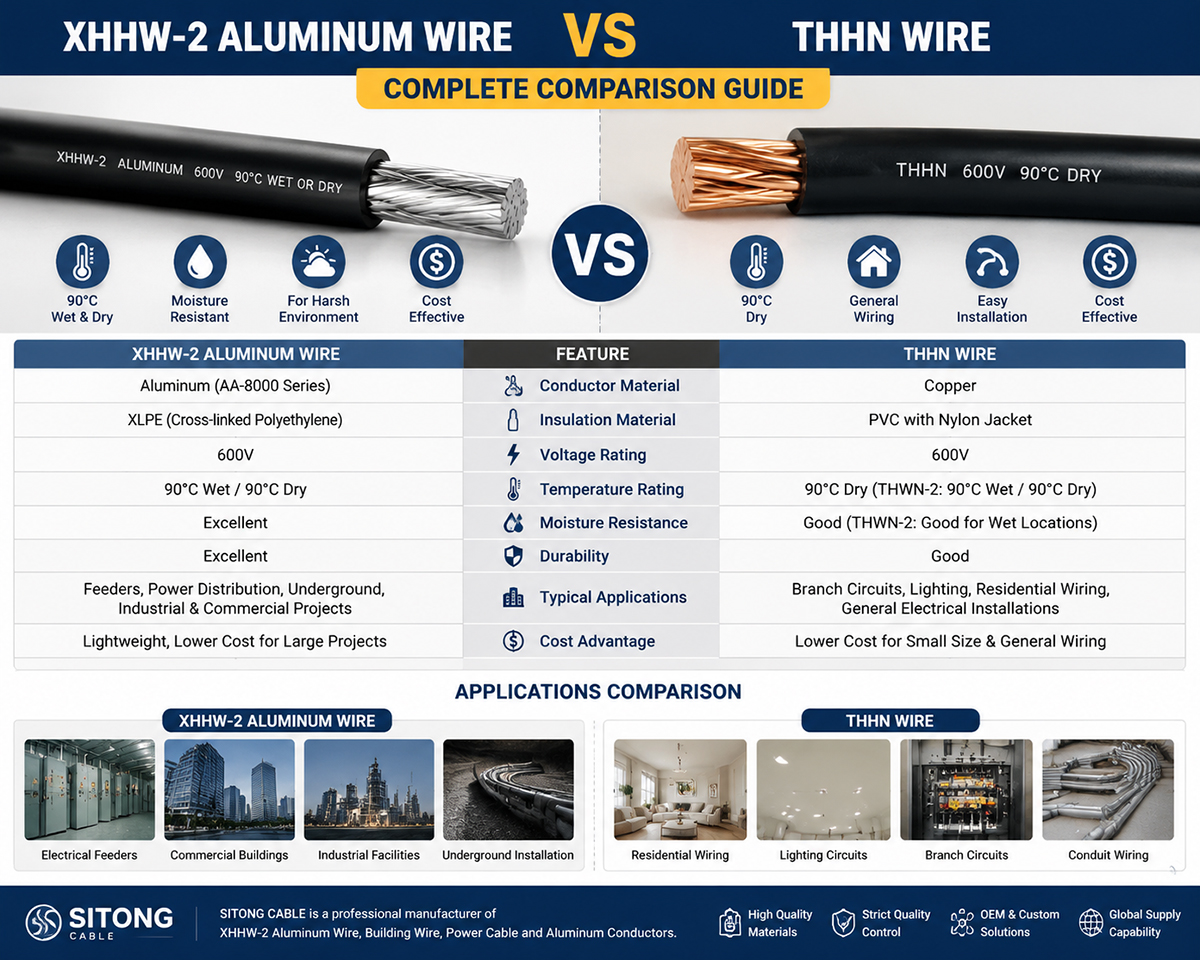
Las principales diferencias entre el cable XHHW-2 y THHN incluyen el material de aislamiento, la resistencia a la humedad, la clasificación de temperatura, el rango de aplicación y los escenarios de uso típicos.
Para sistemas grandes de distribución de energía, muchos ingenieros y contratistas prefieren el cable de aluminio para construcción XHHW-2 debido a su excelente rendimiento en lugares húmedos y su idoneidad para aplicaciones de alimentadores.
¿Qué es el cable de aluminio XHHW-2?
El cable de aluminio XHHW-2 es un cable de construcción con aislamiento termoestable que utiliza un conductor de aleación de aluminio y aislamiento XLPE (polietileno reticulado).
La designación XHHW-2 significa:
- X – Aislamiento de polietileno reticulado
- HH – Alta resistencia al calor
- W – Resistente al agua
- -2 – Clasificación de 90°C tanto en lugares húmedos como secos
El cable XHHW-2 se usa comúnmente para:
- Alimentadores eléctricos
- Edificios comerciales
- Sistemas de energía industriales
- Instalaciones subterráneas en conductos
- Tableros de distribución grandes
La combinación de conductor de aluminio y aislamiento XLPE proporciona una excelente durabilidad, resistencia a la humedad y eficiencia de costos.
¿Qué es el cable THHN?
El cable THHN es uno de los tipos más comunes de cable de construcción utilizado en América del Norte.
THHN significa:
- T – Aislamiento termoplástico
- HH – Alta resistencia al calor
- N – Revestimiento de nailon
El cable THHN normalmente utiliza aislamiento de PVC con una cubierta exterior de nailon.
Se aplica ampliamente en:
- Cableado residencial
- Circuitos derivados comerciales
- Sistemas de iluminación
- Instalaciones eléctricas generales
Muchos productos THHN modernos también están clasificados como THWN-2, lo que permite su uso en lugares húmedos.
Cable de aluminio XHHW-2 vs THHN: Diferencias clave
| Característica | Cable de aluminio XHHW-2 | Cable THHN |
|---|---|---|
| Material del conductor | Aluminio o Cobre | Principalmente Cobre |
| Material de aislamiento | XLPE | PVC + Nailon |
| Tensión nominal | 600V | 600V |
| Temperatura nominal en seco | 90°C | 90°C |
| Temperatura nominal en húmedo | 90°C | Generalmente 90°C (THWN-2) |
| Resistencia a la humedad | Excelente | Buena |
| Flexibilidad | Buena | Excelente |
| Aplicación común | Alimentadores y distribución de energía | Cableado general |
| Uso de conductores grandes | Muy común | Menos común |
| Durabilidad a largo plazo | Excelente | Buena |
1. Diferencia en el material de aislamiento
La mayor diferencia entre XHHW-2 y THHN es el sistema de aislamiento.
XHHW-2 utiliza aislamiento XLPE
El XLPE proporciona:
- Mayor estabilidad térmica
- Excelente resistencia a la humedad
- Fuerte rendimiento de aislamiento eléctrico
- Mejor resistencia al estrés ambiental
Debido a estas ventajas, XHHW-2 se selecciona comúnmente para entornos exigentes.
THHN utiliza aislamiento de PVC y nailon
THHN generalmente utiliza:
- Capa de aislamiento de PVC
- Cubierta protectora de nailon
Las ventajas incluyen:
- Fácil extracción durante la instalación
- Buena protección mecánica
- Rentable para cableado general
Sin embargo, el aislamiento de PVC generalmente tiene un rendimiento térmico inferior en comparación con el XLPE.
2. Comparación de rendimiento en lugares húmedos
Uno de los factores más importantes al seleccionar un cable de construcción es la resistencia a la humedad.
XHHW-2
Clasificado:
90°C Húmedo / 90°C Seco
Adecuado para:
- Conductos subterráneos
- Canaletas exteriores
- Ambientes húmedos
- Instalaciones industriales
THHN
THHN tradicional:
- Clasificación de 90°C en seco
- Uso limitado en lugares húmedos
Sin embargo, la mayoría de los productos THHN modernos se fabrican como THHN/THWN-2, lo que permite:
- Clasificación de 90°C en húmedo
- Clasificación de 90°C en seco
Por lo tanto, siempre confirme la marca real del cable antes de seleccionarlo.
3. Aplicaciones de XHHW-2 vs THHN
Aplicaciones del cable de aluminio XHHW-2
XHHW-2 se selecciona comúnmente para:
Alimentadores eléctricos
Utilizados entre:
- Transformadores
- Tableros de distribución principales
- Equipos eléctricos
Edificios comerciales
Incluyendo:
- Edificios de oficinas
- Centros comerciales
- Grandes instalaciones
Sistemas de energía industriales
Incluyendo:
- Fábricas
- Plantas de manufactura
- Almacenes
Instalaciones subterráneas
Especialmente donde los cables se instalan dentro de:
- Conductos de PVC
- Sistemas de canaletas
Aplicaciones de THHN
THHN se usa comúnmente para:
- Circuitos de iluminación
- Circuitos derivados
- Cableado residencial
- Circuitos de control
- Cableado general en conductos
4. Comparación de costos: aluminio XHHW-2 vs cobre THHN
Para proyectos eléctricos grandes, el material del conductor es una consideración importante.
Ventajas del aluminio XHHW-2
El aluminio proporciona:
- Menor costo de material
- Peso reducido del cable
- Transporte más fácil
- Menores costos de instalación
Para alimentadores grandes, el aluminio XHHW-2 se selecciona a menudo para optimizar los presupuestos del proyecto.
Ventajas del cobre THHN
El cobre proporciona:
- Mayor conductividad
- Excelente flexibilidad
- Tamaño de conductor más pequeño para la misma capacidad de corriente
El cobre THHN a menudo se prefiere cuando el espacio es limitado o la flexibilidad es importante.
¿Cuál deberías elegir?
La elección entre el cable de aluminio XHHW-2 y el THHN depende de los requisitos del proyecto.
Elige el cable de aluminio XHHW-2 cuando:
✔ Se requieran alimentadores eléctricos grandes
✔ Se necesite instalación subterránea
✔ Esté involucrada la distribución de energía a larga distancia
✔ La eficiencia de costos sea importante
✔ Se esperen entornos adversos
Elige el cable THHN cuando:
✔ Se requiera cableado general de construcción
✔ Los circuitos derivados sean la aplicación principal
✔ Una instalación flexible sea importante
✔ Se utilicen tamaños de conductor más pequeños
Por qué el cable de aluminio XHHW-2 es popular en la distribución de energía moderna
Con la creciente demanda de infraestructura eléctrica eficiente, el cable de aluminio para construcción XHHW-2 se ha convertido en una solución preferida para muchos proyectos comerciales e industriales.
Sus ventajas incluyen:
- Clasificación de temperatura de 90°C en húmedo y seco
- Excelente rendimiento del aislamiento XLPE
- Conductor de aluminio ligero
- Operación confiable a largo plazo
- Solución de alimentador rentable
Para contratistas y distribuidores eléctricos, XHHW-2 ofrece un equilibrio entre rendimiento, eficiencia de instalación y costo del proyecto.
¿Cómo seleccionar un proveedor confiable de cable de aluminio XHHW-2?
Al comprar cable de aluminio XHHW-2, considere:
1. Capacidad de fabricación
Un proveedor profesional debe proporcionar:
- Equipos de producción avanzados
- Control de calidad estricto
- Rendimiento eléctrico consistente
2. Calidad del material
Confirme:
- Conductor de aluminio serie AA-8000
- Calidad del aislamiento XLPE
- Cumplimiento con los requisitos del proyecto
3. Soporte técnico
Un fabricante confiable debe proporcionar:
- Especificaciones del producto
- Soluciones personalizadas
- Soporte de ingeniería
Conclusión: Cable de aluminio XHHW-2 vs THHN
Tanto XHHW-2 como THHN son cables de construcción confiables, pero sirven para diferentes propósitos.
El cable THHN se utiliza ampliamente para aplicaciones de cableado eléctrico general, mientras que el cable de aluminio XHHW-2 es más adecuado para alimentadores grandes, instalaciones subterráneas y distribución de energía comercial o industrial.
Para proyectos que requieren alta resistencia a la humedad, larga vida útil y transmisión de energía a gran escala rentable, el cable de aluminio para construcción XHHW-2 es a menudo la opción preferida.
Sitong Cable proporciona soluciones confiables de cable de aluminio para construcción XHHW-2 para contratistas eléctricos, distribuidores y proyectos de ingeniería en todo el mundo.
Contáctenos para obtener especificaciones técnicas y soluciones de cable personalizadas.