Solar Cable vs THHN: Which Cable Is Better for PV Systems?
Solar Cable vs THHN: Which Cable Is Better for PV Systems?
When selecting electrical wiring for a photovoltaic system, one common question is: Solar Cable vs THHN — which cable is better for solar PV systems?
The answer depends on the installation location, environmental conditions, cable listing, voltage, ampacity, and applicable electrical requirements.
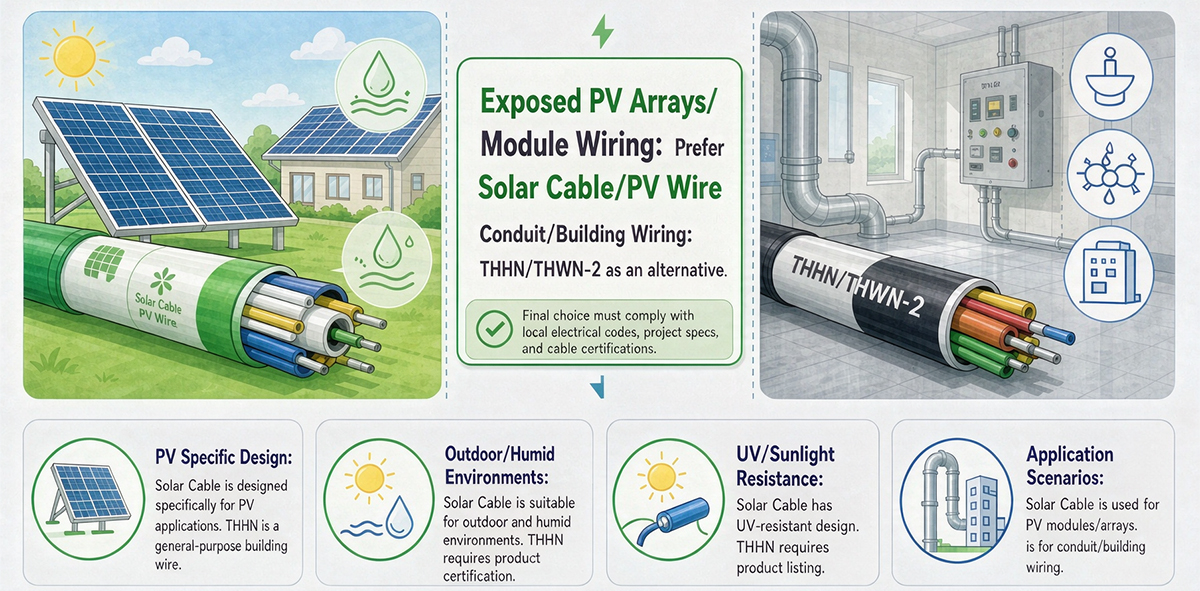
For exposed PV array wiring, Solar Cable / PV Wire is generally the preferred choice because it is specifically designed for photovoltaic applications. THHN or THHN/THWN-2 may be suitable for certain protected conduit installations when permitted by the applicable electrical code.
Solar Cable and THHN are not direct substitutes for every part of a photovoltaic installation. Understanding their differences helps solar installers, EPC contractors, electrical engineers, and cable buyers select the appropriate product for each application.
Solar Cable vs THHN: Quick Comparison
| Feature | Solar Cable / PV Wire | THHN |
|---|---|---|
| Primary Application | Photovoltaic systems | General building wiring |
| Typical Voltage | 600V or higher, depending on product | 600V |
| Main Product Standard | UL 4703 | UL 83 |
| Typical Temperature Rating | 90°C wet/dry, depending on product | 90°C dry |
| PV-Specific Design | Yes | No |
| Outdoor PV Wiring | Designed for specified PV applications | Not generally intended as exposed PV wiring |
| Sunlight Resistance | Available for listed PV products | Product dependent |
| Wet Location | Yes, when properly listed | THHN alone: primarily dry locations |
| Typical Installation | PV modules, strings, arrays | Conduit, raceways, building wiring |
| Best Application | PV array and module wiring | Protected electrical wiring |
What Is Solar Cable?
Solar Cable, also known as PV Wire or Photovoltaic Cable, is designed specifically for electrical connections in photovoltaic power systems.
In North America, PV Wire is commonly associated with UL 4703, the product standard covering photovoltaic wire used for PV system interconnection applications.
Solar Cable is designed for the environmental conditions commonly associated with photovoltaic installations. Depending on the specific product and listing, this can include sunlight exposure, moisture, temperature variations, and outdoor installation.
Typical Solar Cable applications include:
- Solar panel interconnection
- PV string wiring
- PV array wiring
- Rooftop solar systems
- Ground-mounted solar farms
- Combiner box connections
- DC connections between PV equipment
For North American projects requiring a 600V photovoltaic cable, see our 600V Solar Cable product page for conductor sizes, technical specifications, and customization options.
What Is THHN Wire?
THHN stands for Thermoplastic High Heat-Resistant Nylon-Coated wire.
THHN is a widely used general-purpose building wire for residential, commercial, and industrial electrical installations. It is commonly rated at 600V and manufactured according to UL 83 requirements.
Typical THHN applications include:
- Branch circuits
- Feeder circuits
- Electrical panels
- Commercial wiring
- Industrial wiring
- Conduit and raceway installations
An important distinction is that THHN and THWN-2 are different designations.
Standard THHN is primarily associated with dry-location applications. A conductor marked THHN/THWN-2 has additional wet-location capability under the THWN-2 designation.
Therefore, cable buyers should always check the complete cable marking and certification rather than assuming that all THHN products have the same environmental rating.
Solar Cable vs THHN: Key Differences
1. PV-Specific Application
The most important difference between Solar Cable and THHN is their intended application.
Solar Cable is specifically designed and listed for photovoltaic systems, while THHN is primarily a general-purpose building wire.
This makes Solar Cable a natural choice for wiring directly associated with solar modules and PV arrays.
THHN or THWN-2 may be appropriate for other sections of a solar installation when the installation method and applicable electrical requirements permit their use.
For general electrical applications, THHN is commonly used as Building Wire for commercial and industrial wiring systems.
2. Wet-Location Performance
Solar PV systems are typically installed outdoors, where cables can be exposed to rain, condensation, moisture, and changing weather conditions.
A properly listed Solar Cable is designed for applicable PV wet-location requirements.
Standard THHN, however, should not automatically be treated as a wet-location cable.
A simplified comparison is:
| Cable Designation | Typical Capability |
|---|---|
| THHN | Primarily dry locations |
| THWN | Wet-location applications with applicable temperature rating |
| THWN-2 | Wet-location applications, 90°C |
| PV Wire | Photovoltaic applications with applicable listing |
This distinction is particularly important when selecting cable for rooftop and outdoor photovoltaic installations.
3. Sunlight and UV Exposure
PV cables are frequently installed outdoors, including under solar modules and in exposed portions of PV arrays.
Solar Cable is specifically designed for photovoltaic applications and can be listed for sunlight resistance.
THHN is primarily intended for building wiring and should not automatically be considered equivalent to a listed PV cable for exposed outdoor applications.
For outdoor solar installations, always verify the cable's actual marking, listing, and installation requirements.
4. Temperature Rating
Temperature rating is another important factor when selecting cable for a photovoltaic system.
Many PV cables are designed for 90°C wet and dry operation, depending on the specific product construction and listing.
Standard THHN is commonly rated:
- 90°C in dry locations
When the conductor also carries a THWN-2 designation, different wet-location requirements apply.
Temperature rating can affect allowable ampacity, so cable selection should consider the complete installation rather than simply looking at the conductor size.
For detailed conductor sizing and selection, a dedicated Solar Cable Size Guide can help buyers compare AWG sizes, current requirements, and application conditions.
5. Installation Method
Solar Cable is particularly suitable for wiring between PV modules and within photovoltaic arrays.
THHN is commonly installed inside:
- Conduit
- Raceway
- Electrical panels
- Building wiring systems
For certain protected sections of a PV system, THHN/THWN-2 or another permitted wiring method may be appropriate.
The cable must still meet the applicable electrical code, project specification, environmental requirements, and cable listing.
Can THHN Be Used for Solar Panels?
This is one of the most common questions from solar installers, contractors, and electrical engineers.
The answer is:
THHN should not automatically be substituted for Solar Cable in exposed PV array wiring.
The permitted wiring method depends on where the cable is installed and how the photovoltaic system is designed.
For exposed PV array wiring, properly listed PV Wire / PV Cable is generally the straightforward choice.
For wiring installed inside conduit or other protected sections, THWN-2 or another permitted wiring method may be suitable depending on the application and applicable electrical requirements.
Therefore, instead of asking only:
Can THHN be used for solar?
The better engineering question is:
Where is the cable being installed, what environmental conditions apply, and which wiring methods are permitted by the project specification and applicable electrical code?
This approach prevents cable selection based solely on voltage rating or conductor size.
Solar Cable vs THHN Decision Table
The following table provides a practical starting point for PV cable selection.
| PV Installation Requirement | Recommended Cable Type |
|---|---|
| Solar module interconnection | Solar Cable / PV Wire |
| Exposed PV string wiring | Solar Cable / PV Wire |
| Outdoor PV array wiring | Solar Cable / PV Wire |
| Cable exposed to sunlight | Listed PV Wire / approved sunlight-resistant cable |
| PV wiring requiring a PV-specific listing | Solar Cable / PV Wire |
| Wiring installed inside suitable conduit | THWN-2 or another permitted wiring method |
| General indoor building wiring | THHN / THWN-2 as applicable |
| Electrical panel wiring | THHN / THWN-2 as applicable |
| Project specification requires UL 4703 | Solar Cable / PV Wire |
| Project specification requires UL 83 building wire | THHN/THWN-2 as applicable |
The final selection should always be verified against the current electrical code, project specification, cable listing, installation method, and local authority requirements.
Which Cable Is Better for PV Systems?
For most exposed photovoltaic array and solar module wiring, Solar Cable / PV Wire is generally the preferred option.
The main reasons include:
- Designed specifically for photovoltaic applications
- Available with PV-specific listings
- Suitable designs for outdoor PV environments
- Available with wet-location ratings
- Designed for PV installation requirements
- Available in different conductor sizes and voltage ratings
THHN remains useful in photovoltaic projects, particularly for protected wiring sections where conduit or another permitted installation method is used.
Therefore:
Solar Cable is generally better suited to exposed PV wiring, while THHN/THWN-2 can be appropriate for certain protected wiring applications.
The correct choice should be based on the complete installation rather than cable price alone.
600V Solar Cable for North American PV Projects
For North American solar projects requiring a 600V Solar Cable, Sitong Cable provides AWG-size photovoltaic cable solutions for different PV applications.
Available conductor sizes include:
- 14 AWG
- 12 AWG
- 10 AWG
- 8 AWG
- 6 AWG
- 4 AWG
- 3 AWG
- 2 AWG
- 1 AWG
- 1/0 AWG
- 2/0 AWG
- 3/0 AWG
- 4/0 AWG
Depending on the product configuration, the cable can be supplied with XLPO insulation and customized according to project requirements.
For detailed product information, specifications, and quotation requests, visit our 600V Solar Cable product page.
600V Solar Cable Technical Data
| Conductor Size | No. of Strands | Insulation Thickness | Overall Diameter | Net Weight | Ampacity 90°C Wet/Dry |
|---|---|---|---|---|---|
| 14 AWG | 7 | 1.52 mm | 4.90 mm | 24 lbs/kft | 35 A |
| 12 AWG | 7 | 1.52 mm | 5.38 mm | 33 lbs/kft | 40 A |
| 10 AWG | 7 | 1.52 mm | 6.02 mm | 53 lbs/kft | 55 A |
| 8 AWG | 7 | 1.91 mm | 7.54 mm | 78 lbs/kft | 80 A |
| 6 AWG | 7 | 1.91 mm | 8.51 mm | 110 lbs/kft | 105 A |
| 4 AWG | 7 | 1.91 mm | 9.75 mm | 164 lbs/kft | 140 A |
| 3 AWG | 7 | 1.91 mm | 10.46 mm | 200 lbs/kft | 165 A |
| 2 AWG | 7 | 1.91 mm | 11.28 mm | 246 lbs/kft | 190 A |
| 1 AWG | 19 | 2.41 mm | 12.24 mm | 320 lbs/kft | 220 A |
| 1/0 AWG | 19 | 2.41 mm | 14.30 mm | 393 lbs/kft | 260 A |
| 2/0 AWG | 19 | 2.41 mm | 15.47 mm | 485 lbs/kft | 300 A |
| 3/0 AWG | 19 | 2.41 mm | 16.76 mm | 601 lbs/kft | 350 A |
| 4/0 AWG | 19 | 2.41 mm | 18.24 mm | 684 lbs/kft | 405 A |
Note: The ampacity values above are based on the supplied product specification and are identified as 90°C wet/dry. Actual allowable ampacity depends on installation method, ambient temperature, conductor grouping, and applicable electrical requirements.
How to Choose the Right Solar Cable
Before purchasing Solar Cable or THHN for a photovoltaic project, confirm these five factors.
1. System Voltage
First, confirm the required cable voltage rating.
The product discussed in this guide is a 600V Solar Cable. Higher-voltage PV systems require cable with an appropriate voltage rating.
2. Circuit Ampacity
Determine the maximum circuit current and select a conductor with sufficient ampacity for the actual installation conditions.
Conductor size should not be selected based on AWG alone.
3. Installation Environment
Determine whether the cable will be:
- Exposed outdoors
- Installed under solar modules
- Installed in conduit
- Installed in a raceway
- Installed in a cable tray
- Installed indoors
- Exposed to moisture or sunlight
4. Required Cable Listing
Confirm whether the project requires:
- UL 4703 PV Wire
- UL 83 THHN/THWN
- USE-2
- RHW-2
- Another approved wiring method
The required listing should come from the project specification and applicable electrical requirements.
5. Project and Local Requirements
Before final selection, verify the current NEC requirements, project specifications, cable markings, certifications, installation conditions, and local authority requirements.
Solar Cable vs THHN Cost
THHN is widely used as a general-purpose building wire and can be cost-effective for suitable applications.
Solar Cable may have a higher unit price because it is designed and listed specifically for photovoltaic applications.
However, purchase price should not be the only consideration.
A proper comparison should include:
- Cable listing
- Installation environment
- UV exposure
- Wet-location requirements
- Temperature rating
- Voltage rating
- Installation method
- Labor requirements
- Long-term reliability
- Project compliance
Selecting the appropriate cable during the design stage can help reduce installation delays, inspection issues, and replacement costs.
Frequently Asked Questions
Is Solar Cable better than THHN?
For exposed PV array wiring, Solar Cable / PV Wire is generally the better choice because it is specifically designed for photovoltaic applications. THHN may be suitable for certain protected installations when permitted by the applicable electrical requirements.
Can THHN be used for solar panels?
Standard THHN should not automatically be used as a substitute for PV Wire in exposed PV array wiring. The permitted wiring method depends on the installation location, cable listing, and applicable electrical requirements.
What is the difference between Solar Cable and THHN?
Solar Cable is designed specifically for photovoltaic applications, while THHN is general-purpose building wire. Solar Cable is commonly designed for outdoor PV conditions, while standard THHN is primarily associated with dry-location installations.
Is PV Wire the same as Solar Cable?
In North American applications, PV Wire and Solar Cable are commonly used to describe cables designed for photovoltaic systems. However, the exact product designation, listing, and technical specifications should always be verified.
Is Solar Cable more expensive than THHN?
Solar Cable can have a higher purchase price than general-purpose THHN. However, the correct comparison should include the required listing, installation environment, code compliance, and total installation cost.
What standard applies to Solar Cable?
For North American PV Wire, UL 4703 is the key product standard. The exact certification and listing should always be confirmed against the specific cable.
What standard applies to THHN?
THHN is covered under UL 83, which applies to thermoplastic-insulated wires and cables used under applicable electrical requirements.
Should I use 600V Solar Cable or THHN for a rooftop solar system?
For exposed DC wiring within the PV array, 600V Solar Cable / PV Wire is generally the more appropriate option when properly listed for the application. For protected wiring installed in conduit, THWN-2 or another permitted wiring method may be suitable depending on the project design.
Final Verdict: Solar Cable vs THHN
There is no single cable that is best for every section of a photovoltaic system.
For exposed PV array and solar module wiring, Solar Cable / PV Wire is generally the preferred option.
For protected building wiring and conduit applications, THHN/THWN-2 may be suitable when permitted by the applicable electrical requirements.
The key selection factors are:
Application + Voltage + Ampacity + Installation Environment + Cable Listing + Electrical Code
For North American projects requiring a 600V PV cable, Sitong Cable provides AWG-size Solar Cable solutions from 14 AWG to 4/0 AWG.
Request a 600V Solar Cable Quote
Looking for a 600V Solar Cable manufacturer or PV Wire supplier in China?
Send Sitong Cable your:
- Required AWG size
- Cable quantity
- Cable length
- Voltage rating
- Required cable standard
- Insulation requirement
- Cable color
- Packaging requirements
- Destination country
Sitong Cable can review your project requirements and provide a suitable 600V Solar Cable specification and quotation.