When to Use Screened Cable? A Guide for Industrial Cable Selection
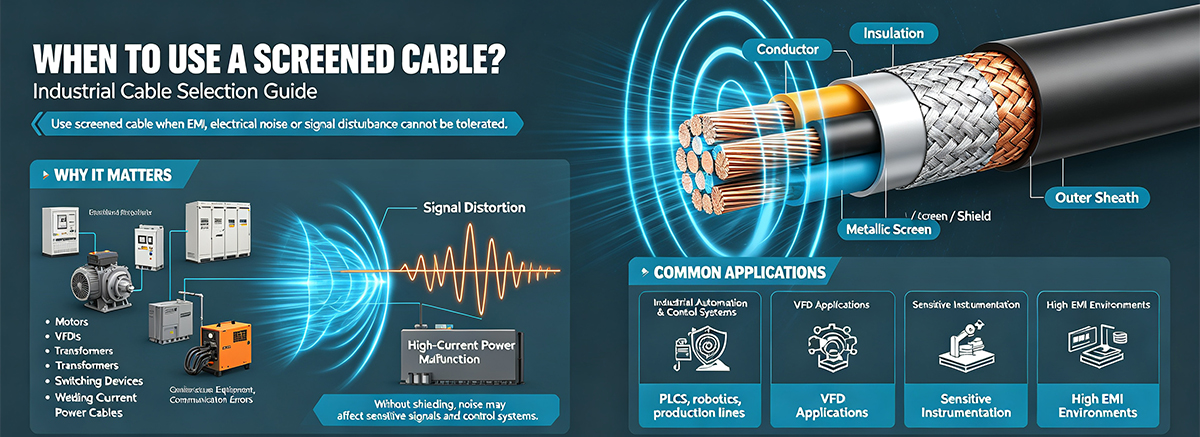
When to Use Screened Cable? A Guide for Industrial Cable Selection
Direct Answer: When Should You Use a Screened Cable?
A screened cable should be used when a cable system needs protection against electromagnetic interference (EMI), electrical noise, or signal disturbance. It is commonly used in industrial automation, motor control systems, instrumentation equipment, communication systems, and installations where sensitive cables are located near high-current power cables or electrical equipment.
The main purpose of a screened cable is to improve signal reliability by adding a conductive shielding layer, such as copper braid, aluminum foil, or metallic tape, around the cable conductors to reduce interference.
For simple electrical applications without significant electromagnetic noise, a standard unshielded cable may be sufficient. The correct cable choice depends on the installation environment, application requirements, and system reliability needs.
What Is a Screened Cable?
A screened cable, also known as a shielded cable, is an electrical cable designed with an additional conductive layer around the insulated conductors.
This shielding layer creates a protective barrier that helps control electromagnetic interference generated by nearby electrical equipment.
A typical screened cable structure may include:
- Conductor
- Insulation layer
- Metallic screen or shield
- Outer sheath
Common screening materials include:
| Screen Type | Features | Typical Applications |
|---|---|---|
| Copper braid | Flexible, durable, good grounding performance | Industrial control and instrumentation |
| Aluminum foil | Lightweight and effective against high-frequency noise | Communication and signal systems |
| Copper tape | Good electrical shielding capability | Power and control applications |
| Foil + braid combination | Higher shielding performance | Heavy industrial environments |
The selection of shielding type depends on the required EMI protection level, mechanical requirements, and installation conditions.
Why Is Screened Cable Important?
Modern industrial environments contain many sources of electromagnetic interference, including:
- Electric motors
- Variable frequency drives (VFDs)
- Transformers
- Switching devices
- Welding equipment
- High-current power cables
These sources can generate electrical noise that may affect sensitive signals and control systems.
Without appropriate shielding, electrical interference may cause:
- Incorrect sensor readings
- Communication errors
- Signal distortion
- Equipment malfunction
- Reduced system reliability
For industrial customers, cable selection should consider not only conductor size and voltage rating but also electromagnetic compatibility (EMC) requirements.
When Do You Need a Screened Cable?
1. Industrial Automation and Control Systems
Industrial automation systems often include sensitive control signals from sensors, PLCs, and monitoring equipment.
In factories and production facilities, cables may be installed close to motors, machines, and power circuits that generate electrical noise.
A screened cable can help improve signal stability in applications such as:
- PLC control systems
- Robotics
- Production line equipment
- Industrial monitoring systems
For these applications, customers often evaluate suitable control cable solutions based on signal type, installation environment, and required protection level.
2. Applications with Variable Frequency Drives (VFDs)
Variable frequency drives are widely used for motor speed control in industrial facilities. However, VFD systems can produce high-frequency electrical noise that may affect nearby cables.
Screened cables are commonly used for:
- Motor control circuits
- Feedback signals
- Encoder connections
- Automation equipment
When VFD power cables and control cables are installed in the same industrial environment, proper cable selection and installation methods are important to maintain reliable operation.
For industrial power systems, customers may also need to consider low voltage power cable solutions according to voltage requirements and installation conditions.
3. Sensitive Instrumentation and Measurement Systems
Instrumentation systems often transmit low-level signals that are more sensitive to electrical interference.
Examples include:
- Temperature sensors
- Pressure monitoring systems
- Flow measurement equipment
- Data acquisition systems
Using screened cables in these applications helps maintain signal accuracy and reduces the risk of interference affecting measurement results.
4. Environments with High Electromagnetic Noise
Some installation environments naturally contain higher levels of electromagnetic interference.
Typical examples include:
- Manufacturing plants
- Power stations
- Renewable energy facilities
- Industrial control rooms
- Transportation infrastructure
In these projects, engineers usually evaluate cable construction together with grounding methods, cable routing, and equipment layout.
Screened Cable vs Unscreened Cable: Which One Should You Choose?
| Factor | Screened Cable | Unscreened Cable |
|---|---|---|
| EMI protection | High | Limited |
| Signal reliability | Better in noisy environments | Suitable for low-noise areas |
| Installation requirements | Requires proper grounding | Simpler installation |
| Cost | Higher | Lower |
| Typical applications | Industrial, control, instrumentation | General electrical applications |
A screened cable is not always required. For applications without significant interference risks, using a standard cable may provide a more economical solution.
The key is selecting a cable based on actual operating conditions rather than choosing the highest specification unnecessarily.
How to Select the Right Screened Cable?
When purchasing screened cable, cable buyers and engineers should consider the following factors:
1. Identify the Application
First determine whether the cable is used for:
- Power transmission
- Motor control
- Instrumentation
- Communication
- Automation systems
Different applications require different cable constructions.
2. Choose the Appropriate Shielding Structure
The shielding design should match the environment.
For example:
- Foil shielding is commonly used for high-frequency interference protection.
- Copper braid provides flexibility and mechanical strength.
- Combined shielding is suitable for demanding industrial environments.
3. Consider Installation Conditions
Important factors include:
- Distance from high-current cables
- Presence of motors or transformers
- Indoor or outdoor installation
- Temperature requirements
- Mechanical protection needs
4. Check Standards and Quality Requirements
For international projects, cable selection should consider:
- Required voltage rating
- Applicable electrical standards
- Testing requirements
- Environmental conditions
For applications requiring additional insulation performance, customers may also evaluate XLPE insulated power cable solutions for reliable power transmission.
Applications of Screened Cable
Screened cables are commonly used in:
Industrial Automation
Supporting reliable connections between controllers, sensors, and equipment.
Power and Energy Projects
Helping improve reliability in systems where electrical noise management is important.
Renewable Energy Systems
Solar and energy projects often require careful cable selection due to complex electrical environments. Sitong Cable also supplies solar cable solutions designed for photovoltaic applications.
Commercial and Industrial Buildings
Used in building systems requiring stable control and communication performance.
How Sitong Cable Supports Cable Selection
Choosing the correct cable requires understanding both technical requirements and real installation conditions.
As a professional wire and cable manufacturer, Sitong Cable provides customized cable solutions for global customers, including:
- Conductor material selection
- Insulation and sheath design
- Shielding requirements
- Customized cable structures
- Production and quality inspection support
With manufacturing experience in various electrical cable applications, Sitong Cable helps customers select suitable cable solutions based on project specifications.
For customers looking for a reliable cable manufacturer, our technical team can provide professional support from cable design confirmation to production delivery.
Frequently Asked Questions About Screened Cable
1. What is a screened cable used for?
A screened cable is mainly used to reduce electromagnetic interference and improve signal reliability in industrial control, instrumentation, communication, and power-related applications.
2. When do I need a screened cable?
You need a screened cable when cables are installed near electrical noise sources such as motors, VFDs, transformers, or high-current power cables, especially when signal accuracy is important.
3. Is screened cable the same as shielded cable?
Yes. In most cable applications, screened cable and shielded cable describe the same type of cable construction with a conductive layer designed to reduce electromagnetic interference.
4. Does every industrial cable require shielding?
No. Shielding is only necessary when electromagnetic interference may affect system performance. Cable selection should be based on application requirements and installation conditions.
Contact Sitong Cable for Customized Cable Solutions
Need help selecting the right screened cable for your project?
Sitong Cable provides professional cable manufacturing support, customized cable solutions, and technical consultation for international customers.
Contact Sitong Cable to discuss your cable requirements, specifications, and project needs.