Optical Power Ground Wire(OPGW) for Transmission Line
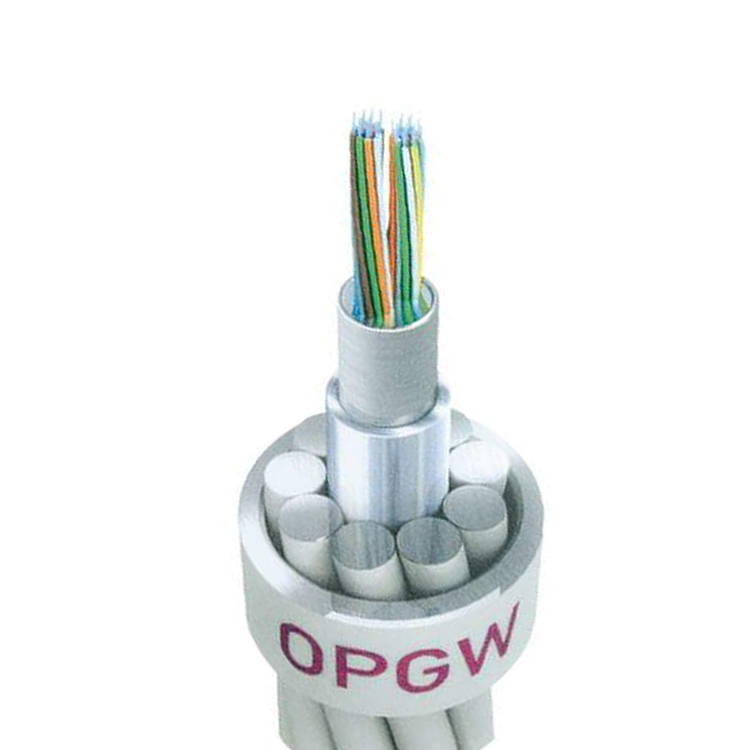
OPGW (Optical Power Ground Wire) is also called Optical Fiber Composite Overhead Ground Wire.
Product Introduction
OPGW Cable: The Integrated Solution for Power Grid Communication & Protection
Product Overview: What is OPGW?
OPGW (Optical Fiber Composite Overhead Ground Wire), commonly referred to as an OPGW optical cable, is a composite cable designed for overhead high-voltage transmission lines. Its primary function is to house optical fibers within a grounded, metallic shield strung from transmission towers. This integration creates a dual-purpose infrastructure:
- Function 1: Ground Wire - Provides lightning protection and carries fault currents.
- Function 2: Communication Network - Forms a robust, high-capacity fiber optic communication network along the power line.
Key Benefits & Features of OPGW Cable
OPGW technology offers significant advantages over separate ground wire and communication cable installations:
- Superior Reliability & Durability: The optical fibers are protected by an outer layer of metal wires (armor), resulting in a cable that is more reliable, stable, and firm against environmental and mechanical stress.
- Cost and Installation Efficiency: Combining two functions into one product (OPGW optical cable) significantly shortens the construction period and saves on overall project costs.
- Enhanced Electrical Performance: When constructed with materials like aluminum-clad steel wire or aluminum alloy wire, it acts as an excellent conductor. This can help to:
- Reduce the submerged current of the transmission line.
- Lower power frequency overvoltage.
- Mitigate interference from the power line to adjacent communication lines.
- Optimized Deployment: The optical fiber's inherent properties (anti-electromagnetic interference, lightweight) permit installation at the top of transmission towers without concerns over optimal mounting position or electromagnetic corrosion.
Material Choice & Performance
The selection of armor material directly influences key performance indicators:
| Armor Material | Key Characteristics | Primary Consideration |
|---|---|---|
| Aluminum-Clad Steel / Aluminum Alloy Wire | Good conductivity, helps improve line electrical performance. | Often chosen for its balance of strength and conductivity. |
| General High-Strength Wire | Higher tensile strength. | Used when mechanical load capacity is the top priority. |
Important Design Note: A fundamental design trade-off exists between short-circuit current capacity and **tensulincreasing the metal cross-section to handle higher short-circuit current increases the cable's diameter and weight, which must be carefully evaluated against the structural strength of the supporting transmission towers.
Primary Applications of OPGW Cables
OPGW cables are designed for specific, high-demand scenarios in electrical transmission.
- Typical Voltage Levels: Primarily used on high-voltage transmission lines rated at 110kV, 220kV, and 500kV.
- Common Use Case: Due to requirements for line power outages during installation, they are mostly used in newly-built lines.
- Key Applicable Features:
- Ideal for long-range lines (e.g., spans >250m) with voltages exceeding 110kV.
- Excellent for long-span crossings due to superior mechanical characteristics.
- The metal armor is resistant to degradation from high-voltage electrical corrosion.
- Most economical and suitable for new construction projects on high-voltage lines (≥110kV) where planned outages are feasible.
- The mechanical design (tensile strength vs. short-circuit capacity) is critical for tower safety.
About SiTong Cable OPGW
SiTong Cable is a proficient manufacturer of high-quality OPGW cables, offering comprehensive solutions:
- Complete Capabilities: Full in-house product production and extensive customization experience.
- Market Advantage: Competitive pricing and reliable quality.
- Strong Support: Fast, effective delivery capabilities and superior product service.
Technical Specifications
OPGW-12B1 Parameters
| Project | Unit | Guarantee Value |
|---|---|---|
| Optical Fiber Type | - | G.652 |
| Quantity Core | - | 12B1 |
| Damping 1310nm | dB/km | 0.35 |
| Damping 1550nm | dB/km | 0.21 |
| Bearing Sectional Area | mm² | 54.5 |
| AS Area | mm² | 54.5 |
| AA Area | mm² | 20.0 |
| Stainless Steel Pipe Area | mm² | 2.0 |
| Total Sectional Area | mm² | 56.5 |
| Outer Layer Stranding Direction | - | Right |
| External Diameter | mm | 10.20 |
| Unit Weight | kg/km | 385.1 |
| Rated Breaking Force (RTS) | kN | 67.8 |
| 20℃ DC Resistance | Ω/km | 1.557 |
| Short Circuit Current Capacity (40℃~200℃,0.25s) | kA²·s | 21.3 |
| Short Circuit Current | kA | 9.2 |
| Rally to Weight Ratio | km | 18.0 |
| Elastic Modulus | kN/mm² | 162.0 |
| Linear Expansion Coefficient | 1×10⁻⁶/℃ | 13.0 |
| Maximum Allowable Working Tension (MAT) | kN | 27.1 |
| Average Annual Operating Tension (EDS) | kN | 17.0 |
| Allowable Minimum Bending Radius | mm | Construction: 204 Operational: 153 |
| Storage Temperature | ℃ | -40~+70 |
| Maximum Delivery Length | m | 6000 |
Application Fields
High voltage transmission lines (500KV, 220KV, 110KV)
Newly-built power lines
Optical fiber communication networks
Overhead ground wire replacement
Packaging & Shipping
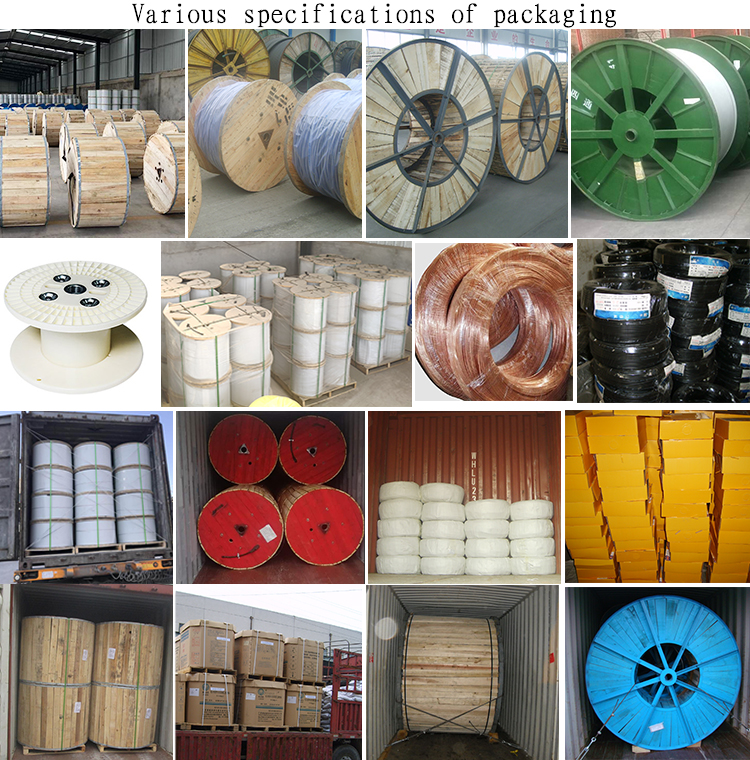
All cables will be packaged in different materials based on their outer diameter and net weight, and can be customized according to requirements