Magnet Wire (Enameled Wire): Complete Technical Guide, Standards & Selection Best Practices
Magnet wire, also known as enameled wire or winding wire, is a fundamental component in electrical engineering — a copper or aluminum conductor coated with a thin layer of insulation. It is the lifeblood of motors, transformers, generators, inductors, solenoids, and countless electromagnetic devices that power modern industry. This guide provides a comprehensive overview of magnet wire types, international standards, key specifications, and selection criteria for engineers and procurement professionals.
What is Magnet Wire?
Magnet wire is a solid or stranded conductor — typically copper or aluminum — covered with a thin electrical insulation layer. Unlike standard building wire with thick PVC or rubber jackets, magnet wire uses an enamel coating that is just micrometers thick, allowing for maximum copper fill in winding applications.
The term "magnet wire" is used primarily in North America; internationally, it is often called enameled wire or winding wire.
Applications
Magnet wire is essential in virtually every electromechanical and electromagnetic device:
| Application | Description | Typical Wire Grades |
|---|---|---|
| 🔌 Electric Motors | AC/DC motors, servo motors, traction motors | MW 35, MW 36, MW 80 |
| ⚡ Transformers | Distribution transformers, power transformers, isolation transformers | MW 35, MW 80-C |
| 🔋 Generators | Wind turbine generators, hydro generators, alternators | MW 36, MW 80 |
| 🔧 Solenoids & Relays | Automotive solenoids, contactors, electromagnetic valves | MW 35, MW 28 |
| 🎛️ Inductors & Chokes | Power supplies, EMI filters, RF circuits | MW 80, MW 79 |
| 🚗 Automotive | EV traction motors, alternators, ignition coils | MW 35, MW 36, P180 |
| 🏭 Industrial | Lifting magnets, welding transformers, reactors | MW 36, MW 80-C |
Types of Magnet Wire by Insulation
Magnet wire is classified primarily by its insulation coating. The insulation determines the thermal class, chemical resistance, and mechanical properties.
Round Wire vs. Rectangular Wire
- Round magnet wire: Most common, used in general motor and transformer windings
- Rectangular/Rectangular magnet wire: Used in large transformers and high-power motors for better space factor and heat dissipation
Main Insulation Types
| Type | Thermal Class | Temperature | Standards | Key Properties |
|---|---|---|---|---|
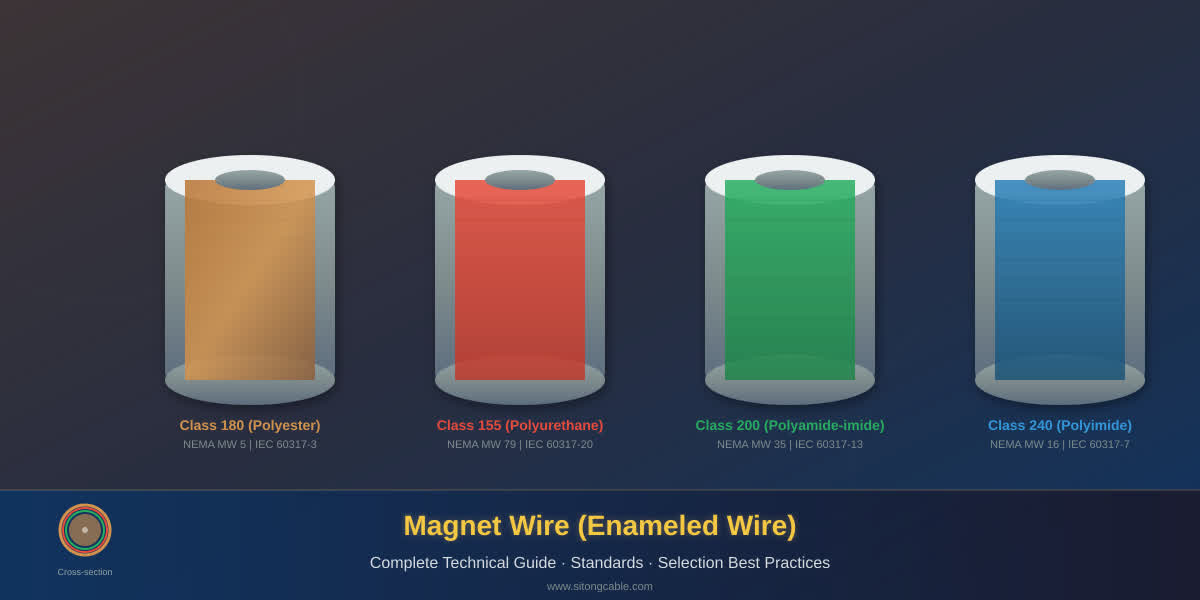
| Polyurethane (UEW) | Class 130–180 | 130°C–180°C | IEC 60317-4, NEMA MW 79 | Solderable without stripping; excellent for fine wire; good flexibility |
| Polyester (PEW) | Class 155–180 | 155°C–180°C | IEC 60317-3, NEMA MW 5 | Good thermal and mechanical properties; cost-effective general purpose |
| Polyesterimide (EIW) | Class 180 | 180°C | IEC 60317-8, NEMA MW 30 | Higher thermal stability than polyester; excellent chemical resistance |
| Polyamide-imide (AIW) | Class 200–220 | 200°C–220°C | IEC 60317-13, NEMA MW 35 | Very high thermal class; excellent overload resistance; standard for motor windings |
| Polyimide (PIW) | Class 240 | 240°C | IEC 60317-7, NEMA MW 16 | Highest thermal endurance; exceptional chemical and radiation resistance; premium cost |
| Self-Bonding | Variable | 130°C–200°C | Various | Thermoplastic outer layer bonds windings when heated; ideal for coils without bobbins |
Dual-Coated and Triple-Coated Wires
Modern magnet wires often use multiple coating layers to combine the best properties:
- MW 35: Polyester base coat + polyamide-imide top coat — the most widely used motor wire globally
- MW 36: Polyesterimide base coat + polyamide-imide top coat — higher thermal rating for demanding applications
- MW 80: Polyester base coat + polyamide-imide top coat (heavy build) — for high-voltage transformers and inductors
- MW 80-C: Similar to MW 80 but with higher partial discharge resistance for inverter-driven motors
International Standards
Magnet wire is governed by several international standards bodies:
NEMA Standards (North America)
Developed by the National Electrical Manufacturers Association (NEMA) under the MW (Magnet Wire) series:
| Standard | Description |
|---|---|
| NEMA MW 1000 | General specification for magnet wire |
| NEMA MW 35 | Heavy build polyester/polyamide-imide — most common motor wire |
| NEMA MW 36 | Solderable polyester/polyamide-imide |
| NEMA MW 79 | Polyurethane solderable wire |
| NEMA MW 80 | Polyester/polyamide-imide for transformers |
| NEMA MW 16 | Polyimide (230°C+ rated) |
IEC Standards (International)
International Electrotechnical Commission standards, widely adopted in Europe, Asia, and Africa:
| Standard | Description |
|---|---|
| IEC 60317-0-1 | General requirements for enameled round copper wire |
| IEC 60317-0-2 | General requirements for enameled rectangular copper wire |
| IEC 60317-7 | Polyimide enameled round copper wire, class 240 |
| IEC 60317-8 | Polyesterimide enameled round copper wire, class 180 |
| IEC 60317-13 | Polyester/polyamide-imide enameled round copper wire, class 200 |
| IEC 60317-20 | Solderable polyurethane enameled round copper wire, class 155 |
Other Standards
| Standard | Region | Details |
|---|---|---|
| JIS C 3202 | Japan | Enameled winding wires |
| GB/T 6109 | China | Equivalent to IEC 60317 series for enameled round winding wire |
| BS EN 60317 | UK/Europe | Adoption of IEC standards |
Key Technical Specifications
1. Conductor Material
| Material | Conductivity | Density | Typical Use | Cost Factor |
|---|---|---|---|---|
| Copper (Cu) | 100% IACS | 8.89 g/cm³ | General purpose, motors, transformers | 1.0x (baseline) |
| Aluminum (Al) | 61% IACS | 2.70 g/cm³ | Large transformers, where weight matters | ~0.4x |
2. Wire Dimensions
Magnet wire is specified by bare conductor diameter. Standard sizes follow the AWG (American Wire Gauge) system in North America and metric (mm) internationally.
| AWG | Bare Diameter (mm) | Resistance (Ω/km at 20°C) | Typical Application |
|---|---|---|---|
| 12 | 2.053 | 5.21 | Large motor windings |
| 14 | 1.628 | 8.28 | Power transformers |
| 16 | 1.291 | 13.2 | General motor windings |
| 18 | 1.024 | 21.0 | Small motors, transformers |
| 20 | 0.812 | 33.3 | Solenoids, relays |
| 22 | 0.644 | 53.0 | Small transformers, inductors |
| 24 | 0.511 | 84.2 | Instrument transformers |
| 26 | 0.405 | 134.0 | Relays, small coils |
| 28 | 0.321 | 213.0 | Automotive coils, solenoids |
| 30 | 0.255 | 339.0 | Fine wire applications |
| 32 | 0.202 | 538.0 | Precision instruments |
| 34 | 0.160 | 856.0 | Micro-motors, sensors |
| 36 | 0.127 | 1360 | Miniature devices |
| 38 | 0.101 | 2160 | Ultra-fine winding |
| 40 | 0.080 | 3430 | Micro-electronics |
3. Insulation Build
The insulation thickness is categorized by "build":
| Build | Description | Typical Dielectric Strength |
|---|---|---|
| Grade 1 (Single Build) | Thin coating | 1,500–2,500 V |
| Grade 2 (Heavy Build) | Standard coating | 2,500–5,000 V |
| Grade 3 (Triple Build) | Extra-thick coating | 5,000–8,000 V+ |
4. Thermal Class (Temperature Index)
The Temperature Index (TI) indicates the maximum continuous operating temperature for 20,000 hours of rated life:
| Class | Temperature | Typical Insulation |
|---|---|---|
| 130 | 130°C | Polyurethane (UEW) |
| 155 | 155°C | Polyester (PEW) |
| 180 | 180°C | Polyesterimide (EIW) |
| 200 | 200°C | Polyamide-imide (AIW) |
| 220 | 220°C | Polyamide-imide (AIW) — dual coat |
| 240 | 240°C | Polyimide (PIW) |
How to Choose the Right Magnet Wire
Step 1: Define the Electrical Requirements
- Current rating: Determines conductor cross-sectional area (AWG)
- Voltage rating: Determines insulation build (Grade 1, 2, or 3)
- Frequency: High-frequency applications (e.g., >1 kHz) require litz wire or special dielectrics
Step 2: Determine the Thermal Environment
- What is the maximum ambient temperature?
- How much self-heating occurs due to I²R losses?
- Select a thermal class with at least 20°C margin above the maximum expected temperature
Step 3: Consider Mechanical Requirements
- Winding tension: Higher tension requires mechanically stronger insulation
- Slot fill: For motor stators, rectangular wire offers better slot fill than round wire
- Flexibility: Fine wire (AWG 30+) needs flexible coating to survive winding
Step 4: Select the Conductor Material
- Copper: Higher conductivity, smaller winding size, higher cost
- Aluminum: Lighter, lower cost, but requires larger cross-section (approximately 2 AWG sizes larger for equivalent resistance)
Step 5: Choose the Insulation System
| Application | Recommended Grade |
|---|---|
| General purpose motors (<1 kV) | MW 35 (polyester/polyamide-imide) |
| Inverter-duty motors | MW 35 with inverter-resistant coating, MW 80-C |
| High-voltage motors (>1 kV) | MW 36 (heavy build) or MW 80-C |
| Transformers | MW 35, MW 80 |
| Fine wire coils (< AWG 30) | MW 79 (solderable polyurethane) |
| High-temperature (>220°C) | MW 16 (polyimide) |
| Automotive/EV | MW 35, MW 36, P180 (partial discharge resistant) |
FAQ
Q: What is the difference between magnet wire and regular wire? A: Magnet wire uses a thin enamel coating (micrometers thick) instead of thick PVC/rubber insulation, allowing maximum conductor density in windings. Regular building wire has thick, mechanically robust insulation for safety in conduit and cable trays.
Q: Can magnet wire be soldered without stripping? A: Yes — polyurethane (UEW, MW 79) and certain polyester types are self-fluxing and can be soldered directly at 370°C–400°C without mechanical or chemical stripping. For polyamide-imide or polyimide wires, the insulation must be stripped thermally or mechanically.
Q: How do I determine the right AWG for my application? A: Calculate the required current (I), select a current density of 3–5 A/mm² for motors or 2–3 A/mm² for transformers, and choose the smallest AWG that fits. Then verify the temperature rise stays within the insulation class.
Q: What is inverter-duty magnet wire? A: Inverter-duty wire is designed for variable frequency drive (VFD) motors. It has enhanced partial discharge resistance (PDIV ≥ 600V for most applications) to withstand the voltage spikes from PWM inverters. Grade: MW 80-C or equivalent.
Q: Is aluminum magnet wire suitable for transformers? A: Yes — aluminum magnet wire is widely used in large distribution and power transformers. It offers cost advantages and weight reduction. However, aluminum requires approximately 1.6x the cross-sectional area of copper for equivalent conductivity.
Q: What thermal margin should I allow when selecting magnet wire? A: A minimum of 20°C margin above the maximum expected operating temperature is recommended. For example, if the motor's maximum winding temperature is 155°C, use at least Class 180 wire.
Q: Can magnet wire be used in outdoor or humid environments? A: Standard magnet wire is not designed for direct outdoor exposure. However, sealed windings (encapsulated, varnish-impregnated, or potted) can operate in humid environments. For extreme humidity or chemical exposure, consider polyimide (MW 16) or special hermetic grades.
Why Choose Sitong Cable for Magnet Wire?
Sitong Cable manufactures high-quality magnet wire that meets international standards including IEC 60317, NEMA MW 1000, and GB/T 6109. Our product range includes:
- Round copper magnet wire: AWG 12–40, all thermal classes 130–240
- Round aluminum magnet wire: AWG 10–30, Class 180–200
- Rectangular copper and aluminum wire: Custom sizes for large transformers
- Inverter-duty wire: Enhanced PDIV performance for VFD motors
- Self-bonding wire: For bobbin-less coil winding
All products undergo rigorous testing — dielectric strength, thermal endurance, flexibility, adhesion, and chemical resistance — to ensure consistent quality for demanding applications.
📞 Contact our technical team for specification sheets, samples, or custom magnet wire solutions: www.sitongcable.com
This guide is part of the Sitong Cable Technical Resource Library. For more information on power cables, overhead conductors, and winding wires, visit our blog or product pages.