Building Wire (THHN/THWN-2/XHHW-2) — Complete Technical Guide: UL 83, UL 44, NEC Article 310 Standards, Specifications, Ampacity Ratings & Selection for Residential, Commercial & Solar Applications
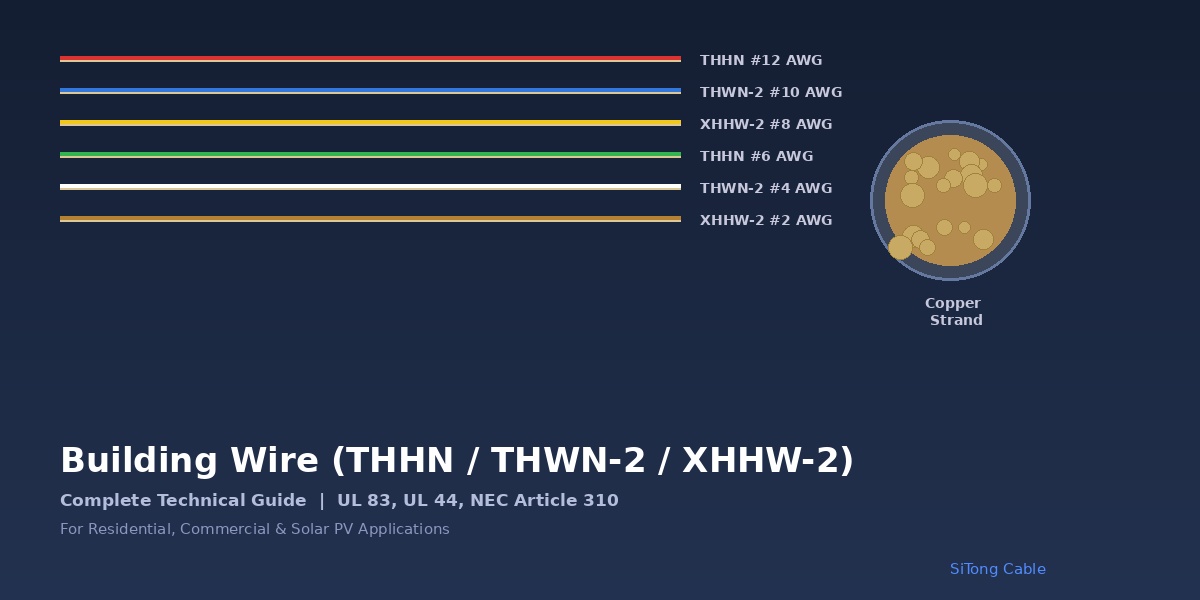
Building Wire (THHN/THWN-2/XHHW-2) — Complete Technical Guide: UL 83, UL 44, NEC Article 310 Standards, Specifications, Ampacity Ratings & Selection for Residential, Commercial & Solar Applications
Building wire — also referred to as electric wire or hook-up wire — is the most widely installed conductor type in residential, commercial, and industrial electrical systems. Unlike bare overhead conductors used in transmission, building wire is fully insulated and rated for installation in conduits, cable trays, raceways, and direct burial applications. This comprehensive guide covers the major building wire types (THHN, THWN-2, XHHW-2, USE-2, MTW), the governing UL and NEC standards, conductor material comparisons (copper vs aluminium), ampacity ratings per NEC Table 310.16, temperature classifications, voltage ratings, and practical selection guidance for electricians, contractors, and specifiers.
What is Building Wire? Types and Construction
Building wire refers to insulated single-conductor cables rated for permanent installation in buildings and related structures. The most common types are defined by UL standards and the National Electrical Code (NEC) based on their insulation material, temperature rating, and environmental suitability.
THHN / THWN-2 (Thermoplastic High Heat-resistant Nylon-coated)
THHN and THWN-2 are the most popular building wire types in North American electrical construction, accounting for the majority of branch-circuit and feeder installations.
| Property | THHN | THWN-2 |
|---|---|---|
| Full name | Thermoplastic High Heat-resistant Nylon-coated | Thermoplastic Heat and Water-resistant Nylon-coated |
| Insulation | PVC (polyvinyl chloride) | PVC (polyvinyl chloride) |
| Jacket | Nylon (polyamide) | Nylon (polyamide) |
| Max temperature (dry) | 90°C | 90°C |
| Max temperature (wet) | 75°C | 90°C |
| Voltage rating | 600 V | 600 V |
| UL standard | UL 83 | UL 83 |
| NEC Article | 310 | 310 |
The key distinction is wet‑location rating: THHN is rated 75°C in wet locations, while THWN‑2 maintains its full 90°C rating in both dry and wet environments. Modern THHN conductors are dual‑rated as THHN/THWN‑2 by most manufacturers, offering the combined temperature rating for maximum flexibility.
Construction layers (from inside out): 1. Conductor — Solid or stranded copper (or aluminium for larger sizes) 2. PVC insulation — Colour‑coded per NEC 200.6 (for neutral identification) and phase‑colour conventions (black, red, blue for 120/208 V; brown, orange, yellow for 277/480 V) 3. Nylon jacket — Tough, slick outer layer that reduces friction during conduit pulling and provides resistance to oils, gasoline, and moisture
XHHW-2 (Cross‑Linked Polyethylene High Heat‑resistant Water‑resistant)
XHHW‑2 uses cross‑linked polyethylene (XLPE) insulation instead of thermoplastic PVC, offering several performance advantages:
| Property | XHHW-2 |
|---|---|
| Insulation material | XLPE (cross‑linked polyethylene) |
| Max temperature (dry) | 90°C |
| Max temperature (wet) | 90°C |
| Voltage rating | 600 V / 1000 V |
| UL standard | UL 44 (for XLPE) or UL 83 |
| Min insulation thickness | 30 mils (typical for #14–#8 AWG) |
| Oil resistance | Good |
| Sunlight resistance | Excellent (when marked "Sunlight Resistant") |
XHHW‑2's XLPE insulation provides higher ampacity than THHN/THWN‑2 in certain conduit‑fill scenarios because XLPE can be manufactured with thinner insulation walls (30 mils vs 45 mils for THHN), allowing more conductors per conduit while maintaining full 90°C wet/dry rating. This makes XHHW‑2 a preferred choice for high‑density raceway installations in commercial and industrial projects.
USE-2 (Underground Service‑Entrance Cable)
USE‑2 is designed specifically for underground service applications:
- Insulation: XLPE with enhanced moisture resistance
- Temperature rating: 90°C (wet), 90°C (dry)
- Voltage rating: 600 V
- Key feature: Rated for direct burial without conduit, with extra‑thick XLPE insulation and a robust jacket that resists moisture, soil chemicals, and ground‑water ingress
- UL standard: UL 854 (Service‑Entrance Cables)
USE‑2 is commonly used for underground service laterals from utility transformers to building meter sockets, and for solar PV array interconnections where conductors run underground between combiner boxes and inverters.
MTW (Machine Tool Wire)
MTW is a flexible building wire rated for control panels, machinery, and industrial equipment:
- Insulation: PVC or XLPE (depending on type)
- Temperature rating: 60°C, 75°C, or 90°C
- Voltage rating: 600 V
- Key feature: Extra‑fine stranding for maximum flexibility in tight panel wiring
- UL standard: UL 1063
International Standards and Regulations
UL Standards
Building wires in North America are listed and tested by Underwriters Laboratories (UL) under specific product standards:
| UL Standard | Applicable Wire Types |
|---|---|
| UL 83 | THHN, THWN, THWN‑2, TW |
| UL 44 | XHHW, XHHW‑2, RHH, RHW‑2 |
| UL 719 | NM‑B (Romex®), NMC |
| UL 854 | USE‑2, SE‑U, SE‑Style R |
| UL 1063 | MTW (Machine Tool Wire) |
| UL 4703 | PV Wire (Photovoltaic Wire) |
NEC (National Electrical Code) Requirements
The NEC governs building wire installation in the United States:
- NEC Article 310 — Conductors for general wiring: ampacity tables, temperature correction factors, conduit‑fill limits
- NEC Table 310.16 — Allowable ampacities for insulated conductors rated 0–2000 V (60°C–90°C columns)
- NEC Table 310.15(B)(16) — (2020 NEC onward) the successor to 310.16 with updated columns
- NEC 310.15(B)(2)(a) — Ambient temperature correction factors
- NEC 310.15(B)(3)(a) — Adjustment factors for more than three current‑carrying conductors in a raceway
- NEC 300.3 — Conductors of the same circuit must be run together
- NEC 250.122 — Equipment grounding conductor sizing
CSA and Canadian Standards
In Canada, building wires are governed by CSA standards:
- CSA C22.2 No. 38 — Thermoplastic insulated wires (TWH, T90)
- CSA C22.2 No. 75 — XLPE insulated wires (RW90, R90)
- Canadian Electrical Code (CE Code) — Section 4 (Conductors) provides ampacity tables similar to the NEC
IEC and International Standards
Outside North America, building wires follow IEC and national standards:
- IEC 60227 — PVC insulated cables (equivalent to THHN)
- IEC 60502-1 — XLPE insulated cables for rated voltages 1–30 kV
- BS 6004 — PVC insulated cables for electric power and lighting (UK)
- VDE 0281 — PVC insulated wiring cables (Germany)
- AS/NZS 5000.1 — Electric cables for building wiring (Australia/New Zealand)
Conductor Materials: Copper vs Aluminium
Building wire is available in both copper and aluminium conductors, each with distinct trade‑offs.
Copper Building Wire
| Property | Value |
|---|---|
| Conductivity | 100% IACS (International Annealed Copper Standard) |
| Resistivity | 0.017241 Ω·mm²/m at 20°C |
| Tensile strength | 200–250 MPa (annealed) |
| Density | 8.89 g/cm³ |
| Relative cost (per ampacity) | Baseline (reference) |
Advantages: Highest conductivity, excellent ductility, proven long‑term reliability, easy termination, no creep at connections when properly torqued. Disadvantages: Heavier than aluminium (3.3× density), higher material cost, susceptible to theft (high scrap value).
Aluminium Building Wire
| Property | Value |
|---|---|
| Conductivity | 61.0% IACS (AA‑1350 series) or 53% (AA‑8000 series) |
| Resistivity | 0.028264 Ω·mm²/m at 20°C (AA‑1350) |
| Tensile strength | 85–110 MPa (AA‑1350) |
| Density | 2.70 g/cm³ |
| Relative cost (per ampacity) | 40–60% of copper |
Advantages: Much lighter (1/3 the weight of copper for the same ampacity after upsizing), lower material cost, good for large‑feeder applications. Disadvantages: Requires upsizing by one to two AWG sizes for the same ampacity (per NEC 310.15(B)), special termination requirements (CO/ALR rated devices, anti‑oxidation compound), higher thermal expansion, risk of galvanic corrosion when connected to copper terminals without proper bimetallic connectors.
Important: Modern aluminium building wire uses AA‑8000 series alloys (8000‑H24 or 8000‑T4 temper) which have improved creep resistance and mechanical properties compared to older AA‑1350. The NEC has permitted AA‑8000 aluminium conductors since the 1970s for sizes #12 AWG and larger.
Sizing Comparison (NEC Table 310.16 — Copper vs Aluminium, 75°C Terminals)
| Conductor Size | Copper Ampacity (75°C) | Aluminium Ampacity (75°C) | Typical Upsize |
|---|---|---|---|
| #12 AWG | 25 A | 20 A | — |
| #10 AWG | 35 A | 30 A | — |
| #8 AWG | 50 A | 40 A | One size |
| #6 AWG | 65 A | 50 A | One size |
| #4 AWG | 85 A | 65 A | One size |
| #2 AWG | 115 A | 90 A | One size |
| #1/0 AWG | 150 A | 120 A | One size |
| #4/0 AWG | 230 A | 180 A | One size |
| 350 kcmil | 350 A | 280 A | One size |
| 500 kcmil | 430 A | 350 A | One size |
Ampacity Ratings and Temperature Derating
NEC Table 310.16 (310.15(B)(16)) Allowable Ampacities
Standard ampacity ratings are based on 30°C ambient temperature and not more than 3 current‑carrying conductors in a raceway or cable. Three temperature columns are provided:
| Insulation Rating | Typical Wire Types | Ampacity Column |
|---|---|---|
| 60°C (140°F) | TW, UF | Lowest ampacity — used only for older wiring or specific equipment listings |
| 75°C (167°F) | THHW, THW, THWN, XHHW, USE‑2 | Standard for most terminal ratings (breakers, switches, panels are typically rated 75°C) |
| 90°C (194°F) | THHN, THWN‑2, XHHW‑2 | Used for derating and ampacity adjustment — but terminations limit final ampacity to 75°C unless equipment is rated 90°C |
Critical Rule (NEC 110.14(C)): The actual ampacity of a conductor is limited by the lowest temperature rating of any connected termination, conductor, or device. Since most circuit breakers, switches, and panelboards are rated 75°C, the 75°C column of Table 310.16 typically governs the final circuit ampacity — even when 90°C rated wire (THHN, XHHW‑2) is installed.
Ambient Temperature Correction Factors
When ambient temperature exceeds 30°C, ampacity must be derated using the correction factors in NEC Table 310.15(B)(2)(a):
| Ambient Temperature (°C) | Correction Factor (75°C Insulation) | Correction Factor (90°C Insulation) |
|---|---|---|
| 30°C | 1.00 | 1.00 |
| 35°C | 0.94 | 0.96 |
| 40°C | 0.82 | 0.91 |
| 45°C | 0.71 | 0.87 |
| 50°C | 0.58 | 0.82 |
| 55°C | 0.41 | 0.76 |
| 60°C | — | 0.71 |
Conduit Fill Derating (More than 3 Conductors)
When more than three current‑carrying conductors are installed in a single conduit or raceway, NEC 310.15(B)(3)(a) requires additional derating:
| Number of Current‑Carrying Conductors | Adjustment Factor |
|---|---|
| 4–6 | 0.80 |
| 7–9 | 0.70 |
| 10–20 | 0.50 |
| 21–30 | 0.45 |
| 31–40 | 0.40 |
| 41+ | 0.35 |
Example: Four #12 AWG THHN conductors (90°C rated, 30 A each) in a conduit: 30 A × 0.80 = 24 A adjusted ampacity. At 75°C terminations, the final ampacity is the lower of 24 A (derated) and 25 A (75°C column for #12 THHN), so the circuit is limited to 24 A.
Applications of Building Wire
Residential Wiring
In residential construction, building wire is used throughout the electrical system:
- THHN/THWN‑2 in conduit for service entrance conductors (typically #4 AWG to #4/0 AWG copper or aluminium), feeder circuits to sub‑panels, and individual branch circuits to heavy appliances (ranges, dryers, water heaters, EV chargers)
- NM‑B (Romex®) — a multi‑conductor cable assembly with THHN‑insulated conductors inside a PVC jacket, used for general‑purpose branch circuits (lighting, receptacles) in dry interior locations
- UF‑B (Underground Feeder) — similar to NM but with moisture‑resistant insulation for direct‑burial applications such as outdoor lighting, well pumps, and detached‑garage feeders
Commercial and Industrial Wiring
Commercial buildings rely on building wire in conduit and cable‑tray systems:
- XHHW‑2 is widely preferred in commercial high‑rises for its thinner insulation, higher conduit‑fill capacity, and full 90°C wet/dry rating
- THHN/THWN‑2 remains the standard for branch circuits (20 A – 50 A) in EMT, RMC, or PVC conduit
- MTW is used within control panels, motor control centres (MCCs), and industrial machinery for its flexibility and oil‑resistant jacket
- Large feeders (250 kcmil – 750 kcmil) in commercial distribution systems typically use single‑conductor XHHW‑2 or THHN in parallel conduit runs
Solar Photovoltaic (PV) Systems
Solar installations require building wire rated for outdoor, high‑temperature, and sunlight‑exposed environments:
- PV Wire (UL 4703) — The primary conductor for solar array wiring, rated 90°C wet and 150°C dry, with dual‑rated XLPE insulation, sunlight‑resistant and oil‑resistant jacket
- USE‑2 — Often used for underground runs from PV combiner boxes to inverters, rated for direct burial
- THWN‑2 — Acceptable for conduit‑enclosed wiring between inverters and AC panels, such as in solar cable applications
- XHHW‑2 — Used in inverter output circuits and AC interconnection wiring rated for outdoor exposure
For complete solar PV wiring solutions including specialised PV cables, see our electric wire and cable product range.
Underground Service Entrances
USE‑2 and THWN‑2 are the standard choices for underground service conductors running from utility transformers to building meter sockets. Key considerations:
- Direct‑burial USE‑2 eliminates the need for conduit, reducing installation cost
- Conductors must be sized for voltage drop (typically 2–3% max per NEC 215.2(A)(4) for feeders)
- Riser protection (conduit from grade to meter socket) is required per NEC 300.5(D)(4)
- Burial depth per NEC Table 300.5: 18–24 inches for residential service conductors (12 inches if GFCI‑protected)
Building Wire Selection Guide
Step 1: Determine Circuit Parameters
Start with the load calculation:
- Continuous load (NEC 210.19(A)(1)): Ampacity must be ≥125% of the continuous load current
- Non‑continuous load: Ampacity must be ≥100% of the load current
- Voltage drop: Keep below 3% for branch circuits (5% total) per NEC 215.2(A)(4) and 210.19(A)(1) FPN No. 4
- Short‑circuit rating: Verify that the conductor can withstand the available fault current per NEC 110.10
Step 2: Select Conductor Material
| Condition | Recommended Material |
|---|---|
| Residential branch circuits (#14–#10 AWG) | Copper (compact, reliable terminations) |
| Large residential feeders (#6–#4/0 AWG) | Copper or AA‑8000 aluminium (cost‑sensitive) |
| Commercial feeders (250 kcmil+) | AA‑8000 aluminium (significant cost savings) |
| Control panels, tight space | Copper, fine‑stranded MTW |
| Long runs with voltage drop concerns | Copper (higher conductivity = smaller wire for same VD) |
| Budget‑constrained projects | Aluminium (AA‑8000 series, properly terminated) |
Step 3: Choose Wire Type by Environment
| Installation Environment | Recommended Building Wire Type |
|---|---|
| Residential, indoor, dry | THHN/THWN‑2 or NM‑B |
| Residential, outdoor, wet | THWN‑2 or UF‑B |
| Commercial, dry, conduit | THHN/THWN‑2 or XHHW‑2 |
| Commercial, wet, conduit | THWN‑2 or XHHW‑2 |
| Industrial, high temperature | XHHW‑2 (90°C all environments) |
| Solar PV, outdoor | PV Wire (UL 4703) or USE‑2 |
| Direct burial | USE‑2 or UF‑B |
| Underground duct/bank | XHHW‑2 or THWN‑2 |
| Control panel wiring | MTW |
Step 4: Apply NEC Derating and Adjustment Factors
- Start with the 90°C ampacity column (for THHN/XHHW‑2)
- Apply ambient temperature correction factor (if >30°C)
- Apply conduit‑fill adjustment factor (if >3 current‑carrying conductors)
- Apply any additional adjustment factors (e.g., solar‑radiated roof decks per NEC 310.15(B)(3)(c))
- Compare the result with the 75°C terminal rating — the lower value governs
Step 5: Verify Conduit Fill Compliance
NEC Chapter 9, Tables 1–4 specify maximum conduit fill percentages:
- One conductor: 53% fill
- Two conductors: 31% fill
- Three or more conductors: 40% fill
For XHHW‑2, the smaller insulation thickness (30 mils vs 45 mils for THHN) allows more conductors per conduit. This advantage is most pronounced in large feeder installations where multiple parallel sets are required.
Installation Best Practices
Conductor Pulling
- Use approved pulling lubricant (UL listed, compatible with PVC and XLPE)
- Pulling tension: maximum 8,000 psi for copper, 5,000 psi for aluminium
- Use a swivel pulling eye to prevent conductor twisting
- Maintain a minimum bending radius of 5× the cable diameter for THHN, 3× for XHHW‑2 (per manufacturer specifications)
- Install pulling baskets or grips for multi‑conductor pulls over 200 ft
Terminations and Connections
- Copper conductors: Torque to manufacturer specifications (use a calibrated torque wrench). For #14–#10 AWG, typical torque is 20–35 in‑lb for standard devices
- Aluminium conductors: Use CO/ALR rated receptacles and switches (required by NEC 406.3(C)) for #12–#10 AWG. For larger sizes, apply UL‑listed anti‑oxidation compound (e.g., Penetrox A, Alcoa EC‑J) to all aluminium conductor surfaces before terminating
- Strip length: Follow the device manufacturer's strip gauge — excess exposed conductor increases short‑circuit risk
- Conductor preparation: Use a UL‑listed wire stripper that does not nick the conductor (especially critical for aluminium, where nicks create stress‑risers)
Colour Coding (Per NEC 200.6 and 210.5(C))
| Conductor Function | Colour |
|---|---|
| 120/208 V Phase A | Black |
| 120/208 V Phase B | Red |
| 120/208 V Phase C | Blue |
| 277/480 V Phase A | Brown |
| 277/480 V Phase B | Orange |
| 277/480 V Phase C | Yellow |
| Neutral (120/208 V) | White or Grey |
| Neutral (277/480 V) | Grey |
| Equipment Ground | Green or Bare |
| High‑leg Delta | Orange (marked at terminations) |
Frequently Asked Questions (FAQ)
1. What is the difference between THHN and THWN-2 wire?
THHN is rated 90°C in dry locations and 75°C in wet locations. THWN‑2 is rated 90°C in both dry and wet locations. Modern building wire is typically dual‑rated as THHN/THWN‑2, providing full 90°C wet/dry capability. Unless the wire is marked as "THWN‑2" or "THHN/THWN‑2" on the jacket, it is rated only to THHN specifications (75°C wet). Always check the jacket markings before installing in wet or damp locations.
2. When should I use XHHW-2 instead of THHN?
Use XHHW‑2 when: (1) you need maximum conduit fill — its thinner XLPE insulation (30 mils) allows more conductors in the same conduit than THHN (45 mils); (2) the installation is in a high‑temperature environment (90°C wet, 90°C dry); (3) sunlight resistance is required for outdoor exposed runs; or (4) you're installing in industrial settings where oil and chemical resistance is important. THHN remains the better choice for standard residential and light commercial branch circuits due to its lower cost, wider availability, and easier stripping.
3. What size building wire do I need for a 100-amp sub-panel?
For a 100 A feeder to a sub‑panel, the minimum conductor size per NEC 310.15(B)(16) at 75°C is #3 AWG copper (100 A) or #1 AWG aluminium (100 A). In practice, most electricians install #1 AWG copper or #2/0 AWG aluminium to account for voltage drop over longer runs (over 50 ft) and to provide capacity for future load growth. Use THHN/THWN‑2 or XHHW‑2 in appropriately sized conduit (2" EMT or 2" PVC for parallel runs). Don't forget the equipment grounding conductor — size per NEC 250.122 (minimum #8 AWG copper for a 100 A breaker).
4. Can aluminium building wire be used in residential wiring?
Yes, AA‑8000 series aluminium building wire has been approved by the NEC for residential use since the 1970s in sizes #12 AWG and larger. However, it requires special considerations: (1) use only CO/ALR rated receptacles, switches, and breakers for #12–#10 AWG sizes; (2) apply anti‑oxidation compound to all aluminium conductor surfaces before termination; (3) torque connections to manufacturer specifications (aluminium expands more than copper under load cycles, so proper torque is critical); (4) avoid using aluminium for small branch circuits (#14 AWG is not available in aluminium). For large feeders (#6 AWG and larger), aluminium is a cost‑effective and proven option.
5. What is the maximum distance I can run building wire before voltage drop becomes a problem?
NEC 215.2(A)(4) recommends (but does not mandate) keeping voltage drop below 3% for branch circuits and 2% for feeders (5% total from service to point of use). The maximum distance for a given wire size depends on the current load. As a rule of thumb: - #12 AWG copper at 20 A: ~60 ft (120 V circuit) - #10 AWG copper at 30 A: ~75 ft (240 V circuit) - #6 AWG copper at 50 A: ~100 ft (240 V circuit) - #2 AWG copper at 100 A: ~120 ft (240 V circuit)
For longer runs, upsize the conductor by one AWG size for every 50 ft beyond these limits, or recalculate using the formula VD = 2 × K × I × D / CM (for single‑phase), where K = 12.9 for copper or 21.2 for aluminium.
6. Is XHHW-2 wire sunlight resistant?
Standard XHHW‑2 is not automatically sunlight resistant. Only XHHW‑2 cables that are explicitly marked "Sunlight Resistant" or "SR" on the jacket have been tested and certified per UL 44 for UV exposure. This marking is essential for outdoor exposed runs on rooftops, between buildings, or on cable trays exposed to direct sunlight. If the jacket does not carry this marking, the wire must be installed in conduit or raceway for outdoor use. For PV applications, use dedicated PV Wire (UL 4703) which is dual‑rated for sunlight resistance and high temperature.
7. What gauge building wire is needed for an EV charger (Level 2, 48 A continuous)?
Per NEC 625.40 and 625.42, a 48 A continuous EV charger requires a feeder sized at 125% of the continuous load: 48 A × 1.25 = 60 A minimum circuit ampacity. Using the 75°C column of NEC 310.15(B)(16): #6 AWG copper (65 A) or #4 AWG aluminium (65 A). Install THHN/THWN‑2 or XHHW‑2 conductors in conduit. For hardwired installations (no receptacle), terminations are typically in the EVSE unit which may be rated 75°C, so the 75°C column governs. If voltage drop over a long run (more than 100 ft) is a concern, upsize to #4 AWG copper or #2 AWG aluminium.
For project‑specific building wire requirements — including custom colours, special stranding configurations, large feeder sizes, or PV solar wiring — contact the SiTong Cable engineering team. Browse our full range of electric wires and cables and solar cables for residential, commercial, and industrial applications.