Service Entrance Cable (SEU): Complete Guide & Specs
Service Entrance Cable (SEU): Complete Guide & Specs
Service entrance cable (SEU) is a UL-listed 600 V cable that carries power from the utility service drop to the meter base and distribution panel in residential, commercial, and light industrial buildings. This guide covers SEU construction, AA-8000 aluminum alloy conductors, UL 854 and NEC compliance, ampacity and sizing, and how SEU compares with SER and USE cables. By the end, engineers and procurement teams will know exactly what to specify for a code-compliant service entrance installation.
What Is SEU Service Entrance Cable?
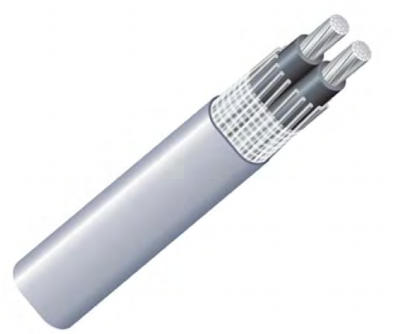
Type SE, Style U (SEU) is an unarmored service-entrance cable defined by UL 854 and installed under NEC Article 338. "Style U" means unarmored: the cable typically has a flat or oval profile with two or three insulated conductors plus a bare (uninsulated) aluminum neutral conductor. Because the neutral is bare and the cable is unarmored, SEU is lighter and easier to terminate than round or armored styles, which makes it a popular choice for overhead service drops and meter-to-panel runs.
The Type SE family has three main variants. Choosing the right one depends entirely on where the cable will run:
| Feature | SEU (Style U) | SER (Style R) | USE |
|---|---|---|---|
| Profile | Flat or oval, unarmored | Round, unarmored or with armor | Round, unarmored |
| Neutral conductor | Bare aluminum | Insulated | Bare or insulated |
| Typical use | Overhead service drop, meter to panel | Panel feeders and branch circuits inside buildings | Underground service, direct burial |
| Direct burial | No | No | Yes (USE-2) |
| Primary standard | UL 854 | UL 854 | UL 854 |
Key Specifications of SEU (Style U)
| Component | Specification |
|---|---|
| Conductor | AA-8000 series aluminum alloy (8030/8176) per ASTM B800, excellent conductivity and corrosion resistance |
| Insulation | XHHW-2 (UL 44) or THWN-2 (UL 83), rated 90 °C |
| Neutral | Bare AA-8000 aluminum neutral conductor for balanced current and system reliability |
| Jacket | Gray UV-resistant PVC jacket, moisture and abrasion resistant, for outdoor use |
| Voltage rating | 600 V |
| Temperature rating | 90 °C maximum, wet or dry |
| Ampacity | Per NEC Table 310.16, 75 °C column (aluminum) |
| Sizes | Typically 8 AWG to 500 kcmil, depending on manufacturer |
Applications of Service Entrance Cable
| Application | Description |
|---|---|
| Utility to meter | Transmitting power from the overhead service drop to the meter base (secure initial connection) |
| Meter to panel | Connecting the meter base to the distribution panel for efficient in-building power distribution |
| Feeders and branch circuits | Permitted for feeders and branch circuits under NEC 338.10 where conditions allow |
| Environments | Wet or dry locations (max 90 °C), including outdoors and basements |
| Not for underground | Direct burial and underground runs require USE cable, not SEU (NEC 338.12) |
Standards & Compliance
| Standard | Scope |
|---|---|
| UL 854 | Type SE service-entrance cable (SEU, SER, USE) — the primary product standard |
| UL 44 | XHHW-2 insulated conductors |
| UL 83 | THHN/THWN-2 insulated conductors |
| ASTM B800 | AA-8000 series aluminum alloy wire |
| NEC Article 230 | Services — overhead service drops and metering |
| NEC Article 338 | Service-entrance cable installation rules |
| NEC Table 310.16 | Ampacity tables at 60/75/90 °C |
UL 854 is the standard that defines Type SE cable itself — SEU, SER, and USE are all listed under it. The insulation and conductor standards above apply to the individual components inside the cable.
Ampacity & Sizing Guidance
Service-entrance conductors are sized from NEC Table 310.16, using the 75 °C column because most aluminum terminations (lugs, meter sockets, panels) are rated 75 °C. Common sizes for aluminum:
| Conductor size | Ampacity @ 75 °C (A) |
|---|---|
| 8 AWG | 40 |
| 6 AWG | 50 |
| 4 AWG | 65 |
| 3 AWG | 75 |
| 2 AWG | 90 |
| 1 AWG | 100 |
| 1/0 AWG | 120 |
| 2/0 AWG | 135 |
| 3/0 AWG | 155 |
| 4/0 AWG | 180 |
Sizing steps for a service entrance: 1. Calculate the total connected load per NEC Article 220. 2. Size for continuous loads at 125 % of the load (NEC 210.19). 3. Check voltage drop — keep feeder drop within 3 % and total branch drop within 5 %. 4. Verify that terminations are rated for the 75 °C column used. 5. Confirm the wet/dry and sunlight (UV) rating matches the installation environment.
For a step-by-step selection method covering the wider low-voltage cable family, see our Low Voltage Power Cable Selection Guide.
Aluminum vs Copper Conductors
SEU service entrance cable is almost always built with AA-8000 aluminum alloy, which NEC requires for aluminum building wire. Here is how it compares with copper:
| Factor | AA-8000 Aluminum | Copper |
|---|---|---|
| Conductivity | ~61 % IACS | 100 % IACS |
| Weight | ~30 % lighter for the same ampacity | Heavier |
| Material cost | Lower | Higher |
| Terminations | Needs anti-oxidant compound and AL-CU rated lugs | Standard lugs |
| Corrosion resistance | Good with proper treatment | Excellent |
| Use in SEU | Standard (required by NEC for aluminum) | Available but uncommon |
Aluminum's cost and weight advantages are exactly why utilities and contractors specify AA-8000 SEU for service entrances — with the correct terminations, it delivers the same reliability as copper at a fraction of the cost.
Installation Best Practices
- Secure and support exposed runs at intervals not exceeding 1.4 m (4½ ft) per NEC 338.
- Apply anti-oxidant compound to aluminum conductors and torque all connections to the manufacturer's specification.
- Protect the cable from physical damage where it is exposed to impact or abrasion.
- Never use SEU for direct burial or underground conduit runs — choose USE cable instead.
- Follow the manufacturer's minimum bending radius guidance to avoid insulation damage.
Recommended Sample Specification
UL-listed Type SE, Style U service entrance cable, rated 600 V, AA-8000 aluminum alloy conductors with XHHW-2 or THWN-2 insulation, gray UV-resistant PVC jacket (SiTong Cable or approved equivalent). Ensures installation consistency across projects.
Why Choose Our Service Entrance Cable?
| Advantage | Description |
|---|---|
| Cost-effective | AA-8000 aluminum outperforms copper on cost for the same ampacity |
| Easy installation | Flexible unarmored design cuts labor time |
| Long-lasting | UV and moisture resistance reduces maintenance |
| Code-compliant | UL 854 listed and built to NEC requirements for global projects |
Frequently Asked Questions
Q: What does SEU stand for? A: SEU stands for service entrance cable, Type SE, Style U — the unarmored, flat or oval variant of UL 854 listed service-entrance cable rated 600 V.
Q: What is the difference between SEU and SER cable? A: SEU (Style U) is flat or oval with a bare aluminum neutral, while SER (Style R) is round with an insulated neutral and may include armor. SEU is commonly used for service drops and meter-to-panel runs; SER is used for panel feeders and branch circuits inside buildings.
Q: Can SEU cable be buried directly in the ground? A: No. NEC 338.12 does not permit SE cable for underground use. For direct burial, specify USE (underground service entrance) cable instead.
Q: What insulation types are used in SEU cable? A: SEU conductors are typically insulated with XHHW-2 (UL 44) or THHN/THWN-2 (UL 83), both rated 90 °C for wet or dry locations.
Q: Is aluminum conductor safe for service entrance? A: Yes. NEC requires AA-8000 series aluminum alloy (ASTM B800) for aluminum building wire. With anti-oxidant compound and rated terminations, AA-8000 performs reliably for decades.
Q: What is the ampacity of 2 AWG aluminum SEU? A: Per NEC Table 310.16, 2 AWG aluminum is rated 90 A at 75 °C before any derating or correction factors are applied.
Q: What voltage is SEU cable rated for? A: SEU service entrance cable is rated 600 V, which covers standard residential and commercial service voltages including 120/240 V and 120/208 V.
Q: Where is SEU cable allowed to be used? A: SEU is permitted for services, feeders, and branch circuits under NEC Article 338, in wet or dry locations up to 90 °C, including outdoor and basement environments.
Conclusion
SEU service entrance cable is the workhorse of utility-to-building power delivery: UL 854 listed, built with AA-8000 aluminum alloy, rated 600 V and 90 °C, and governed by clear NEC installation rules. Whether you are wiring a residential meter base or a commercial service, specifying the correct style, size, and terminations is straightforward when you follow the standards above.
👉 Browse our Service Entrance Cable range 👉 Contact our team
📬 Sales inquiries: sales@sitongcable.com | 📞 Phone: +86-371-69176007