How to Choose the Right Cable: Complete Technical Guide

How to Choose the Right Cable: Complete Technical Guide
Choosing the right cable for your project is one of the most consequential engineering decisions you will make. The wrong voltage class, conductor material or insulation system can cause compliance failures, safety hazards and expensive rework — often discovered only after installation. This guide gives you a five-step framework — voltage level, conductor material, environmental conditions, cable construction, and standards compliance — so you can specify the correct power cable, overhead conductor or specialty cable with confidence. Whether you are an electrical engineer, a procurement professional or a project manager, the same logic applies: define the requirement first, then select the cable.
Step 1: Determine the Voltage Level
The voltage rating of your network is the single most important selection criterion. It determines the insulation thickness, construction type and applicable standard. Cable voltage is expressed as U₀/U, where U₀ is the phase-to-earth voltage and U is the phase-to-phase voltage.
| Voltage Class | Typical Rating | Applications | Governing Standard |
|---|---|---|---|
| Low Voltage (LV) | 0.6/1 kV | Residential and light commercial supply, service entrances, internal wiring | IEC 60502-1 |
| Medium Voltage (MV) | 6–35 kV | Industrial plants, distribution networks, substations | IEC 60502-2 |
| High Voltage (HV) | 66 kV and above | Power transmission lines, grid interconnectors | IEC 60840 / IEC 62067 |
- Low voltage (0.6/1 kV): The most common class for building supply, street lighting and small industrial loads. For service entrances in TN-C-S and TN-S earthing systems, a concentric cable is often the standard choice.
- Medium voltage (6–35 kV): Used in factory power distribution, wind and solar farms, and urban distribution feeders. XLPE-insulated MV power cables offer excellent dielectric and thermal performance.
- High voltage (110 kV+): Reserved for bulk power transmission. These projects require specialist engineering, accessories and testing far beyond the scope of a standard selection guide.
Pro Tip: When in doubt, verify the network voltage with the local distribution network operator (DNO) before ordering. Ordering a 0.6/1 kV cable for a 11 kV circuit is not just a mistake — it is a safety hazard.
Step 2: Choose the Conductor Material — Copper vs. Aluminum
The conductor material drives cost, weight, conductivity and termination practice. Two metals dominate the cable industry: copper and aluminum.
| Comparison Factor | Copper | Aluminum |
|---|---|---|
| Conductivity | Excellent (≈100% IACS, class 2 per IEC 60228) | Good (≈61% IACS) — larger cross-section needed for same ampacity |
| Weight | Heavier | Around 40% lighter for the same ampacity |
| Cost | Higher material cost | Significantly lower material cost |
| Flexibility & handling | More flexible, easier to terminate | Stiffer; requires larger bend radii and proper lugs |
| Corrosion behavior | Very good in most environments | Needs antioxidant compound at terminations; galvanized steel core options |
| Best For | Internal risers, control panels, precision equipment | Long overhead spans, cost-sensitive projects, utility distribution |
- Copper conductors: Superior conductivity and flexibility make copper the default for indoor and high-density installations, control systems and precision applications.
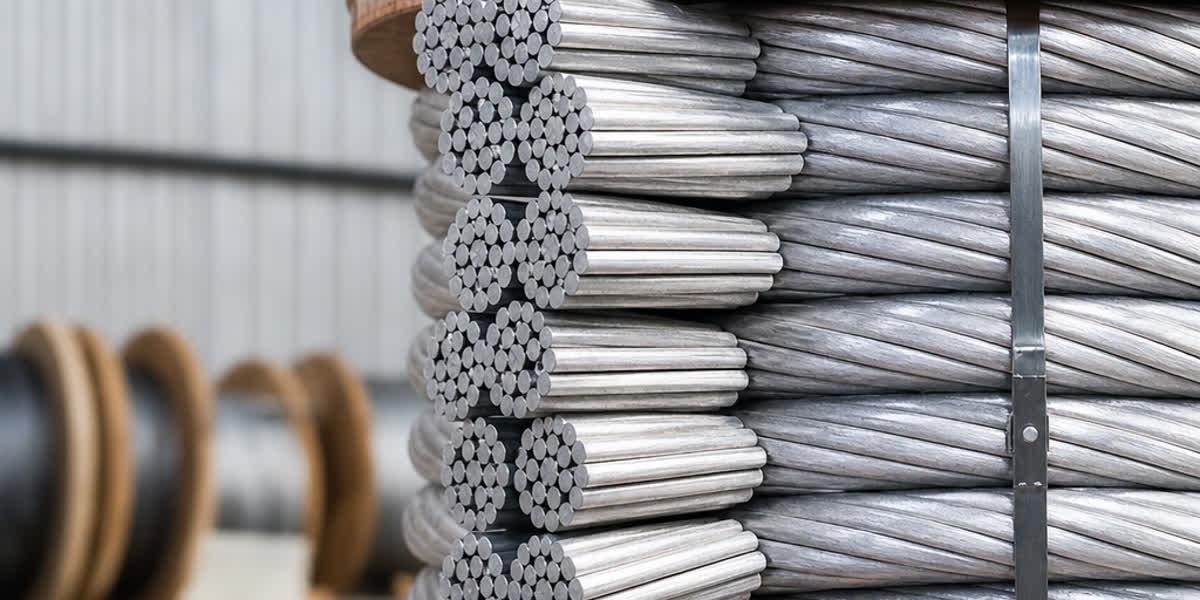
- Aluminum conductors: Lighter weight and lower cost make aluminum ideal for long overhead spans and large cross-sections. For overhead transmission and distribution, aluminum conductor families dominate — see AAC conductor (all-aluminum), AAAC conductor (all-aluminum alloy) and ACSR conductor (aluminum conductor, steel reinforced) for the full range.
Step 3: Assess Environmental Conditions
The installation environment determines insulation, sheathing and armor requirements. Skipping this step is a common cause of premature cable failure.
| Factor | Consideration | Recommended Practice |
|---|---|---|
| Temperature range | -40°C to +90°C typical operating range | XLPE insulation for high-temperature or cyclic loading; PVC for general indoor use |
| UV exposure | Outdoor and aerial installations | Use UV-resistant insulation/jackets for exposed runs |
| Chemical exposure | Industrial atmospheres, coastal salt, oils | Select appropriate jacket materials (LSZH, chloroprene, etc.) |
| Mechanical stress | Direct burial, rodent-prone areas, traffic | Choose armored cables (SWA/STA) for harsh conditions |
| Fire risk | Public buildings, tunnels, high-occupancy areas | Low Smoke Zero Halogen (LSZH) sheathing per IEC 60332 / IEC 60754 |
Pro Tip: If the cable will be buried directly in the ground, do not assume any cable works. Underground installation demands proper armor and moisture barriers — see our underground cable range for application-specific options.
Step 4: Select the Cable Construction for Your Application
Different applications favor different cable constructions. Match your application to the right product family:
| Application | Recommended Construction | Key Advantage |
|---|---|---|
| Overhead power distribution in residential areas | ABC (Aerial Bundled Cable) | Bundled phases reduce short-circuit risk and clearance requirements; see our aerial bundled cable range |
| High-tension transmission lines | ACSR (Aluminum Conductor Steel Reinforced) | Steel core adds tensile strength for long spans; see ACSR conductor |
| Industrial plants, underground feeders | XLPE Power Cable | High thermal rating and excellent dielectric strength |
| Transmission lines requiring communication | OPGW (Optical Ground Wire) | Combines power transmission with fiber-optic communication in one cable; see OPGW |
| LV service entrances (UK/Ireland/Australia) | Concentric Cable | Integrated neutral/earth layer simplifies installation; see concentric cable |
| Control panels and instrumentation | Control Cable | Flexible, screened options for signal integrity; see control cable |
ABC (Aerial Bundled Cable)
Perfect for overhead power distribution in residential and urban areas. The bundled construction eliminates the need for large clearances between phases and reduces the risk of short circuits caused by vegetation or animals.
ACSR (Aluminum Conductor Steel Reinforced)
Ideal for high-tension transmission lines where long spans and high mechanical strength are required. The galvanized steel core carries the mechanical load while the aluminum strands conduct the current — a combination that has made ACSR the workhorse of transmission networks worldwide.
Power Cables
Suitable for underground installation and industrial plants. XLPE-insulated power cables offer higher operating temperatures (up to 90°C continuous) than traditional PVC designs, enabling higher current ratings in the same overall diameter.
OPGW (Optical Ground Wire)
Combines power transmission with fiber-optic communication. Installed in the overhead ground-wire position, OPGW provides both lightning protection and high-bandwidth communication for grid monitoring, SCADA and telecom services.
Step 5: Verify Standards Compliance
Citing the correct standards in your specification removes ambiguity and speeds up approval. Key standards by region:
| Standard | Scope |
|---|---|
| IEC 60502-1 / -2 | Power cables with extruded insulation (1 kV / 6–30 kV) |
| IEC 60228 | Conductor classes for insulated cables (class 1 solid, class 2 stranded) |
| IEC 61089 | Round wire concentric lay overhead electrical stranded conductors |
| ASTM B231 / B232 | Aluminum conductors / steel-reinforced (ACSR) for overhead lines |
| BS 215 | Specification for aluminum conductors and steel-reinforced conductors |
| BS 7671 | IET Wiring Regulations — installation practice and earthing arrangements |
| IEC 60332 / IEC 60754 | Flame propagation and halogen content for fire performance |
| UL / NEC | North American cable standards for specific market entry |
Pro Tip: For tenders in the UK and Commonwealth markets, specify BS 7671 for installation and IEC 60502 for the cable itself. For overhead conductor projects, reference IEC 61089 or ASTM B232 depending on whether the buyer follows international or North American practice.
Installation Considerations
Even a correctly specified cable fails if it is installed poorly. Keep these four rules in mind:
- Bending Radius: Minimum 15× cable diameter for unarmored cables (more for armored) to avoid insulation damage.
- Load Capacity: Calculate ampacity from actual load, not nameplate rating. Apply derating factors for ambient temperature, grouping and burial depth.
- Future Expansion: Plan for 20–30% capacity overhead so the cable does not become the bottleneck of a future upgrade.
- Maintenance Access: Ensure joints, terminations and cable routes remain accessible for inspection and thermal monitoring.
Frequently Asked Questions
Q: What does 0.6/1 kV mean on a cable rating? A: It is the rated voltage expressed as U₀/U: 0.6 kV phase-to-earth and 1 kV phase-to-phase. This is the standard rating for LV power cables and concentric service cables in most national grids.
Q: Copper or aluminum — which should I choose? A: Choose copper for indoor risers, control panels and precision applications where conductivity and flexibility matter most. Choose aluminum for long overhead spans and cost-sensitive projects, where lighter weight and lower material cost outweigh the need for larger cross-sections and special terminations.
Q: What is the difference between AAC, AAAC and ACSR? A: AAC (All Aluminum Conductor) uses pure aluminum strands — lightest and most corrosion-resistant, but lowest strength. AAAC (All Aluminum Alloy Conductor) uses aluminum alloy for a better strength-to-weight ratio. ACSR (Aluminum Conductor Steel Reinforced) adds a galvanized steel core for maximum tensile strength, making it the best choice for long spans and high-tension lines.
Q: When should I use OPGW instead of a standard overhead ground wire? A: Use OPGW when the transmission line needs communication capability — grid monitoring, SCADA, telecom or protection signaling — without installing a separate fiber cable. OPGW replaces the traditional earth wire while providing built-in optical fibers.
Q: Can concentric cable be installed overhead? A: Yes. Aluminum concentric cables are commonly used for overhead service entrances from a utility pole to the meter board, where their light weight reduces sag and pole loading. Copper versions are usually preferred indoors.
Q: What standards should a compliant power cable meet? A: For LV cables, specify IEC 60502-1 with IEC 60228 conductors. For overhead conductors, reference IEC 61089 or ASTM B231/B232 (ACSR: ASTM B232). For installation in the UK, BS 7671 applies. Add IEC 60332-1-2 for flame retardance and, for public buildings, IEC 60754-1 / BS EN 61034-2 for LSZH performance.
Conclusion: Building Your Specification
Selecting the right cable is a systematic five-step process: 1) determine the voltage level, 2) choose the conductor material, 3) assess environmental conditions, 4) select the construction for your application, and 5) verify standards compliance. By working through this framework — and citing the relevant IEC, ASTM, BS or UL standards — you ensure a safe, compliant and cost-effective installation. Always consult a qualified electrical engineer or the cable manufacturer to finalize specifications for your specific project.
👉 Browse our Power Cable product range 👉 How to Choose a Concentric Cable: A 4-Step Framework 👉 Contact our team
📬 Sales inquiries: sales@sitongcable.com | 📞 Phone: +86-371-69176007