Shipboard Cable (Marine Cable): Complete Technical Guide, Standards & Selection Best Practices
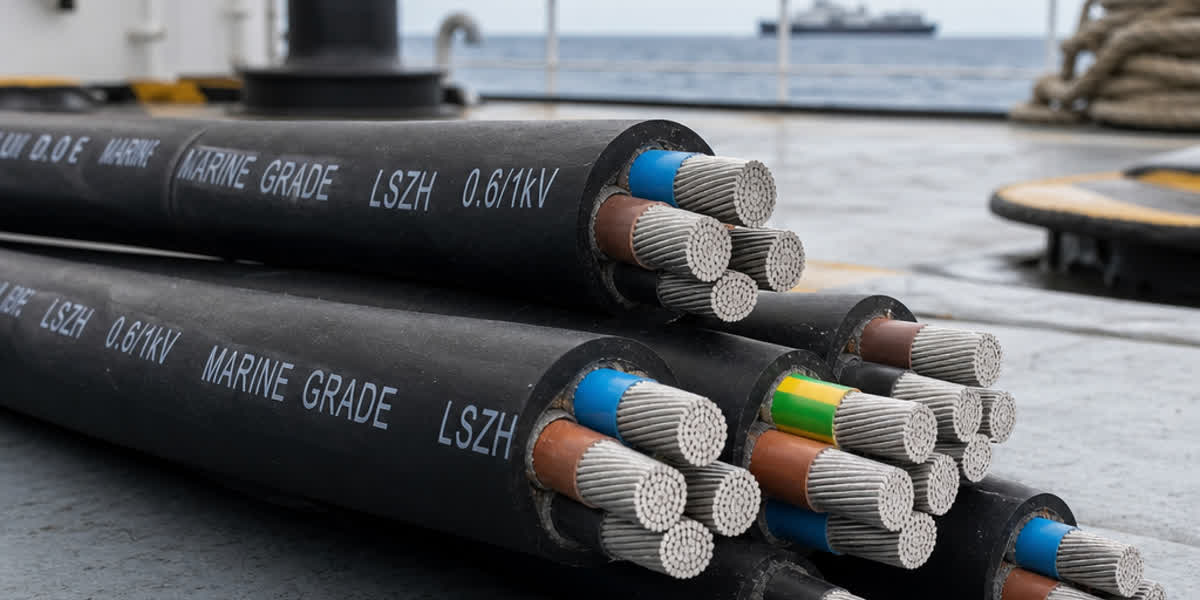
Shipboard cable, also known as marine cable or maritime cable, is a specialized type of electrical cable designed for use in ships, offshore platforms, submarines, and other marine environments. Unlike standard industrial cables, shipboard cables must withstand extreme conditions — constant vibration, saltwater exposure, high humidity, oil and fuel contact, and wide temperature fluctuations — while maintaining reliable power distribution, control signals, and communication in mission-critical maritime operations.
With the global shipbuilding industry projected to reach $280 billion by 2030 (Fortune Business Insights, 2025) and offshore energy infrastructure expanding rapidly, demand for high-quality, certified shipboard cables continues to rise. This guide provides a comprehensive overview of shipboard cable types, international standards, construction specifications, and selection criteria for marine engineers, procurement professionals, and shipyard operators.
What is Shipboard Cable?
Shipboard cable is a flame-retardant, low-smoke, halogen-free (LSZH) electrical cable specifically constructed for marine environments. It connects power generation systems, switchboards, motors, navigation equipment, lighting systems, and communication networks throughout a vessel.
Key Differences from Industrial Cables
| Feature | Shipboard Cable | Standard Industrial Cable |
|---|---|---|
| 🔥 Fire Performance | IEC 60332 (flame retardant), IEC 60754 (zero halogen), IEC 61034 (low smoke) | Basic flame retardance |
| 💧 Moisture Resistance | High — continuous salt spray and humidity | Moderate |
| 🛢️ Oil & Fuel Resistance | Excellent — tested to IEC 60811-2-1 | Limited |
| 🎵 Vibration Tolerance | Enhanced — shipboard vibration profiles | Standard |
| 🔬 Conductor Material | Tinned copper (standard) | Bare or tinned copper |
| 🌡️ Temperature Range | -30°C to +90°C (some grades to +125°C) | -10°C to +70°C |
| ✅ Certification | Type-approved (Lloyd's, DNV, ABS, BV, CCS) | General-purpose ratings |
Applications
| Application Area | Description | Typical Cable Types |
|---|---|---|
| 🚢 Power Distribution | Main switchboard to sub-distribution, emergency generators | Shipboard Power Cable (0.6/1 kV) |
| ⚡ Engine Room | Pumps, compressors, ventilation fans, fuel systems | Oil-resistant Shipboard Cable |
| 🧭 Navigation & Communication | Radar, GPS, sonar, internal communication systems | Instrumentation & Communication Cable |
| 🔧 Deck Machinery | Cranes, winches, mooring systems | Flexible Shipboard Cable |
| 🔥 Fire Safety Systems | Fire pumps, sprinkler systems, alarm loops | Fire-resistant (FP) Shipboard Cable |
| 💡 Lighting & Outlets | Accommodation, passageways, work areas | General-purpose Shipboard Cable |
| 🛳️ Offshore Platforms | Drilling, processing, living quarters | Enhanced-performance Marine Cable |
| 🚤 Submarines & Naval | Military specifications, shock resistance | Naval Shipboard Cable (MIL-DTL-24643) |
International Standards for Shipboard Cable
Shipboard cables are governed by a comprehensive set of international standards to ensure safety, reliability, and interoperability across global maritime operations.
IEC 60092 Series (International)
The IEC 60092 series is the primary international standard for electrical installations in ships, published by the International Electrotechnical Commission. Part 350 through 360 cover shipboard power, control, and instrumentation cables specifically.
| Standard | Description |
|---|---|
| IEC 60092-350 | General construction and test requirements for shipboard power, control, and instrumentation cables |
| IEC 60092-351 | Insulating materials for shipboard cables |
| IEC 60092-352 | Sheathing materials for shipboard cables |
| IEC 60092-353 | Shipboard power cables — rated voltages 0.6/1 kV |
| IEC 60092-354 | Shipboard power cables — rated voltages 3.6/6 kV to 18/30 kV |
| IEC 60092-355 | Shipboard control cables |
| IEC 60092-360 | Shipboard instrumentation and communication cables |
| IEC 60092-374 | Cables with a halogen-free and/or flame-retardant insulation and sheath |
| IEC 60092-375 | Halogen-free and/or flame-retardant cables with improved fire performance |
| IEC 60092-376 | Cables for shipboard communication and data transmission |
IEEE 45 (USA)
IEEE 45 — IEEE Recommended Practice for Electrical Installations on Shipboard — is the primary North American standard for marine electrical systems, including cable specifications.
| Section | Description |
|---|---|
| IEEE 45.1 | General requirements for shipboard electrical systems |
| IEEE 45.8 | Cable and cable installation |
| IEEE 45.9 | Fire protection |
Classification Society Standards
Classification societies — Lloyd's Register (LR), Det Norske Veritas (DNV), American Bureau of Shipping (ABS), Bureau Veritas (BV), China Classification Society (CCS) — each issue type-approval certificates for shipboard cables:
| Classification Society | Abbreviation | Region | Key Standard |
|---|---|---|---|
| Lloyd's Register | LR | UK | LR Type Approval for Electrical Cables |
| DNV | DNV | Norway | DNV-OS-D201 / DNV-ST-F101 |
| American Bureau of Shipping | ABS | USA | ABS Rules for Building and Classing Steel Vessels |
| Bureau Veritas | BV | France | BV NR 216 |
| China Classification Society | CCS | China | CCS Rules for Electrical Installations |
| Nippon Kaiji Kyokai | NK/ClassNK | Japan | NK Guidelines for Electrical Installations |
| Registro Italiano Navale | RINA | Italy | RINA Rules for Electrical Installations |
| Russian Maritime Register | RS | Russia | RS Rules for Electrical Equipment |
Fire Performance Standards
| Standard | Description | Requirement |
|---|---|---|
| IEC 60332-1-2 | Flame propagation for single cable | Self-extinguishing |
| IEC 60332-3-22 | Flame propagation for bunched cables | Category A — limited flame spread |
| IEC 60754-1/2 | Halogen gas evolution | <0.5% HCl (halogen-free) |
| IEC 61034-1/2 | Smoke density | Light transmittance ≥ 60% |
| IEC 60331-21 | Circuit integrity under fire | Maintains function for 90+ minutes at 750°C |
| IMO FTP Code Part 5 | IMO fire test procedures | Surface spread of flame, heat release |
Types of Shipboard Cables
1. Shipboard Power Cables (0.6/1 kV)
Used for general power distribution throughout vessels: main switchboard feeders, motor circuits, distribution panel connections.
| Specification | Standard | Details |
|---|---|---|
| Rated Voltage | IEC 60092-353 | 0.6/1 kV |
| Conductor | IEC 60228 | Tinned copper, Class 2 (stranded) or Class 5 (flexible) |
| Insulation | IEC 60092-351 | XLPE (cross-linked polyethylene) or EPR (ethylene propylene rubber) — halogen-free, flame-retardant |
| Sheath | IEC 60092-352 | LSZH (low-smoke zero-halogen) compound |
| Temperature Rating | — | -30°C to +90°C (XLPE), -30°C to +85°C (EPR) |
2. Shipboard Control Cables
Used for control, monitoring, and automation circuits — connecting control panels, sensors, actuators, and PLC systems.
| Specification | Standard | Details |
|---|---|---|
| Rated Voltage | IEC 60092-355 | 0.6/1 kV |
| Core Count | — | 2 to 48 cores (typical) |
| Conductor | IEC 60228 | Tinned copper, Class 2 or Class 5 |
| Insulation | IEC 60092-351 | EPR or XLPE |
| Sheath | IEC 60092-352 | LSZH compound |
| Shielding | — | Optional — tinned copper braid or foil for EMI protection |
3. Shipboard Instrumentation & Communication Cables
Used for low-voltage signals — sensors, transmitters, communication networks, PA systems, and navigation equipment.
| Specification | Standard | Details |
|---|---|---|
| Rated Voltage | IEC 60092-360 | 150/250 V or 0.6/1 kV |
| Conductor | — | Tinned copper, Class 2 or Class 5 |
| Insulation | — | PE (polyethylene) or EPR — low dielectric loss for signal integrity |
| Pairing | — | Twisted pairs with individual and overall shielding |
| Sheath | IEC 60092-352 | LSZH compound |
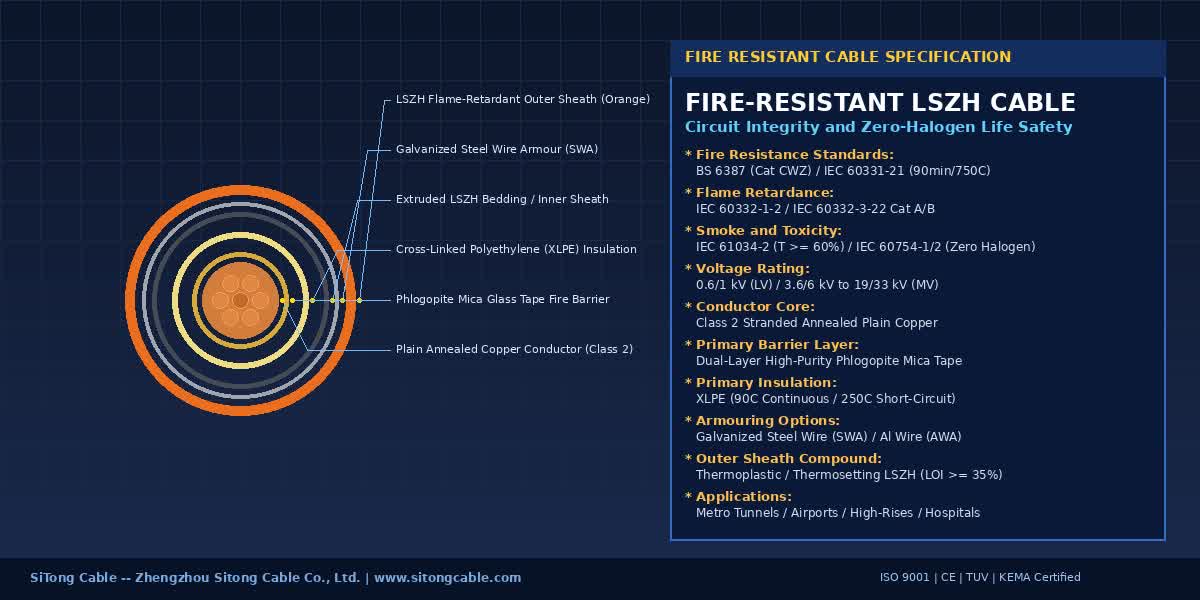
4. Fire-Resistant (FP) Shipboard Cables
Maintain circuit integrity during a fire for emergency systems: fire pumps, sprinklers, alarms, emergency lighting.
| Specification | Standard | Details |
|---|---|---|
| Fire Rating | IEC 60331-21 | 90+ minutes at 750°C (standard); up to 120 minutes on request |
| Conductor | — | Tinned copper with mica tape wrapping |
| Insulation | — | Mica tape + XLPE or EPR |
| Sheath | — | LSZH — halogen-free, low smoke |
5. Naval Shipboard Cables (MIL-DTL-24643)
Specialized cables for naval vessels requiring superior shock resistance, electromagnetic compatibility, and nuclear radiation resistance.
| Specification | Standard | Details |
|---|---|---|
| Voltage | MIL-DTL-24643 | 600 V to 5 kV |
| Conductor | — | Tinned copper, stranded |
| Insulation | — | EPR or silicone rubber — nuclear-grade radiation resistance |
| Sheath | — | LSZH or chlorosulfonated polyethylene (CSPE) |
| Shock Rating | MIL-S-901D | High-impact shock tested |
| EMI Shielding | MIL-STD-461 | Electromagnetic interference protection |
Shipboard Cable Construction
Conductor
| Material | Properties | Standard |
|---|---|---|
| Tinned Copper | Corrosion resistance against saltwater; maintains solderability | IEC 60228 Class 2 (stranded) or Class 5 (fine-stranded/flexible) |
| Bare Copper | Less common; used in dry internal compartments | IEC 60228 Class 2 |
Why tinned copper? Tin coating prevents sulfide tarnishing and galvanic corrosion in the salt-laden marine atmosphere. It also improves solderability for connections in confined shipboard spaces. Nearly all classification societies require tinned conductors for shipboard cables.
Insulation Materials
| Material | Temperature Rating | Key Properties | Typical Application |
|---|---|---|---|
| XLPE (Cross-linked Polyethylene) | -30°C to +90°C | High dielectric strength, moisture resistance, excellent aging | Power cables (0.6/1 kV and above) |
| EPR (Ethylene Propylene Rubber) | -30°C to +85°C | Excellent flexibility, good in wet environments, thermal stability | Power and control cables |
| Silicone Rubber | -60°C to +180°C | Extreme temperature range, high flexibility | Naval and special-purpose cables |
| PVC (limited use) | 0°C to +70°C | Cost-effective but limited fire performance | Non-essential interior cables (declining usage) |
Sheathing Materials
| Material | Properties | Application |
|---|---|---|
| LSZH (Low-Smoke Zero-Halogen) | Halogen-free, low smoke emission, flame retardant | Modern shipboard cables — mandatory for enclosed spaces |
| CSPE (Chlorosulfonated Polyethylene, e.g., Hypalon®) | Excellent UV, oil, and weather resistance | Deck and topside cable runs |
| PCP (Polychloroprene, e.g., Neoprene®) | Good oil and abrasion resistance | Engine room and machinery spaces |
Armoring & Shielding
| Type | Function | Standard |
|---|---|---|
| Tinned Copper Wire Braid | Mechanical protection, EMI shielding | IEC 60092-350 |
| Steel Wire Armor (SWA) | Deep mechanical protection for buried or exposed runs | — |
| Aluminum/PET Laminated Foil | EMI shielding for signal cables | IEC 60092-360 |
| Individual Pair Shield | Crosstalk prevention in instrumentation cables | IEC 60092-360 |
Key Technical Parameters
Voltage Ratings
| Voltage Class | Application |
|---|---|
| 150/250 V | Instrumentation, communication, low-voltage control |
| 0.6/1 kV | General power distribution, motors, lighting |
| 1.8/3 kV | Large motors, feeder circuits |
| 3.6/6 kV — 18/30 kV | High-voltage distribution on large vessels and offshore platforms |
Temperature Ranges
| Operating Environment | Typical Range |
|---|---|
| General shipboard | -30°C to +90°C |
| Engine room (near engines/exhaust) | -30°C to +125°C |
| Deck (UV exposure) | -30°C to +85°C |
| Arctic-rated | -50°C to +90°C |
Fire Performance Parameters
| Parameter | LSZH Standard | Standard Cable (PVC) |
|---|---|---|
| Halogen Content | <0.5% | 30-40% chlorine |
| Smoke Emission (IEC 61034) | ≥60% light transmittance | <20% transmittance |
| Flame Spread (IEC 60332-3) | Pass Category A | Often fails Category A |
| Toxicity Index (NES 713) | <5 (typically 1-3) | 15-25 |
How to Select the Right Shipboard Cable
Selecting the correct shipboard cable involves assessment of electrical, environmental, fire-safety, and regulatory requirements.
Step 1: Define Electrical Requirements
- Voltage: Match the rated voltage to the system voltage (0.6/1 kV for general power, higher for main feeders)
- Current: Calculate ampacity considering ambient temperature, cable grouping, and installation method
- Core count: For control cables, include spare cores (typically 20% margin)
Step 2: Assess Environmental Conditions
- Location: Engine room (oil, heat) vs. deck (UV, salt spray) vs. accommodation (low smoke requirement)
- Temperature: Select insulation/sheath temperature rating with margin above expected conditions
- Mechanical risk: Use armored cable where mechanical damage is possible
Step 3: Verify Fire Safety Compliance
- Enclosed spaces: LSZH compounds are mandatory under SOLAS (Safety of Life at Sea) regulations
- Emergency systems: Fire-resistant (FP) cables per IEC 60331 required for fire pumps, alarms, emergency lighting
- Bunched cables: Ensure IEC 60332-3 Category A compliance for cable trays through compartments
Step 4: Classification Society Approval
- Verify the cable manufacturer's type-approval certificate from the vessel's chosen classification society (LR, DNV, ABS, BV, CCS, etc.)
- Check the scope of approval — does it cover the specific cable type, voltage, and core count?
Step 5: Installation Requirements
- Bending radius: Typically 6× outer diameter for armored, 4× for unarmored (check manufacturer's datasheet)
- Glanding: Use appropriate cable glands with IPS (Ingress Protection) rating for the location
- Segregation: Separate power, control, and communication cables per IEC 60092-352 guidance
Selection Matrix
| Application | Cable Type | Insulation | Sheath | Standard |
|---|---|---|---|---|
| Main power distribution | Power Cable 0.6/1 kV — 3.6/6 kV | XLPE | LSZH | IEC 60092-353 |
| Motor circuits (engine room) | Power Cable, oil-resistant | EPR | LSZH (oil-resistant grade) | IEC 60092-353 |
| Control panels & PLC | Control Cable, multi-core | EPR | LSZH | IEC 60092-355 |
| Navigation & signals | Instrumentation Cable | PE | LSZH | IEC 60092-360 |
| Fire pump circuits | Fire-resistant Power Cable | Mica + EPR | LSZH | IEC 60331 / 60092-353 |
| Deck crane & mooring | Flexible Power Cable | EPR | CSPE (weather-resistant) | IEC 60092-353 |
| Emergency lighting | Fire-resistant Control Cable | Mica + EPR | LSZH | IEC 60331 / 60092-355 |
| Offshore platform | Enhanced Power Cable | XLPE (heavy-duty) | LSZH | IEC 60092-354 |
FAQ
Q: What is the difference between shipboard cable and ordinary industrial cable? A: Shipboard cable is specifically designed for the marine environment — tinned copper conductors for corrosion resistance, LSZH (low-smoke zero-halogen) sheathing for fire safety in enclosed spaces, and enhanced vibration, oil, and moisture resistance. Ordinary industrial cables lack these critical properties and are not approved by classification societies for maritime use.
Q: Why is LSZH (low-smoke zero-halogen) required on ships? A: Under SOLAS regulations, cables in enclosed shipboard spaces must be halogen-free and low-smoke. In a fire, halogenated cables (e.g., PVC) release dense toxic smoke containing hydrogen chloride (HCl), which obscures escape routes and causes fatal respiratory damage. LSZH compounds emit minimal smoke (≥60% light transmittance per IEC 61034) and no halogens, allowing safe evacuation.
Q: What classification society certifications should a shipboard cable have? A: The required certification depends on the vessel's flag state and insurance. Common certifications include Lloyd's Register (LR), DNV, ABS (American Bureau of Shipping), BV (Bureau Veritas), CCS (China Classification Society), NK (Nippon Kaiji Kyokai), and RINA. Always verify that the cable's type-approval certificate covers the specific voltage, core count, and application.
Q: What is the standard voltage rating for shipboard power cables? A: For general power distribution, the standard rating is 0.6/1 kV per IEC 60092-353. For large vessels and offshore platforms, medium-voltage cables rated 3.6/6 kV to 18/30 kV per IEC 60092-354 are used for main generator and high-power feeder circuits.
Q: Can I use XLPE-insulated shipboard cable in all shipboard areas? A: XLPE is suitable for most areas but may not be optimal for all. In hot engine rooms where cables run near exhaust pipes, EPR or silicone rubber may be better. For flexible applications (crane cables, pendant cables), Class 5 flexible conductors with EPR insulation are recommended. Always consult the cable manufacturer's application guide.
Q: What is the difference between IEC 60092-353 and IEC 60092-354? A: IEC 60092-353 covers shipboard power cables with rated voltages up to 0.6/1 kV, while IEC 60092-354 covers medium-voltage power cables for ships rated 3.6/6 kV to 18/30 kV — used for main power generation and large motor feeders on large vessels and offshore platforms.
Q: How are shipboard cables tested for fire resistance? A: Fire-resistant (FP) cables are tested to IEC 60331-21, which requires maintaining circuit integrity for at least 90 minutes at 750°C flame temperature while mechanically shocked. Some naval specifications require up to 120 minutes at 950°C.
Q: What are the standard color codes for shipboard cable cores? A: Per IEC 60092-351, power cable cores follow standard phase colors (brown, black, grey for 3-phase; blue for neutral; green-yellow for earth). Control cables typically use numbered cores according to IEC 60757. The outer sheath is usually black or grey.
Q: Is tinned copper always required for shipboard cables? A: Most classification societies require tinned copper conductors for shipboard cables in all areas due to the corrosive saltwater atmosphere. Bare copper may be accepted in some dry, interior compartments, but tinned copper is the recommended standard for all maritime applications.
Why Choose Sitong Cable for Shipboard Cables?
At Sitong Cable, we manufacture a comprehensive range of shipboard cables certified to international marine standards:
- ✅ Full IEC 60092 Series Compliance — Power, control, instrumentation, and fire-resistant cables
- ✅ Classification Society Approvals — LR, DNV, ABS, BV, CCS, NK certification available
- ✅ LSZH Materials — All shipboard cables use halogen-free, low-smoke compounds
- ✅ Tinned Copper Conductors — Standard on all marine-grade cables
- ✅ Custom Manufacturing — Special lengths, core counts, and armoring configurations
- ✅ Global Shipping — Direct export to shipyards and offshore projects worldwide
For technical specifications, certification documents, or a quote for your marine cable project, visit our Shipboard Cable Product Page or browse our complete range of marine cables and accessories.
This guide is part of the Sitong Cable Technical Resource Library. For more information, visit our blog or product pages.