When to Use AAC or ACSR? A Practical Project Guide for Power Line Engineers
When to Use AAC or ACSR? A Practical Project Guide for Power Line Engineers
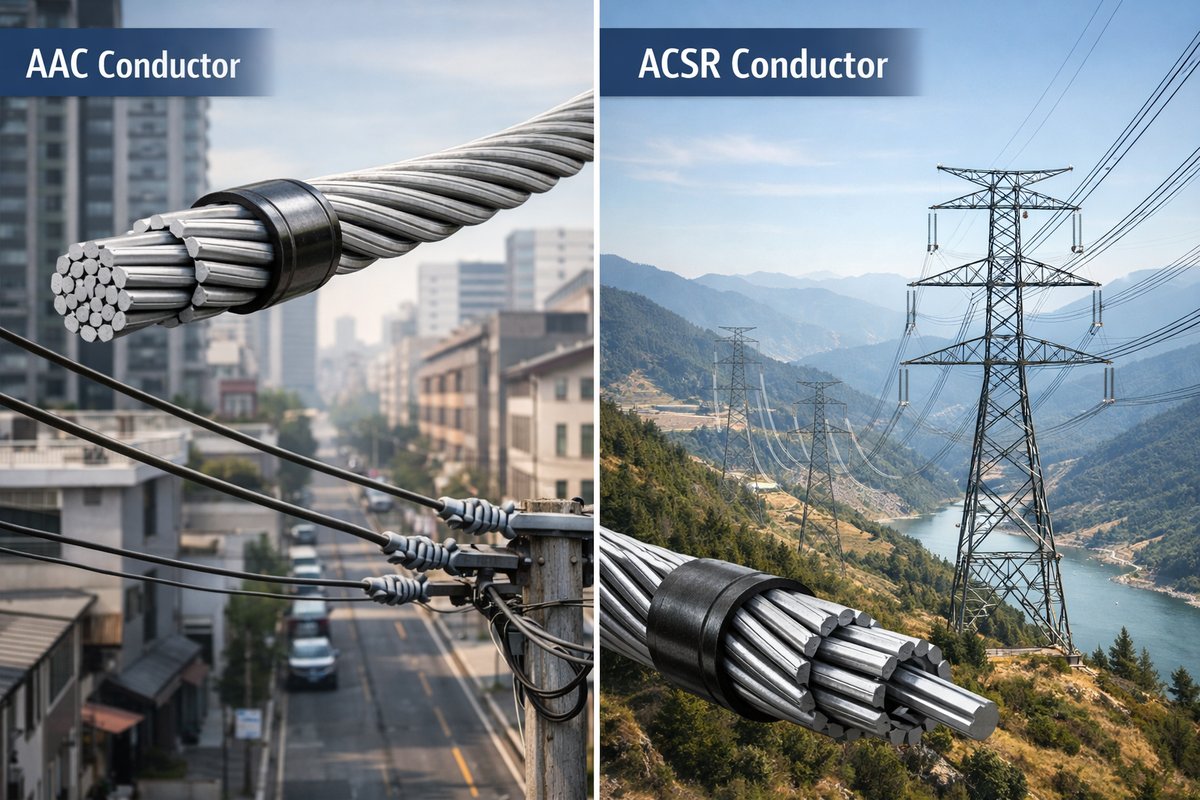
Selecting between AAC Conductor (All Aluminum Conductor) and ACSR Conductor (Aluminum Conductor Steel Reinforced) is one of the most fundamental decisions in overhead transmission and distribution engineering. While both conductors utilize high-purity electrical-grade aluminum to conduct current, their mechanical architectures and behavior under environmental stress are radically different.
Specifying the wrong conductor type can lead to premature line failure, excessive mid-span sag, accelerated galvanic corrosion, or unjustifiably inflated civil infrastructure costs.
This engineering guide provides a practical, field-tested decision framework for utility engineers, EPC contractors, and project planners. We analyze the exact boundary conditions—spanning distance, mechanical tension, coastal exposure, thermal ratings, hardware requirements, and total cost of ownership (TCO)—that dictate when to specify AAC versus ACSR.
1. Core Structural and Material Comparison
To understand where each conductor belongs in the field, we must first compare their metallurgical composition and construction mechanics:
AAC (All Aluminum Conductor)               ACSR (Aluminum Conductor Steel Reinforced)
┌─────────────────────────────────┐        ┌─────────────────────────────────┐
│  ○ ○ ○ ○ ○ ○ ○ (Outer Layer)    │        │  ○ ○ ○ ○ ○ ○ ○ (Outer Al Strands)│
│   ○ ○ ○ ○ ○ ○  (Middle Layer)   │        │   ○ ○ ○ ○ ○ ○  (Inner Al Strands)│
│     ○ ○ ○ ○    (1350-H19 Al)    │        │     ● ● ● ●    (Galvanized Steel)│
│       ○ ○                       │        │       ● ●      (High-Strength    │
│        ○       (Center Al Wire) │        │        ●        Core Wire)       │
└─────────────────────────────────┘        └─────────────────────────────────┘
 100% Electrical Grade Aluminum             Composite: EC Aluminum + Steel Core
 High Conductivity / Low Tensile            High Tensile Strength / Controlled Sag
AAC (All Aluminum Conductor) — Construction and Standards
- Material Composition: 100% stranded aluminum 1350-H19 (minimum 99.5% purity) with a minimum electrical conductivity of 61.2% IACS (International Annealed Copper Standard).
- Core: Homogeneous construction with no steel reinforcement.
- Governing Standards: ASTM B231, IEC 61089, BS 215 Part 1, DIN 48201-5, and EN 50182.
- Mechanical Characteristic: Relatively low Ultimate Tensile Strength (UTS) ranging between 160 MPa and 200 MPa per strand.
ACSR (Aluminum Conductor Steel Reinforced) — Construction and Standards
- Material Composition: Concentric-lay stranded conductor with one or more outer layers of 1350-H19 aluminum wire surrounding a central core of high-strength galvanized steel wires.
- Core Variations: Standard Class A, B, or C galvanized steel per ASTM B498 / IEC 60888, or Aluminum-Clad Steel (ACSR/AW) per ASTM B502 for enhanced corrosion resistance.
- Common Stranding Configurations (Al/Steel): 6/1, 7/1, 18/1, 26/7, 30/7, and 54/7.
- Governing Standards: ASTM B232, IEC 61089, BS 215 Part 2, DIN 48204, and CSA C49.
- Mechanical Characteristic: Very high UTS, where the steel core supports 50% to 60% of the entire line mechanical tension despite making up only 15% to 30% of the conductor weight.
2. Technical Comparison Matrix: Key Engineering Parameters
The table below contrasts standard industry sizes of AAC and ACSR under equivalent operational benchmarks (ambient temperature 25°C, wind speed 0.6 m/s, solar radiation 1000 W/m², max conductor operating temperature 75°C):
| Metric / Parameter | AAC Conductor (e.g., Orchid / 636 kcmil) | ACSR Conductor (e.g., Hawk / 477 kcmil) | Engineering Significance |
|---|---|---|---|
| Material Makeup | 37 Strands (100% Al 1350) | 26 Al / 7 Steel (Composite) | Weight distribution and mechanical stiffness |
| Nominal Cross Section | 322.3 mm² | 241.7 mm² Al / 38.6 mm² St (280.3 mm² total) | Current-carrying volume vs structural core |
| Overall Diameter | 23.2 mm | 21.8 mm | Wind load profile and ice accumulation area |
| Total Linear Weight | 886 kg/km | 976 kg/km | Gravity load on cross-arms and suspension towers |
| Rated Tensile Strength (UTS) | ~51.9 kN | ~86.7 kN (+67% higher) | Maximum allowable span length and tension limits |
| DC Resistance at 20°C | 0.0894 Ω/km | 0.1196 Ω/km | I²R line transmission losses |
| Continuous Ampacity (75°C) | ~780 A | ~659 A | Maximum continuous thermal transfer capacity |
| Modulus of Elasticity (Final) | ~55 GPa | ~77 GPa to 82 GPa | Dynamic sag response under wind and ice loading |
| Coefficient of Linear Expansion | 23.0 × 10⁻⁶ / °C | 19.3 × 10⁻⁶ / °C | Thermal expansion and vertical sag at peak load |
3. The 5 Crucial Project Decision Criteria
When evaluating your overhead line alignment, evaluate your project against these five engineering criteria:
                               PROJECT SELECTION FLOWCHART
                                            │
                           Span Length / Ruling Span?
                                  /                                   < 100-120 meters     > 120-150 meters
                             /                                         Coastal or Saline?           ACSR Required
                        /          \          (High UTS, Low Sag)
                     YES            NO
                     /                                 AAC Preferred       Evaluate Mechanical
            (Zero Galvanic Risk)     Loads & Tension
Criterion 1: Span Length and Ruling Span Limits
- Short Spans (< 100–120 meters): AAC Conductor is the standard solution for urban low-voltage (LV) and medium-voltage (MV) distribution lines (11 kV to 33 kV). Because support poles are closely spaced to accommodate service drop take-offs, the lower tensile strength of AAC is not a limiting factor.
- Medium to Long Spans (> 150 meters): ACSR Conductor is mandatory for high-voltage (66 kV to 500 kV+) transmission corridors. The steel core allows conductors to be strung at significantly higher tension (typically 18% to 25% of UTS everyday tension), keeping vertical sag within statutory ground-clearance limits across rolling hills, highway crossings, and long agricultural corridors.
Criterion 2: Environmental Corrosion and Atmosphere Classification
- Marine and Salt-Spray Environments (C4 / C5 Coastal Zones): In coastal zones within 5 to 10 km of the sea, salt deposition creates a galvanic cell between the zinc-galvanized steel core and outer aluminum strands of standard ACSR. If moisture penetrates between the layers, electrolytic corrosion attacks the zinc coating, eventually rusting the steel and causing internal strand failure. AAC is 100% homogeneous aluminum, completely eliminating galvanic cell potential.
- Inland, Rural, and Desert Terrains: ACSR performs exceptionally well in dry, rural, or non-corrosive inland areas with expected lifespans exceeding 40 to 50 years. Where ACSR must be used in mildly corrosive areas, specifying grease-impregnated steel cores or Aluminum-Clad Steel (ACSR/AW) is recommended.
Criterion 3: Mechanical Loading (NESC Heavy vs. Light Zones)
- Heavy Ice and Wind Loading: In regions subject to freezing rain, radial ice accumulation (e.g., 12.5 mm NESC Heavy loading), and extreme wind gusts (> 100 km/h), the additional mechanical stress will cause AAC to stretch past its yield point and experience excessive, irreversible creep. ACSR’s steel core handles the composite mechanical load without exceeding safe elongation thresholds.
- Aeolian Vibration and Galloping: Because ACSR lines operate under higher tension, they are more susceptible to high-frequency wind-induced Aeolian vibrations. Engineers must install Stockbridge vibration dampers and armor rods at suspension clamps. AAC operates under lower stringing tension, making it less prone to fatigue-inducing Aeolian vibration on short spans.
Criterion 4: Electrical Efficiency and Current Density
- For a given outer diameter, AAC offers higher total aluminum cross-sectional area and lower electrical resistance than ACSR, resulting in lower line losses ($I^2R$) and superior thermal ampacity.
- In substations and industrial facilities where short jumper spans require maximum current capacity with minimum weight on busbar supports, AAC is the preferred industry specification.
Criterion 5: Civil Infrastructure and Total Installed Cost (TCO)
While AAC raw material cost per metric ton is comparable or slightly lower than ACSR, total project economics depend on structural civil costs: 1. Long-Distance Transmission: Using AAC would require 30% to 50% more transmission towers per kilometer to prevent ground clearance violations from excessive sag. The massive increase in tower steel, concrete foundations, and right-of-way (ROW) acquisition makes AAC economically unfeasible for transmission corridors. ACSR drastically lowers total project CAPEX by maximizing span distance between towers. 2. Urban Distribution: Where pole locations are already fixed by street intersections, building access, and property boundaries, ACSR’s high strength cannot be utilized. Here, AAC delivers the lowest material cost and easiest field handling.
4. Practical Application Scenarios: Summary Table
| Application Scenario | Recommended Conductor | Primary Engineering Justification |
|---|---|---|
| Urban and Suburban LV/MV Distribution (0.4 kV – 33 kV) | AAC Conductor | Short pole spans (<80m), high ampacity, easy cutting and tapping in dense street corridors. |
| Coastal Distribution Lines (<5 km from shoreline) | AAC Conductor (or AAAC) | Eliminates bimetallic galvanic corrosion; homogeneous aluminum structure resists salt-fog pitting. |
| Substation Busbars, Jumpers and Station Equipment | AAC Conductor | Maximum electrical conductivity, lightweight connections to disconnect switches and transformers. |
| HV/EHV Cross-Country Transmission (66 kV – 765 kV) | ACSR Conductor | High tensile strength permits 300m–500m spans, controlling mid-span sag and minimizing tower counts. |
| River, Fjord and Canyon Long-Distance Crossings | ACSR Conductor (High-Steel 54/7 or 30/7) | Extreme mechanical UTS prevents conductor snapping over spans exceeding 800m–1500m. |
| High Wind and Mountainous Ice-Loading Corridors | ACSR Conductor (with Stockbridge dampers) | High structural integrity under NESC Heavy ice accumulation and transverse wind pressure. |
5. Field Installation and Hardware Considerations
Specifying between AAC and ACSR also directly impacts installation equipment, hardware fittings, and field labor procedures:
- Splicing and Mid-Span Joints:
- AAC: Utilizes a single-sleeve aluminum compression joint. Crimping is fast and requires standard hexagonal or circular compression dies.
- ACSR: Requires a two-piece joint: an inner high-pressure steel compression sleeve crimped directly onto the exposed steel core, followed by an outer aluminum sleeve with conductive paste injected to bridge the current path.
- Dead-End and Suspension Clamps:
- AAC: Requires aluminum-lined suspension clamps with preformed armor rods to prevent strand notching under clamp pressure.
- ACSR: Uses heavy-duty bolted quadrant clamps or wedge-type tension clamps capable of gripping both the steel core and aluminum layers without slipping under high tension.
- Alternative Solutions to Consider:
- When projects require the corrosion resistance of AAC but the span strength of ACSR, engineers often specify AAAC Conductor (All Aluminum Alloy) or Aerial Bundled Cable (ABC) for congested urban rights-of-way.
6. Frequently Asked Questions (FAQ)
Q1: Can AAC conductor ever be used for 132 kV or 220 kV transmission lines?
In general transmission line practice, no. The tensile strength of pure aluminum 1350-H19 is insufficient to support the high tension required across standard 300m+ transmission spans without excessive sag or risk of fatigue failure. However, AAC is routinely used within 132 kV and 220 kV substations as flexible overhead busbars and equipment jumpers where spans are under 30 meters.
Q2: Why does ACSR suffer from internal corrosion in coastal areas?
ACSR consists of two dissimilar metals in direct contact: zinc-galvanized steel and aluminum. In a dry environment, the metals are stable. In coastal marine environments, airborne salt moisture penetrates between the outer aluminum strands, forming an electrolyte. Because aluminum and steel have an electrochemical potential difference of approximately 1.22 V, galvanic corrosion occurs, depleting the zinc layer and corroding the steel core from the inside out. For coastal transmission lines, specifying grease filling per IEC 61089 or Aluminum-Clad Steel (ACSR/AW) is essential.
Q3: What are the most common standard code names for AAC and ACSR conductors?
Under North American ASTM conventions, bare overhead conductors are designated by standardized code names: - AAC Code Names (Flower Names): Peachbell (6 AWG), Rose (4 AWG), Iris (397.5 kcmil), Orchid (636 kcmil), Bluebell (1033.5 kcmil). - ACSR Code Names (Bird Names): Raven (1/0 AWG 6/1), Penguin (4/0 AWG 6/1), Hawk (477 kcmil 26/7), Drake (795 kcmil 26/7), Cardinal (954 kcmil 54/7).
Q4: How does thermal expansion differ between AAC and ACSR under peak electrical loads?
AAC has a higher coefficient of linear thermal expansion ($23.0 \times 10^{-6} / ^\circ\text{C}$) compared to ACSR ($19.3 \times 10^{-6} / ^\circ\text{C}$). When operating at elevated temperatures (e.g., 75°C to 90°C during peak summer loads), AAC elongates and sags significantly more than ACSR. The steel core in ACSR restrains thermal elongation once the conductor reaches its thermal transition point (knee-point temperature), stabilizing the sag.
Q5: What information is needed when requesting a quotation for AAC or ACSR conductors?
To obtain an accurate, project-ready manufacturing quotation, specify: 1. Conductor type (AAC or ACSR) and target standard (e.g., ASTM B231/B232, IEC 61089, BS 215). 2. Stranding configuration (e.g., 26/7, 54/7 for ACSR; 7, 19, 37 strands for AAC). 3. Code name or cross-sectional area (kcmil or mm²). 4. Steel core galvanizing class (Class A, B, C) or ACSR/AW requirement. 5. Special manufacturing requirements (grease filling, specific drum lengths, wooden/steel reel type).
7. Partner with SiTong Cable for Overhead Line Projects
Zhengzhou SiTong Cable Co., Ltd. is a specialized manufacturer and global exporter of bare overhead conductors and insulated power cables. With modern multi-wire stranding lines, precision wire drawing machinery, and an in-house CNAS-standard testing laboratory, we produce conductors meeting the most rigorous international standards:
- Full Product Range: Complete series of AAC, ACSR, AAAC, ACAR, and Covered Line Wire / ABC Cable.
- Factory Acceptance Testing (FAT): Routine and type testing for tensile strength, elongation, DC resistance, zinc coating mass, and wrapping adhesion.
- Custom Engineering Support: Tailored drum packaging, anti-corrosion grease impregnation, and custom stranding ratios for extreme spans and special climate zones.
Planning an overhead distribution or transmission project? Contact SiTong Cable Technical Sales Team today for detailed engineering datasheets, standard compliance certificates, and factory-direct project quotations.