SER vs. SEU Service Entrance Cable: NEC Article 338 Rules, Subpanel Feeder Compliance, AA-8000 Ampacity & Termination Guide
SER vs. SEU Service Entrance Cable: NEC Article 338 Rules, Subpanel Feeder Compliance, AA-8000 Ampacity & Termination Guide
Service entrance cables represent the critical electrical artery connecting the utility service drop or transformer to a building's main service equipment and interior distribution panels. Among the most widely specified cable types in North American, Caribbean, and Latin American electrical infrastructure are Type SER (Service Entrance Round) and Type SEU (Service Entrance Unarmored). While both fall under the governing umbrella of NEC Article 338 and UL Standard 854, their physical architectures, grounding capabilities, and permissible installation topologies differ fundamentally. Specifying or installing the incorrect cable assembly—most notably attempting to feed an interior subpanel with Type SEU—remains one of the most frequent and hazardous code violations encountered by electrical inspectors, causing objectionable neutral currents, elevated chassis voltages, and catastrophic fire hazards.
In this engineering guide, Zhengzhou Sitong Cable Co., Ltd. (SiTong Cable) provides a comprehensive analysis of Type SER and Type SEU cable assemblies. We examine their structural configurations, evaluate the strict legal mandates of NEC Article 230, 250, and 338, clarify the contentious 60°C vs. 75°C ampacity derating rules for AA-8000 aluminum conductors, and detail the termination protocols necessary to guarantee long-term operational reliability.
1. Physical Architecture: SER vs. SEU Structural Anatomy
The foundational difference between Type SER and Type SEU lies in cable geometry and conductor arrangement, dictating where and how each cable can establish return and grounding paths.
+--------------------------------------------------------------------------------------------------+
|                             SER vs. SEU Cross-Sectional Geometry                                 |
+--------------------------------------------------------------------------------------------------+
|                                                                                                  |
|         Type SER (Round Configuration)                    Type SEU (Flat Configuration)          |
|                                                                                                  |
|                  +---------------+                               +-------------------------+     |
|                 /  Phase A   Phase \                            |  Phase A       Phase B   |     |
|                |    (XLPE)     B    |                           |  (XLPE)        (XLPE)    |     |
|                |                    |                           |                          |     |
|                |  Neutral    Bare   |                            \   Bare Concentric Neutral/    |
|                 \  (XLPE)   Ground /                              \  Helical Wire Wrap     /     |
|                  +---------------+                                 +----------------------+      |
|             (Sunlight-Resistant PVC)                               (Sunlight-Resistant PVC)      |
+--------------------------------------------------------------------------------------------------+
Type SEU (Service Entrance, Unarmored)
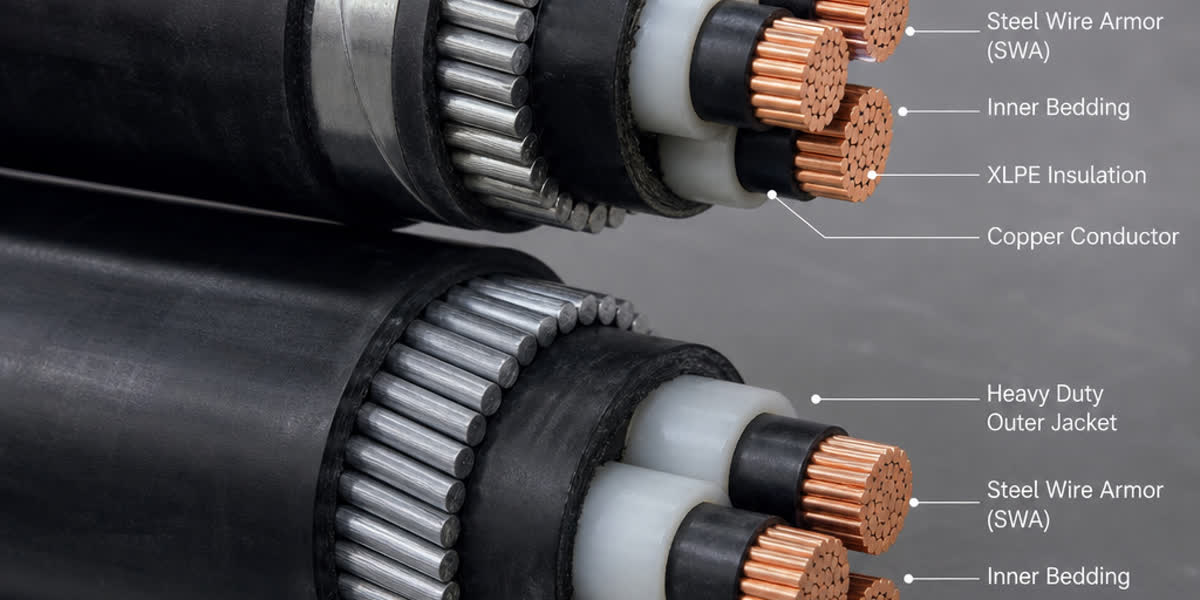
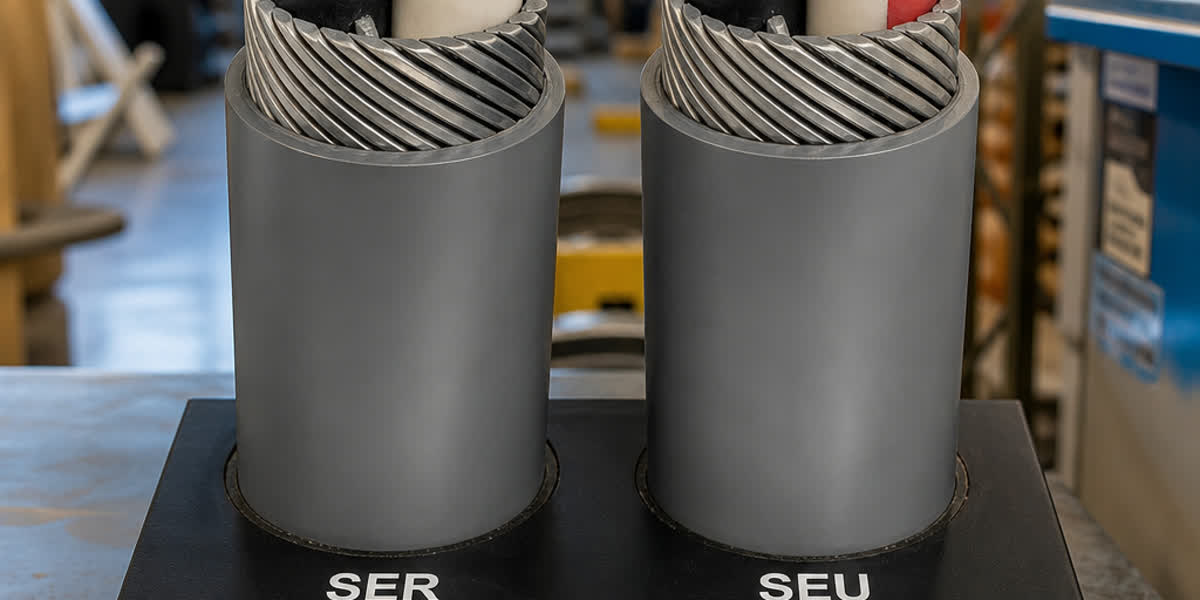
Type SEU cable is engineered primarily as a flat-profile, three-conductor assembly designed specifically for 120/240V single-phase, 3-wire utility services. - Phase Conductors: Consists of two insulated phase legs (typically Black and Red, or Black with a colored stripe) insulated with 90°C cross-linked polyethylene (XLPE) or high-grade PVC/Nylon. - Neutral Conductor: Unlike conventional multi-conductor cables that feature an insulated neutral core, Type SEU utilizes a concentric layer of bare aluminum or copper strands spirally wrapped around the insulated phase conductors. This concentric neutral structure, similar in geometric concept to our specialized concentric cable range, delivers a compact profile, inherent tamper resistance against unauthorized taps, and uniform electromagnetic shielding. - Reinforcement & Jacket: A glass-reinforced binder tape wraps the concentric neutral assembly, encapsulated within an extruded, heavy-duty polyvinyl chloride (PVC) outer jacket that is sunlight-resistant and flame-retardant. Because SEU features only two insulated conductors and a single concentric neutral, it cannot provide an isolated equipment grounding conductor (EGC).
Type SER (Service Entrance, Round)
Type SER cable features a round cross-sectional profile containing three or four fully insulated circuit conductors plus a separate, dedicated bare or green-insulated equipment grounding conductor. - Single-Phase Configurations (3 insulated + 1 bare ground): Two insulated phase conductors (Line 1, Line 2), one fully insulated neutral conductor (White), and one bare equipment grounding conductor. - Three-Phase Configurations (4 insulated + 1 bare ground): Three insulated phase conductors (Line 1, Line 2, Line 3), one fully insulated neutral conductor, and one bare equipment grounding conductor. - Jacket & Fillers: The insulated conductors and ground wire are cabled together with non-hygroscopic polypropylene fillers, wrapped with an overall glass-reinforced binder tape, and jacketed with an ultraviolet-resistant, moisture-resistant PVC sheath. Because SER contains an insulated neutral completely isolated from the grounding conductor, it fully supports 4-wire single-phase and 5-wire three-phase feeder distribution.
2. Engineering Comparison: SER, SEU, and USE-2 Technical Parameters
To ensure correct specification, the table below highlights the physical, electrical, and regulatory specifications of SER, SEU, and underground service entrance (USE-2) cables manufactured to UL 854 standards.
| Technical Parameter | Type SEU (Service Entrance Unarmored) | Type SER (Service Entrance Round) | Type USE-2 (Underground Service Entrance) |
|---|---|---|---|
| Governing Standard | UL 854 / ASTM B800, B801 | UL 854 / ASTM B800, B801 | UL 854 / ASTM B800, B801 |
| Cross-Section Profile | Flat (Parallel Cores) | Round (Cabled Cores) | Single Conductor / Flat Parallel |
| Conductor Metallurgy | AA-8000 Compact Aluminum or Annealed Cu | AA-8000 Compact Aluminum or Annealed Cu | AA-8000 Aluminum or Annealed Cu |
| Insulation Material | XLPE (XHHW-2 rating) or THHN | XLPE (XHHW-2 rating) or THHN | Heavy-Duty XLPE (Direct Burial) |
| Conductor Count | 2 Insulated + 1 Concentric Neutral | 3 or 4 Insulated + 1 Bare Ground | 1, 2, 3, or 4 Conductors |
| Separate Ground Wire? | No (Only concentric neutral) | Yes (Dedicated EGC included) | Optional depending on multi-core build |
| Voltage Rating | 600 Volts | 600 Volts | 600 Volts |
| Maximum Temp Rating | 90°C Dry / 90°C Wet | 90°C Dry / 90°C Wet | 90°C Wet or Dry |
| Permitted for Subpanels? | Strictly Prohibited (NEC 250.24) | Permitted & Recommended (NEC 338.10) | Permitted outdoors/trench only |
| Direct Burial Rated? | No (Above-ground / riser only) | No (Indoor / outdoor raceway/riser) | Yes (Direct burial without conduit) |
| Interior Building Use | Permitted (Main service run only) | Permitted (Feeder & branch circuits) | Prohibited indoors past point of entrance |
When transitioning from overhead distribution, engineers frequently interface SER/SEU with outdoor drop lines, utilizing utility aerial bundled cable (ABC) for secondary drops and transitioning to heavy-duty underground cable where buried utility connections are required.
3. NEC Compliance: The Critical Subpanel Feeder Code Violation
The most critical regulatory distinction between SER and SEU stems from the strict division between Service Conductors and Feeder Conductors defined in the National Electrical Code (NEC / NFPA 70).
+--------------------------------------------------------------------------------------------------+
|                   NEC Service Disconnect vs. Subpanel Grounding Architecture                     |
+--------------------------------------------------------------------------------------------------+
|                                                                                                  |
|   Utility Drop / Meter Base                        Main Service Panel (First Disconnect)         |
|   +-----------------------+                        +-----------------------------------+         |
|   |                       |    Type SEU or SER     | Main Breaker                      |         |
|   | L1  L2  Neutral       | =====================> | Neutral & Ground BONDED HERE      |         |
|   +-----------------------+   (Neutral bonded at   | [Main Bonding Jumper (MBJ)]       |         |
|                                service disconnect) | Earth Grounding Electrode System  |         |
|                                                    +-----------------------------------+         |
|                                                                      |                           |
|                                                          Type SER ONLY (4-Wire Feeder)           |
|                                                          - L1 & L2 (Phase Conductors)            |
|                                                          - Insulated Neutral (Floating)          |
|                                                          - Bare Ground (Equipment Chassis)       |
|                                                          =============================\          |
|                                                                                       |          |
|                                                           Interior Subpanel           V          |
|                                                    +-----------------------------------+         |
|                                                    | Neutral Bar: FLOATING (Isolated)  |         |
|                                                    | Ground Bar: BONDED TO ENCLOSURE   |         |
|                                                    | (NO BONDING JUMPER PERMITTED)     |         |
|                                                    +-----------------------------------+         |
+--------------------------------------------------------------------------------------------------+
Why Type SEU Is Allowed from Meter to Main Disconnect
Per NEC Article 230 (Services) and NEC 250.24(C), the grounded service conductor (the neutral) is connected to the equipment grounding conductor and the grounding electrode conductor (ground rods, water pipe, foundation rebar) at the service disconnecting means. Prior to this first disconnect, electrical ground and electrical neutral are intentionally bonded at one single point via the Main Bonding Jumper (MBJ).
Because the neutral and ground are at zero electrical potential relative to each other at this point, Type SEU's bare concentric neutral can safely carry unbalanced return current without introducing stray voltage onto metallic enclosures. Therefore, running Type SEU from an exterior meter socket to an interior main breaker panel is fully code-compliant under NEC Article 338.
Why Using Type SEU for Subpanels Violates NEC 250.24 & NEC 338.10
The moment power leaves the main service disconnect, the circuit transitions from a "Service" to a "Feeder". Per NEC 250.24(A)(5) and NEC 250.142(B):
"A grounded conductor shall not be connected to normally non-current-carrying metal parts of equipment on the load side of the service disconnecting means."
If an installer runs Type SEU to a subpanel, they are faced with an illegal and hazardous dilemma: 1. If the installer bonds the SEU bare concentric neutral to the subpanel metal frame: Neutral current returning from 120V loads will divide between the neutral conductor and every grounded metal path in the building (copper water pipes, gas lines, HVAC ductwork, structural steel). This creates continuous touch potential, severe electric shock hazards, and high risk of arcing fires. 2. If the installer floats the SEU bare concentric neutral: The subpanel chassis has no equipment grounding path back to the main service. A ground fault occurring inside the subpanel (or any downstream branch circuit) will energize the panel enclosure to 120V without tripping the circuit breaker, creating an immediate electrocution trap.
The Engineering Conclusion: Type SEU is strictly illegal for interior subpanel feeders. Type SER (with its separate insulated neutral and dedicated grounding conductor) must be specified for all subpanel feeder applications. When sourcing building distribution materials, consulting electric wire and building wire products alongside certified SER cables ensures full regulatory adherence.
4. Metallurgy & Ampacity: AA-8000 Aluminum Alloys & NEC 338.10(B)(4)
Over 90% of commercial and residential Type SER and SEU installations utilize aluminum conductors due to their significant cost and weight advantages over copper. However, engineering aluminum service entrance cables requires strict compliance with metallurgical standards and thermal derating rules.
Metallurgy: AA-8000 Series (ASTM B800 / B801) vs. Legacy 1350 Aluminum
In decades past, aluminum wiring gained a problematic reputation due to the use of utility-grade EC-1350 electrical aluminum. EC-1350 exhibited a high coefficient of thermal expansion and significant mechanical creep (cold flow) under set-screw pressure, which caused connections to loosen over repeated thermal cycles, leading to high-resistance hotspots and fires.
Modern Type SER and SEU cables manufactured by Zhengzhou Sitong Cable Co., Ltd. are fabricated exclusively from AA-8030 or AA-8176 aluminum alloy conforming to ASTM B800 and compact stranded per ASTM B801. AA-8000 series aluminum contains controlled micro-alloying additions of iron and silicon: - Creep Resistance: Demonstrates over 300% greater resistance to thermal relaxation under terminal screw torque compared to EC-1350. - Ductility & Flexibility: Withstands tight bending radii without micro-fracturing of the outer stranding layers. - Thermal Stability: Maintains mechanical integrity across cyclic load swings between ambient temperature and 90°C conductor limits.
The Ampacity Temperature Rating Trap: NEC 338.10(B)(4)
One of the most frequently misunderstood clauses in the National Electrical Code involves the temperature rating used to determine the ampacity of Type SER cable. While SiTong Cable insulates each SER conductor with 90°C rated cross-linked polyethylene (XHHW-2 type insulation), engineers and contractors cannot always use the 90°C column of NEC Table 310.16.
Per NEC 338.10(B)(4)(a), when Type SE or SER cable is installed as interior branch circuits or feeders, it must comply with the installation provisions of NEC Article 334 (Nonmetallic-Sheathed Cable / Type NM): - Where installed in thermal building insulation (e.g., fiberglass batt or blown cellulose within interior wall cavities or attics), the conductor ampacity must be sized using the 60°C temperature column of NEC Table 310.16. - The 90°C rating may still be utilized as the starting point for ambient temperature correction and conductor bundling derating factors, provided the final calculated ampacity does not exceed the 60°C rating. - Where SER is run through open commercial spaces, exposed basements, or properly ventilated plenums without contacting thermal insulation, terminations onto equipment with dual-rated 75°C terminals (marked AL9CU) permit sizing from the 75°C column.
Aluminum Conductor Sizing Reference (NEC Table 310.16)
| AWG / kcmil Size | 60°C Ampacity (In Insulation / NM Rule) | 75°C Ampacity (Standard AL9CU Terminals) | 90°C Ampacity (Derating Benchmark) | Common Application |
|---|---|---|---|---|
| #6 AWG | 40 A | 50 A | 55 A | 40A Subpanel / Heat Pump |
| #4 AWG | 55 A | 65 A | 75 A | 60A Subpanel / EV Charger |
| #2 AWG | 75 A | 90 A | 100 A | 90A-100A Residential Subpanel |
| #1/0 AWG | 85 A | 100 A | 115 A | 100A Main Service / Large Feeder |
| #2/0 AWG | 100 A | 115 A | 135 A | 125A Feeder Distribution |
| #4/0 AWG | 150 A | 180 A | 205 A | 200A Residential Main (NEC 310.12) |
| 250 kcmil | 170 A | 205 A | 230 A | 200A Commercial Feeder |
| 300 kcmil | 190 A | 230 A | 255 A | Commercial 3-Phase Distribution |
Note: For single-phase residential 120/240V main power services, NEC 310.12 permits 4/0 AWG aluminum to serve as a complete 200A main service entrance conductor.
5. Field Installation, Terminations & Hardware Selection
A cable assembly is only as reliable as its physical termination. Improper termination of aluminum conductors remains the leading root cause of service entrance equipment degradation.
+--------------------------------------------------------------------------------------------------+
|                   Proper Aluminum Conductor Termination Protocol                                 |
+--------------------------------------------------------------------------------------------------+
|                                                                                                  |
|   Step 1: Strip Insulation                                                                       |
|   - Pencil cut or mechanical rotary stripper. Never score the aluminum core.                     |
|                                                                                                  |
|   Step 2: Remove Aluminum Oxide Film                                                             |
|   - Wire-brush the exposed AA-8000 aluminum strands to eliminate high-resistance Al2O3.          |
|                                                                                                  |
|   Step 3: Apply Oxide-Inhibiting Compound                                                        |
|   - Coat immediately with synthetic antioxidant paste (containing zinc particles).               |
|                                                                                                  |
|   Step 4: Seat into Dual-Rated AL9CU Terminal                                                    |
|   - Ensure terminal lug is marked AL9CU or AL7CU. Connect using bimetallic compression lugs      |
|     or mechanical screw terminals.                                                               |
|                                                                                                  |
|   Step 5: Calibrate Torque to Manufacturer Specification                                         |
|   - Tighten using a calibrated torque wrench (NEC 110.14(D)). Never estimate by feel.           |
+--------------------------------------------------------------------------------------------------+
Preventing Galvanic Corrosion & Terminal Loosening
- AL9CU Dual-Rating Verification: Standard copper-only mechanical lugs (marked CU only) will cause aggressive galvanic corrosion when paired with aluminum conductors due to disparate electrochemical potential. All terminals, breaker lugs, and disconnects must be marked AL9CU (indicating suitability for Aluminum or Copper up to 90°C) or utilize precision-machined bimetallic cable lugs.
- Wire Brushing and Antioxidant Compound: Aluminum immediately forms an ultra-thin, electrically resistive aluminum oxide ($Al_2O_3$) film upon contact with air. Installers must lightly wire-brush the exposed stranding and coat the conductor with a high-grade petroleum- or synthetic-based oxide inhibitor (such as Penetrox A or Noalox) prior to insertion.
- Calibrated Torque Tightening (NEC 110.14(D)): Since the 2017 NEC revision, code strictly mandates the use of a calibrated torque screwdriver or torque wrench on all mechanical screw terminals. Under-torquing leads to micro-arcing and overheating; over-torquing crushes the aluminum stranding and shears individual wire strands, drastically reducing the conductor's effective cross-sectional area.
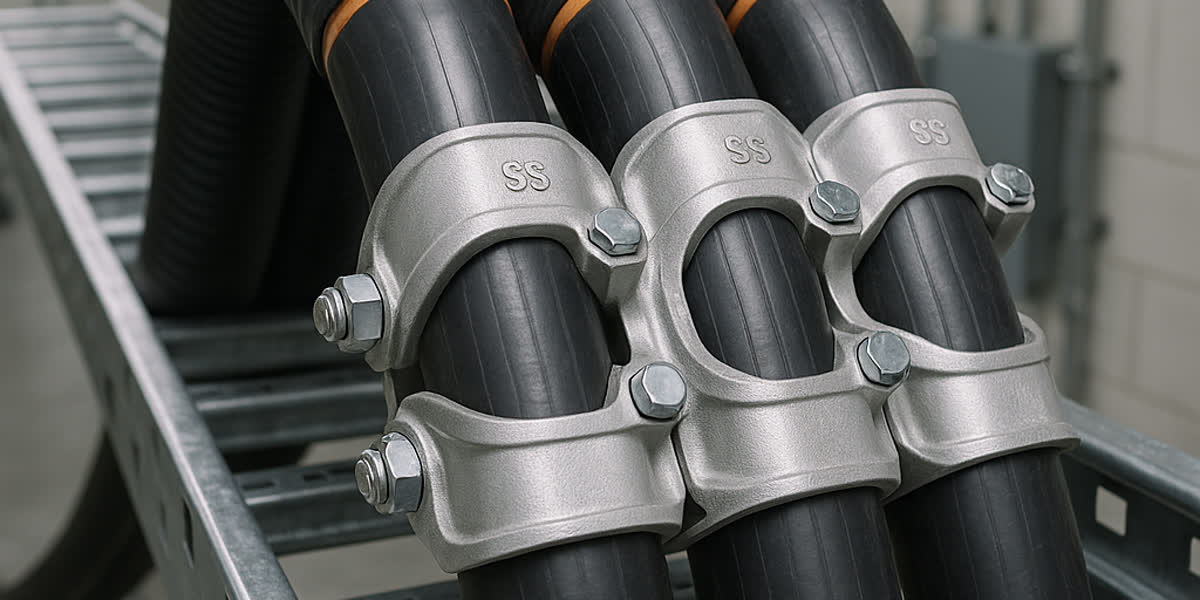
- Hardware and Cable Support: When routing SER or SEU along building exteriors or within distribution shafts, secure the cable within 12 inches of every box, cabinet, or meter enclosure, and at intervals not exceeding 4.5 feet, using approved cable staples, straps, or power line fittings and hardware designed specifically for flat and round non-metallic sheathed cable to prevent jacket pinching.
6. Manufacturing Excellence: SiTong Cable Quality Assurance
Zhengzhou Sitong Cable Co., Ltd. (SiTong Cable) produces premium Type SER and Type SEU cables engineered for harsh industrial, commercial, and residential environments across global markets.
+--------------------------------------------------------------------------------------------------+
|                         SiTong Cable Manufacturing & Quality Matrix                              |
+--------------------------------------------------------------------------------------------------+
|                                                                                                  |
|   +-----------------------+     +-----------------------+     +-----------------------+          |
|   | 1. Alloy Metallurgy   | --> | 2. Tandem Extrusion   | --> | 3. High-Voltage Spark |          |
|   | Continuous casting &  |     | Dual-layer cross-     |     | 100% in-line spark    |          |
|   | compact stranding of  |     | linking of XLPE/PVC   |     | testing to ensure     |          |
|   | AA-8030 / AA-8176.    |     | insulation & jacket.  |     | dielectric integrity. |          |
|   +-----------------------+     +-----------------------+     +-----------------------+          |
|                                                                           |                      |
|                                                                           V                      |
|   +-----------------------+     +-----------------------+     +-----------------------+          |
|   | 6. Global Export Pack | <-- | 5. Mechanical Testing | <-- | 4. Environmental Test |          |
|   | Steel-reinforced      |     | Elongation, tensile   |     | Xenon-arc UV aging,   |          |
|   | wooden reels with     |     | strength, and torque  |     | cold bend test down   |          |
|   | heat-shrink end caps. |     | retention audits.     |     | to -40 deg C.         |          |
|   +-----------------------+     +-----------------------+     +-----------------------+          |
+--------------------------------------------------------------------------------------------------+
- Precision Alloy Control: Our advanced drawing and continuous annealing lines produce AA-8000 series aluminum conductors with exceptionally tight diameter tolerances, ensuring optimal conductivity and maximum resistance to mechanical creep.
- Advanced Tandem Extrusion: Phase conductors receive uniform XLPE insulation applied via high-precision extrusion tooling, guaranteeing concentricity, high dielectric withstand, and moisture resistance that exceeds UL 854 standards.
- Rigorous Quality Testing: Every production master coil undergoes 100% in-line spark testing, conductor resistance verification, Xenon-arc UV weatherometer simulation, and cold-bend testing at -40°C to ensure zero jacket cracking during cold-weather handling.
- Integrated Cable Solutions: In addition to service entrance cables, SiTong supplies heavy-duty industrial power cable systems and transmission lines to electrical utilities, industrial EPC contractors, and international distributors worldwide.
7. Frequently Asked Questions (FAQ)
Q1: Can I use Type SEU cable to feed an electric vehicle (EV) charging station or electric range?
No. Both modern EV charging stations (Level 2 chargers) and modern electric ranges or clothes dryers require a separate equipment grounding conductor. Electric ranges operate on 120/240V, requiring two hots, one insulated neutral for 120V clock/timer circuitry, and one dedicated equipment grounding conductor to bond the metal chassis (per NEC 250.140). Because Type SEU only possesses two insulated conductors and a bare concentric neutral, using SEU would either leave the appliance frame ungrounded or illegally force neutral current onto the appliance chassis. You must use 4-conductor Type SER or individual conductors in conduit.
Q2: What is the main difference between Type SE and Type USE cables?
Type SE (Service Entrance, including SER and SEU) is designed for above-ground use, featuring a flame-retardant outer jacket suitable for indoor installation and outdoor risers. However, standard Type SE cannot be directly buried in the earth. Type USE (Underground Service Entrance) is engineered specifically for direct burial underground, featuring heavy-duty, moisture-impervious XLPE insulation without requiring an overall jacket. Conversely, standard Type USE is not flame-retardant and cannot be routed inside a building past the first service enclosure unless dual-rated as USE-2 / RHW-2.
Q3: Why does Type SER use compact stranding for its aluminum conductors?
Compact stranding compresses the round concentric strands through shaping dies, eliminating internal air voids between strands. This reduces the overall outside diameter (OD) of the conductor by 8% to 10% compared to conventional concentric stranding while maintaining the exact same cross-sectional metallic area and electrical ampacity. The smaller OD reduces the overall weight of the cable, requires less insulation and jacket material, and allows the cable to fit easily into smaller electrical knockouts and raceways.
Q4: When is Type SER permitted to be sized from the 75°C ampacity column instead of 60°C?
Type SER can be sized using the 75°C column of NEC Table 310.16 only when two conditions are met simultaneously: (1) The cable is connected to electrical equipment and terminal lugs rated and listed for 75°C or higher (marked AL9CU or AL7CU), and (2) The cable does not pass through or come into direct contact with thermal building insulation in interior wall cavities or attics (complying with NEC 338.10(B)(4)(a)).
Q5: Can Type SEU or SER cable be installed outdoors without conduit?
Yes. Both Type SER and Type SEU feature heavy-duty PVC jackets that are specifically rated as sunlight-resistant (UV-resistant). They can be surface-mounted directly to exterior building walls, such as running from an overhead weatherhead down to an outdoor meter socket, or from an outdoor meter to an interior main panel, provided they are securely fastened and protected against physical damage where required by local building codes.
Engineering Consultation & Procurement Support
Selecting between Type SER and Type SEU requires precise evaluation of system architecture, NEC grounding mandates, thermal envelope constraints, and termination hardware. Sourcing certified, code-compliant cables from an experienced manufacturer is essential to eliminate inspection delays, life-safety hazards, and costly project rework.
👉 Browse our Concentric Cable & Service Entrance product range
👉 Explore Aluminum Service Drop & ABC Cable Solutions
👉 Contact SiTong Cable Engineering Team
📬 Sales Inquiries: sales@sitongcable.com | 📞 Phone: +86-371-69176007
Zhengzhou Sitong Cable Co., Ltd. — Your Trusted Global Partner for Overhead, Distribution, and Industrial Cable Systems.