Aerial Bundled Cable (ABC) vs Bare Overhead Conductor: Complete Technical Comparison and Selection Guide
Introduction
When planning overhead power distribution infrastructure, one of the most critical decisions engineers and procurement professionals face is choosing between Aerial Bundled Cable (ABC) and traditional bare overhead conductors. Each option offers distinct technical advantages, application scenarios, and economic considerations.
Bare overhead conductors — including ACSR (Aluminum Conductor Steel Reinforced), AAC (All Aluminum Conductor), and AAAC (All Aluminum Alloy Conductor) — have a successful track record spanning over a century, prized for their low cost and straightforward installation. Aerial Bundled Cable, on the other hand, has gained rapid global adoption since the 1980s, becoming the preferred choice for urban distribution networks, rural electrification, and forested areas due to its superior safety and reliability.
This comprehensive guide provides a six-dimensional comparative analysis — covering technical specifications, electrical performance, mechanical characteristics, installation and maintenance, cost-effectiveness, and safety and environmental impact — referencing the latest international standards (IEC 60502, IEC 60228, IEC 61089, IEEE 524, BS 7870, GB/T 12527, and more) to support your project decision-making.
1. What is Aerial Bundled Cable (ABC)?
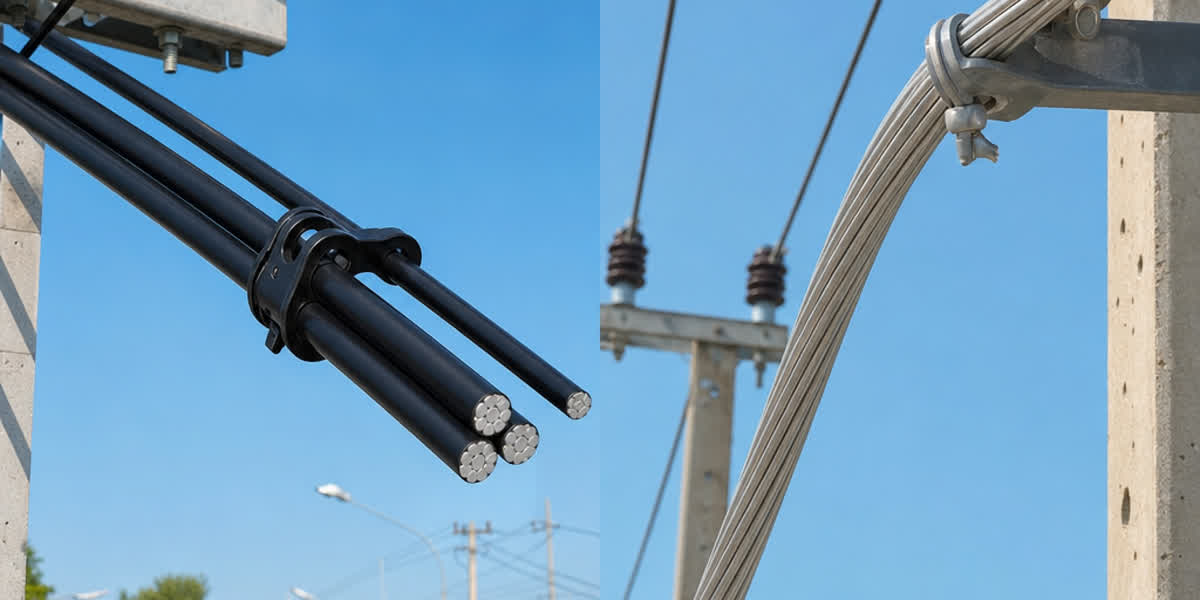
Aerial Bundled Cable (ABC) is a system of insulated conductors bundled together — either with a separate messenger/support wire or using a self-supporting design — directly installed on utility poles for overhead power distribution.
Key Standards
- IEC 60502: Power cables with extruded insulation for rated voltages 1kV to 30kV
- IEC 60228: Conductors of insulated cables
- BS 7870: LV and MV ABC cables for overhead distribution
- GB/T 12527: Overhead insulated cables for rated voltage up to 1kV
- GB/T 14049: Overhead insulated cables for rated voltage 10kV and 35kV
- NFC 33-209: French ABC cable standard (internationally recognized)
Typical Construction
| Component | Material | Function |
|---|---|---|
| Conductor | Aluminum / Aluminum Alloy (hard drawn or annealed) | Electrical conduction |
| Insulation | XLPE (Cross-linked Polyethylene) or PVC | Electrical insulation |
| Messenger/Support | Galvanized steel strand or aluminum alloy | Mechanical tension bearing |
| Bundling method | Spiral binding or parallel arrangement | Structural stability |
2. What is a Bare Overhead Conductor?
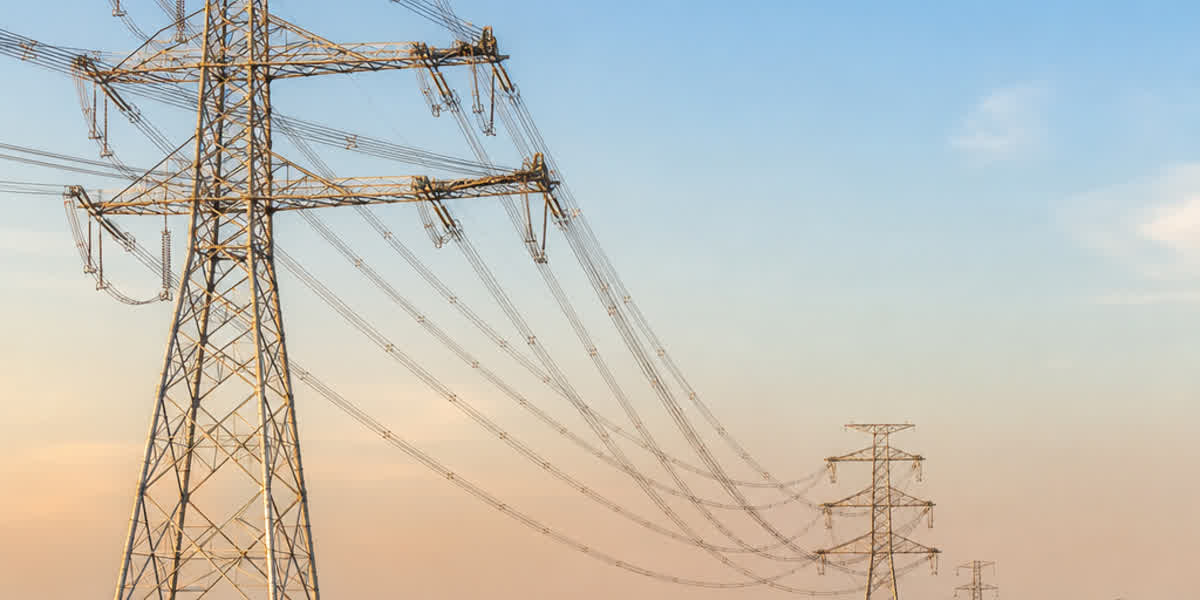
Bare overhead conductors are metal wires without any insulation, mounted on insulators and attached to poles or towers. The main types include:
- ACSR (Aluminum Conductor Steel Reinforced): Aluminum strands over a steel core — excellent conductivity combined with high strength
- AAC (All Aluminum Conductor): All-aluminum stranded — highest conductivity
- AAAC (All Aluminum Alloy Conductor): Aluminum alloy strands — higher strength than AAC
Key Standards
- ASTM B230/B231: Standard for aluminum wire and stranded aluminum conductors
- IEC 61089: Round wire concentric lay overhead electrical stranded conductors
- BS EN 50182: Conductors for overhead lines
- GB/T 1179: Round wire concentric lay overhead electrical stranded conductors
Typical Construction
| Component | Material | Function |
|---|---|---|
| Conductive layer | EC-grade aluminum / aluminum alloy | Electrical conduction |
| Reinforcing core (ACSR) | Galvanized steel wire | Mechanical tension bearing |
| Surface | Bare metal (no insulation) | Directly exposed to environment |
3. Six-Dimension Comparative Analysis
3.1 Electrical Performance Comparison
| Parameter | ABC Cable | Bare Overhead Conductor |
|---|---|---|
| Insulation withstand | 0.6/1kV ~ 12/20kV (standard) | No insulation, relies on air clearance |
| Leakage current | Minimal (blocked by insulation) | Higher (increases in rain) |
| Power loss | Lower (short distances) | Lower (large cross-sections) |
| Conductor operating temp | XLPE: 90°C (normal) / 250°C (short circuit) | Aluminum: 80-90°C (normal) |
| Capacitive current | Higher (insulation adds capacitance) | Very low |
| Lightning performance | Requires surge arresters | Naturally lightning-strike tolerant |
Key takeaway: ABC cable provides superior electrical safety in densely populated areas; bare conductors have lower capacitive losses for long-distance transmission.
3.2 Mechanical Characteristics Comparison
| Parameter | ABC Cable | Bare Overhead Conductor |
|---|---|---|
| Tensile strength | Determined by messenger wire (30-50kN typical) | Determined by steel core (ACSR up to 100kN+) |
| Min. bending radius | 6-15× outer diameter | Unrestricted (individual wires) |
| Span capability | 40-60m (typical) | 100-300m (long spans) |
| Wind load | Higher (larger diameter) | Lower (smaller diameter) |
| Ice/snow tolerance | Lower (larger diameter, heavier icing) | Better |
| Sag characteristics | Smaller sag (self-supporting) | Sag calculated based on temperature rise |
Key takeaway: Bare conductors outperform in long-span and severe weather conditions; ABC cable is ideal for shorter-span urban and rural distribution.
3.3 Installation & Maintenance Comparison
| Aspect | ABC Cable | Bare Overhead Conductor |
|---|---|---|
| Installation tools | Requires specialized stripping & jointing tools | Basic tools sufficient |
| Installation speed | Slower (stripping, jointing work) | Fast (direct stringing) |
| Pole spacing | 40-60m | 50-120m |
| Insulator requirement | Only at terminations (or insulator-free) | Pin/post insulators at every pole |
| Maintenance frequency | Low (insulation protects conductors) | Regular cleaning (bird nests, tree branches) |
| Fault location | More difficult (faults not visible) | Visual identification possible |
| Repair difficulty | Requires outage | Possible to work live (under specific conditions) |
Key takeaway: ABC cable significantly reduces maintenance workload, but installation is slower and requires more skilled labor.
3.4 Safety Performance Comparison (ABC's Core Advantage)
| Aspect | ABC Cable | Bare Overhead Conductor |
|---|---|---|
| Electrocution risk | Extremely low (insulated) | High (exposed conductors) |
| Tree clearance distance | Can contact trees (insulation permits) | Requires 1-3m clearance |
| Bird electrocution | Nearly zero | High (thousands of birds annually) |
| Electricity theft risk | Very low (tapping requires stripping) | Exists (direct hook-up) |
| Wind/storm reliability | High (insulation prevents phase-to-phase faults) | Low (conductor clashing under galloping) |
| Public safety | Pedestrians can be in close proximity | Must maintain safe distance |
Key takeaway: Safety is the single biggest advantage of ABC cable. In residential areas, schools, parks, and public spaces, ABC is the indisputable choice.
3.5 Cost-Benefit Analysis
Let's compare a typical 10km 11kV distribution network upgrade project:
| Cost Item | ABC Cable (10km) | Bare Overhead (10km) |
|---|---|---|
| Conductor material | $8,000-12,000/km | $3,000-5,000/km |
| Insulators | $500-1,000/km | $1,500-3,000/km |
| Installation labor | $4,000-6,000/km | $2,000-3,000/km |
| Annual maintenance | $200-400/km | $500-1,000/km |
| Initial investment | $12,500-19,000/km | $6,500-11,000/km |
| 5-year total cost | $13,500-21,000/km | $9,000-16,000/km |
| 10-year total cost | $14,500-23,000/km | $11,500-21,000/km |
Key takeaway: - Initial ABC investment is approximately 80-90% higher than bare conductors - However, reduced maintenance costs and fewer outage-related losses allow cost parity within 3-5 years - In scenarios demanding low maintenance and zero electrocution risk, ABC's total lifecycle cost is often lower
3.6 Environmental & Social Impact
| Aspect | ABC Cable | Bare Overhead Conductor |
|---|---|---|
| Electromagnetic field | Lower (insulation provides some shielding) | Higher |
| Visual impact | Cleaner, more aesthetically pleasing | More cluttered appearance |
| Tree trimming | Significantly reduced | Frequent trimming required |
| Wildlife protection | Protects birds from electrocution | High bird electrocution rates |
| Corona noise | Nearly none | Audible corona noise (especially in rain) |
| Right-of-way width | Narrow corridor (5-8m) | Wide corridor (15-30m) |
4. Selection Decision Guide
Prioritize ABC Cable When
- ✅ Urban and residential distribution: Limited safe clearance, high population density
- ✅ Forested areas and parks: Tree contact with lines is unavoidable
- ✅ Coastal and high-pollution zones: Insulation protects conductors from corrosion
- ✅ Wildlife conservation areas: Protection of birds from electrocution
- ✅ Around schools and hospitals: High reliability requirements, strict safety standards
- ✅ Right-of-way constraints: City space optimization
Prioritize Bare Overhead Conductors When
- ✅ Long-distance transmission lines (>50km): Clear cost advantage
- ✅ Remote rural lines: Maintenance access difficult, needs robust solution
- ✅ High-altitude and heavy-icing regions: Bare conductors handle ice better
- ✅ Long-span lines (>200m): Superior mechanical performance
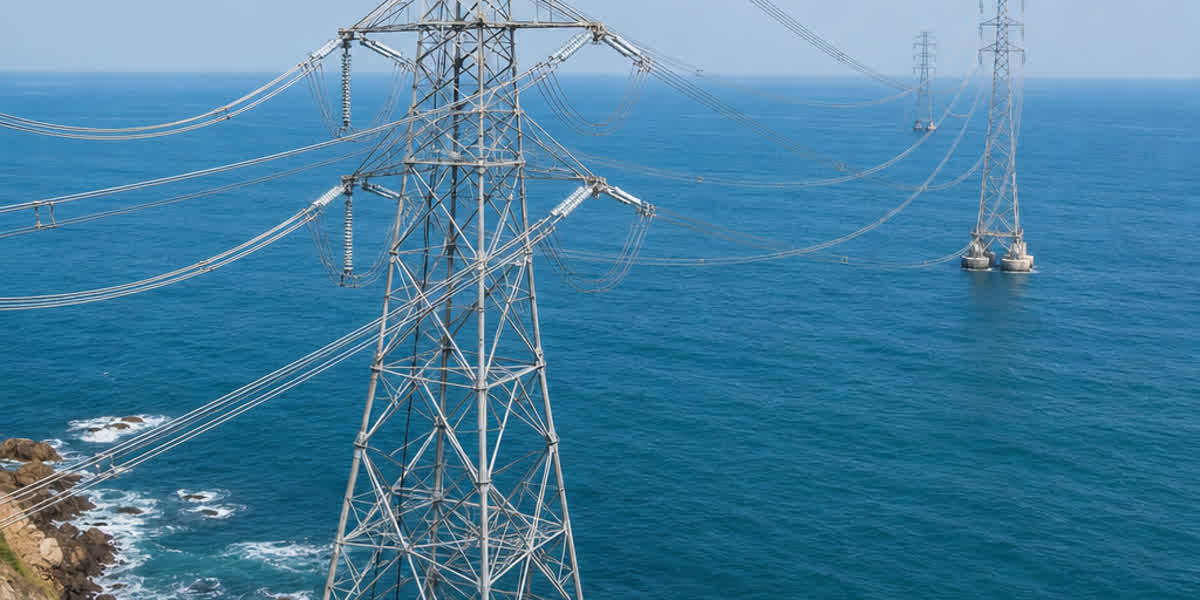
- ✅ EHV transmission (110kV and above): Only bare conductor option exists
- ✅ Low-cost basic electrification: Minimize initial investment
Decision Flowchart
Project Requirements Analysis
│
├── Voltage > 35kV? ──→ Choose Bare Conductor
│
├── Span > 200m? ──→ Choose Bare Conductor
│
├── Line passes through forest/residential area? ──→ Choose ABC Cable
│
├── Limited maintenance team? ──→ Prioritize ABC Cable
│
└── Budget-constrained? ──→ Bare Conductor (but calculate 5-year TCO)
5. Technical Specifications Reference
Common ABC Cable Specifications
| Type | Conductor (mm²) | Voltage (kV) | Current Rating (A) | OD (mm) | Weight (kg/km) |
|---|---|---|---|---|---|
| ABC 4×16 | 16 | 0.6/1 | 85 | 12×19 | 350 |
| ABC 4×25 | 25 | 0.6/1 | 110 | 14×22 | 480 |
| ABC 4×35 | 35 | 0.6/1 | 135 | 15×24 | 600 |
| ABC 4×50 | 50 | 0.6/1 | 165 | 17×27 | 770 |
| ABC 4×70 | 70 | 0.6/1 | 205 | 19×30 | 980 |
| ABC 4×95 | 95 | 0.6/1 | 250 | 21×34 | 1,250 |
| ABC 3×50+54.6 | 50+54.6 | 12/20 | 165 | 22×35 | 1,100 |
| ABC 3×95+54.6 | 95+54.6 | 12/20 | 250 | 26×42 | 1,600 |
Equivalent Bare Conductor Specifications
| Type | Cross-section (mm²) | DC Resistance (Ω/km, 20°C) | Current Rating (A) | OD (mm) | Weight (kg/km) |
|---|---|---|---|---|---|
| ACSR 16/2.5 | 18.5 | 1.811 | 105 | 5.4 | 61 |
| ACSR 25/4 | 29.5 | 1.131 | 140 | 6.9 | 98 |
| ACSR 35/6 | 41.2 | 0.823 | 175 | 8.2 | 136 |
| ACSR 50/8 | 58.1 | 0.595 | 210 | 9.7 | 196 |
| ACSR 70/10 | 80.6 | 0.422 | 260 | 11.4 | 270 |
| ACSR 95/15 | 109.5 | 0.307 | 315 | 13.3 | 369 |
| ACSR 120/20 | 138.1 | 0.242 | 370 | 15.0 | 464 |
6. Frequently Asked Questions (FAQ)
Q1: Can ABC cable be installed on existing bare conductor routes?
A: Yes. ABC cable termination hardware is compatible with standard insulators, allowing direct replacement. However, consider whether pole spacing needs adjustment — ABC requires shorter spans than bare conductors.
Q2: How long does ABC cable last?
A: Under normal conditions, XLPE-insulated ABC cable has a design life of 30-40 years. Actual lifespan depends on installation quality, environmental conditions, and load factors. Bare conductors in non-corrosive environments can last 40-50 years.
Q3: Can ABC cable be used for submarine installations?
A: No. ABC cable is designed exclusively for overhead aerial installation. Submarine applications require specially designed water-blocking armored cables such as XLPE-insulated HYJXF-type submarine cables.
Q4: How does ABC cable perform under lightning strikes?
A: ABC cable insulation can withstand moderate lightning-induced overvoltages, but direct strikes can puncture the insulation. Surge arresters are recommended, especially in regions with high isokeraunic levels.
Q5: Does ABC cable accumulate more ice than bare conductors?
A: Yes. ABC cable's larger outer diameter presents a larger ice-catching surface. In heavy-icing regions (annual average ice thickness >10mm), bare conductors or specialized anti-icing ABC cables are recommended.
Q6: How to select the messenger wire size for ABC cable?
A: Messenger wire cross-section depends on span length and weather conditions. General guidelines: - Spans <40m: Minimum 25mm² messenger - Spans 40-60m: Minimum 35mm² messenger - Spans >60m: Requires special engineering design
Q7: What's the difference between XLPE and PVC insulation in ABC cables?
A: XLPE (Cross-linked Polyethylene) offers higher temperature rating (90°C vs 70°C), better electrical properties, and longer service life than PVC (Polyvinyl Chloride). XLPE is the preferred insulation for overhead insulated cables; PVC is only used in low-voltage, low-demand applications.
Q8: What should I consider when importing ABC cables?
A: Key considerations: 1. Standard compliance: Confirm whether IEC, BS, or local standards apply 2. Voltage rating: Verify system voltage matches cable rated voltage 3. Environmental adaptation: UV protection for tropical regions, low-temperature flexibility for cold climates 4. Packaging: ABC cables are typically shipped on wooden drums; ensure moisture protection for sea freight
7. Internal Links & Related Products
We offer a complete product range of ABC cables and bare overhead conductors:
- Aerial Bundled Cable (ABC) Products — Full ABC cable range, 0.6/1kV to 12/20kV
- ACSR Conductor Products — 16mm² to 800mm² complete range
- AAC Conductor Products — High-conductivity overhead conductors
- AAAC Conductor Products — High-strength aluminum alloy conductors
8. Conclusion
Aerial Bundled Cable (ABC) and bare overhead conductors each have optimal application scenarios — there is no universal "best solution":
- ABC Cable excels in safety, reliability, and low maintenance — the top choice for urban distribution, forest routes, and residential areas
- Bare Overhead Conductors remain irreplaceable for long-distance transmission, long spans, and severe weather conditions
For specific project requirements, we recommend a holistic evaluation considering voltage level, span length, environmental conditions, safety requirements, budget constraints, and total lifecycle cost.
SiTong Cable brings over 15 years of manufacturing expertise in both ABC cables and bare overhead conductors, strictly adhering to IEC, BS, ASTM, and other international standards. We provide high-quality power conductor products and professional technical consulting services to customers worldwide.
Contact us for quotations and detailed technical data sheets.
References: IEC 60502, IEC 60228, IEC 61089, IEEE 524, BS 7870, GB/T 12527, GB/T 14049, ASTM B230/B231, ASTM B232