OPGW (Optical Ground Wire) Complete Technical Guide: Standards, Selection & Engineering Practice
OPGW (Optical Ground Wire) Complete Technical Guide: Standards, Selection & Engineering Practice
1. Introduction
OPGW (Optical Ground Wire) is a specialized overhead cable that integrates optical fiber communication within a metallic earth/ground wire structure. It serves dual purposes: providing lightning protection and grounding for transmission lines (replacing conventional overhead ground wires) while simultaneously delivering high-bandwidth communication channels. Since its first commercial deployment in the 1980s, OPGW has become the backbone transmission medium for global power utility communication networks, extensively deployed in EHV/HV transmission lines, smart grid infrastructure, SCADA systems, and power dispatch communications.
This guide is intended for power system engineers, telecommunication planners, and transmission line procurement specialists. It covers international standards, structural types, selection methodology, installation practices, and engineering application considerations.
2. OPGW Overview & Applications
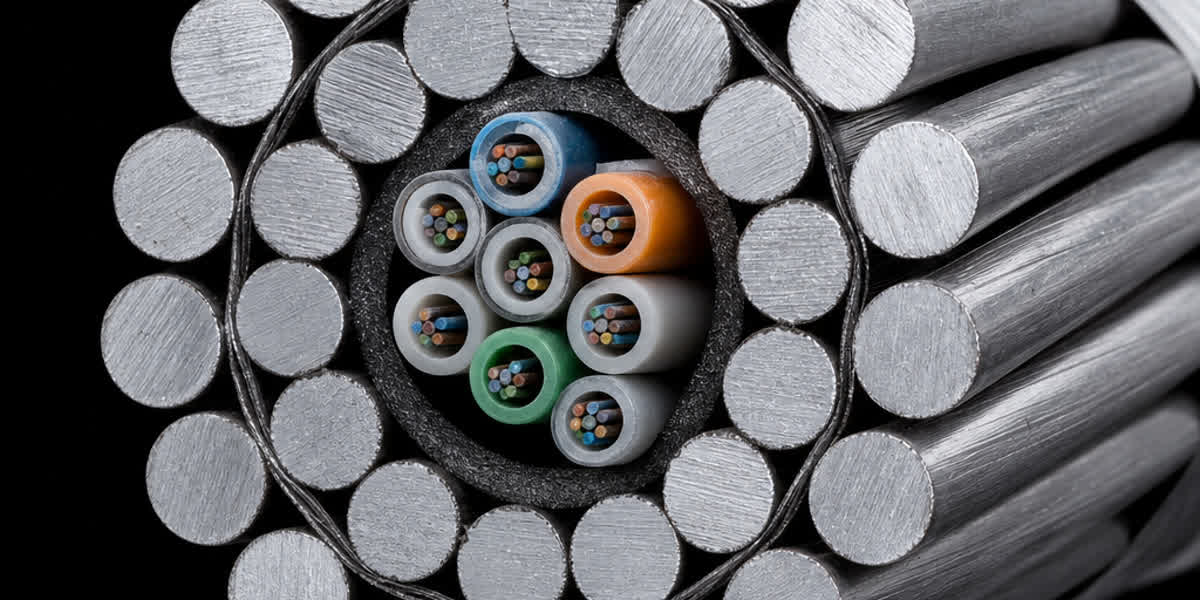
The core structure of OPGW consists of three main components: the optical fiber unit (typically housed in a stainless steel or aluminum tube), the load-bearing strands (aluminum-clad steel or aluminum alloy wires), and the outer layer strands (providing mechanical protection and electrical performance). Standard fiber types are G.652 single-mode fiber (SMF) and G.655 dispersion-shifted fiber (DSF), with fiber counts ranging from 12 to 96 fibers.
Application Reference Table
| Application | Voltage Rating | Fiber Count | Recommended Structure |
|---|---|---|---|
| EHV Transmission Lines | 220kV-1000kV | 24-72 fibers | Aluminum tube central loose tube with aluminum-clad steel |
| HV Transmission Lines | 110kV-220kV | 12-48 fibers | Stainless steel tube central loose tube |
| Medium Voltage Distribution | 35kV-110kV | 12-24 fibers | Stranded loose tube |
| Smart Grid Backbone | All voltages | 48-96 fibers | Aluminum tube stranded loose tube |
| Cross-regional Power Dispatch | 330kV and above | 24-72 fibers | Stainless steel tube central loose tube |
| Wind/Solar Farm Grid Connection | 35kV-220kV | 12-36 fibers | Stainless steel tube loose tube |
| Urban Grid Automation | 110kV and below | 12-24 fibers | Micro OPGW |
3. International Standards Reference Table
| Standard | Title / Scope | Key Parameters |
|---|---|---|
| IEEE 1138 | Testing and Performance for OPGW (USA) | Electrical, mechanical, fiber optic test methods |
| IEC 60794-4-10 | Optical fibre cables for power lines — OPGW sectional specification (International) | Structural, mechanical, environmental, electrical requirements |
| IEC 60794-1-2 | Basic optical fibre cable testing methods (International) | OTDR, attenuation, temperature cycling |
| ASTM B415 | Aluminum-Clad Steel Wire (USA) | Conductivity, tensile strength, elongation |
| ASTM B498 | Zinc-Coated (Galvanized) Steel Core Wire (USA) | Zinc coating weight, diameter tolerance |
| ASTM B609 | 1350-H19 Aluminum Alloy Wire (USA) | Conductivity ≥61% IACS |
| IEC 61089 | Round wire concentric lay overhead electrical stranded conductors (International) | Stranding construction, tolerances |
| CIGRE TB 308 | OPGW Installation Guide (International Council on Large Electric Systems) | Installation tension, bending radius, clamp design |
| GB/T 7424.4 | OPGW National Standard (China) | Structural requirements, test methods |
| DL/T 832 | OPGW Electric Power Industry Standard (China) | Engineering application code |
💡 Project Tip: International tenders (World Bank, ADB-financed) typically require compliance with both IEEE 1138 and IEC 60794-4-10. Chinese domestic projects shall comply with DL/T 832 and GB/T 7424.4.
4. OPGW Structure & Specification Tables
4.1 Structural Classification
| Structure Type | Fiber Protection | Typical OD | Typical RTS (kN) | Application |
|---|---|---|---|---|
| Central Loose Tube | Fibers in stainless steel tube at core | 10-16 mm | 50-100 | Light ice zone, low-tension lines |
| Stranded Loose Tube | Multiple loose tubes around central FRP | 12-18 mm | 70-130 | Heavy ice zone, high-tension lines |
| Aluminum Tube Central | Fibers in aluminum tube, outer strands | 11-17 mm | 60-120 | EHV, high-current lines |
| Slotted Core | Fibers in slotted polymer core | 13-20 mm | 80-150 | High fiber count (72+) |
| Micro OPGW | Compact design | 6-10 mm | 25-45 | Distribution, space-constrained |
4.2 Common Specification Table
| Type | Fiber Count | Layer | OD (mm) | Weight (kg/km) | RTS (kN) | DC Resistance @20°C (Ω/km) | Short-circuit Capacity (kA²s) |
|---|---|---|---|---|---|---|---|
| OPGW-48-AL-90 | 48 | Al tube central | 14.5 | 490 | 90 | 0.31 | 120 |
| OPGW-24-SS-70 | 24 | SS tube central | 12.8 | 380 | 70 | 0.42 | 80 |
| OPGW-72-AL-120 | 72 | Al tube stranded | 16.8 | 620 | 120 | 0.26 | 180 |
| OPGW-36-SS-100 | 36 | SS tube stranded | 15.2 | 510 | 100 | 0.33 | 140 |
| OPGW-12-SS-50 | 12 | SS tube central | 10.5 | 280 | 50 | 0.55 | 50 |
| OPGW-96-AL-150 | 96 | Slotted core | 19.5 | 780 | 150 | 0.22 | 220 |
💡 Selection Note: RTS (Rated Tensile Strength) is the most critical mechanical parameter for OPGW. It must exceed the maximum design tension (including ice load) divided by the safety factor. Short-circuit capacity (kA²s) shall match or exceed the line's short-circuit current level with a minimum margin of 1.2.
5. Selection Methodology
Step 1: Determine Electrical Parameters
| Parameter | Source | Typical Range |
|---|---|---|
| Rated Voltage (kV) | System design | 110-1000 |
| Short-circuit Current (kA) | System calculation | 10-63 |
| Fault Duration (s) | Protection configuration | 0.1-0.5 |
| Short-circuit Capacity (kA²s) | I²×t calculation | 10-220 |
| Max Continuous Current (A) | Ground + induced current | 100-600 |
| Grounding System Type | Design documents | Solid/resonant grounded |
Condition: I_OPGW² × t ≥ I_system² × t (minimum margin factor: 1.2)
Step 2: Determine Mechanical Parameters
| Parameter | Description |
|---|---|
| Span Length (m) | Typical 200-600m; long-span up to 1500m |
| Safety Factor | Typically 2.5-3.0 (including ice load) |
| Max Design Wind Speed (m/s) | Per local meteorology, typically 28-40 |
| Ice Thickness (mm) | Light zone 5-10mm; heavy zone 15-30mm |
| Annual Average Temperature (°C) | Site-specific annual average |
| Temperature Range (°C) | -40°C to +80°C |
📐 Quick Rule: For standard 220kV double-circuit lines (400m span, no ice), OPGW shall have RTS ≥ 70kN and short-circuit capacity ≥ 80 kA²s.
Step 3: Determine Fiber Parameters
| Parameter | Recommended Value | Notes |
|---|---|---|
| Fiber Type | G.652D (SMF) | Supports 10G/100G transmission |
| Fiber Count | 1.2×(near-term + 3-5yr expansion) | Minimum 24; 48 is current standard |
| Attenuation | ≤0.22 dB/km @ 1550nm | Standard G.652D specification |
| Dispersion | ≤18 ps/(nm·km) @ 1550nm | Standard G.652D specification |
| PMD | ≤0.2 ps/√km | Compliant with 40G/100G systems |
Step 4: Verify Electrical Performance
| Check Item | Requirement | Formula |
|---|---|---|
| DC Resistance | ≤ substitute ground wire resistance | R_OPGW = ρ/A_metal |
| Short-circuit Temperature Rise | ≤ aluminum-clad steel limit (typically 300°C) | ΔT = I²t / (C×A²) |
| Ground Impedance | Per system grounding requirement | Z = √(R² + X_L²) |
Step 5: Comprehensive Evaluation
| Weight | Dimension | OPGW Advantage | vs. Conventional Ground Wire + ADSS |
|---|---|---|---|
| High | Function Integration | One ground wire + one communication path | Two separate installations |
| High | Reliability | Fiber protected by metal, 30+ year life | ADSS prone to electrical tracking |
| Medium | Installation Complexity | Requires specialized hardware + tension stringing | Similar to ground wire + fiber splicing |
| Medium | Cost | Higher upfront than ground wire alone | Lower lifecycle cost (no separate telecom towers) |
6. Installation Practices & Specifications
6.1 Stringing
| Operation | Requirement | Standard Reference |
|---|---|---|
| Stringing Tension | ≤15% RTS | IEEE 1138 |
| Bending Radius (installation) | ≥40× OPGW OD | IEC 60794-4-10 |
| Bending Radius (in-service) | ≥25× OPGW OD | IEC 60794-4-10 |
| Pulling Speed | ≤0.5 m/s | CIGRE TB 308 |
| Pulling Length | ≤3km per section | Engineering design |
| Pre-tension | 2-3% RTS for 24 hours | IEEE 1138 |
6.2 Hardware & Accessories
| Component | Purpose | Standard |
|---|---|---|
| Tension Clamp | Dead-end / angle tower fixing | IEEE 1138, IEC 61284 |
| Suspension Clamp | Tangent tower support | IEEE 1138, IEC 61284 |
| Vibration Damper | Aeolian vibration suppression | IEEE 1138, IEC 61897 |
| Splice Box | Fiber splicing protection | IEC 60794-4-10 |
| Ground Down-lead | Tower-to-ground connection | Design code |
| Cable Coil Bracket | Spare cable storage on tower | Tower hardware |
⚠️ Warning: Never apply axial tension to the optical fiber unit during OPGW installation. Fiber splicing shall be monitored end-to-end by OTDR, with single splice loss not exceeding 0.1 dB.
6.3 Inspection & Acceptance
| Inspection Item | Method | Acceptance Criteria |
|---|---|---|
| Visual Inspection | Visual check | No damage, scratches, or loose strands |
| Fiber Attenuation | OTDR | ≤ design + 0.1 dB/km |
| Tension Test | Tension gauge | Compliant with design tension |
| Ground Resistance | Ground resistance tester | ≤ design value |
| Short-circuit Thermal Stability | Type test (pre-qualified) | Temperature rise ≤ allowable limit |
7. Case Study: 330kV Wind Farm OPGW Selection
Project Background: 2GW wind farm in Northwest China, 330kV transmission line, 95km total length, double-circuit configuration, 220 towers, max span 520m, traversing Class IV heavy ice zone (30mm ice), design wind speed 32m/s.
Project Parameters
| Parameter | Value |
|---|---|
| Voltage Level | 330kV |
| Line Length | 95km |
| Circuits | Double-circuit (two OPGW paths) |
| Fiber Requirement | 48 fibers (dispatch + wind monitoring + future redundancy) |
| Short-circuit Capacity | 168 kA²s (system-calculated) |
| Max Span | 520m |
| Ice Load | 30mm (heavy ice zone) |
| Thunderstorm Days | 40 days/year |
Option Comparison
| Parameter | Option A: OPGW-48-AL-120 | Option B: OPGW-48-SS-130 |
|---|---|---|
| Structure | Aluminum tube central | SS tube stranded |
| OD | 16.8 mm | 15.8 mm |
| RTS | 120 kN | 130 kN |
| Short-circuit Capacity | 180 kA²s | 150 kA²s |
| Unit Weight | 620 kg/km | 550 kg/km |
| Fiber Attenuation | 0.22 dB/km | 0.22 dB/km |
Recommended Solution: Option A (OPGW-48-AL-120)
- Short-circuit capacity 180 kA²s > system requirement 168 kA²s — margin satisfied ✅
- Aluminum tube structure offers better short-term overload capacity in heavy ice zones ✅
- RTS 120 kN meets mechanical requirements for 520m span with 30mm ice load ✅
8. Environmental & Durability Considerations
| Factor | Recommended Measure | Rationale |
|---|---|---|
| Coastal Salt Fog Corrosion | Use aluminum-clad steel wire (≥20% IACS) instead of galvanized steel | 3-5× longer corrosion life in salt spray |
| Industrial Pollution (acid rain) | Aluminum alloy outer strands | Better acid/caustic corrosion resistance than steel |
| Heavy Ice Zone | SS tube stranded structure + ice shedding rings | Higher fiber safety margin under ice |
| High Wind Area | Additional vibration dampers (2-3 sets per span) | Suppress aeolian vibration fatigue |
| High Lightning Area | Select short-circuit capacity adequately | Ensure fiber integrity after lightning strikes |
| Seismic Zone | Increase sag allowance, use spiral vibration dampers | Improved seismic performance |
| High Altitude (>3000m) | Low-temperature fiber gel and materials | Fiber excess attenuation ≤0.05 dB/km below -40°C |
9. FAQ
Q1: What is the difference between OPGW and ADSS cable? A1: OPGW is a metallic stranded structure combining grounding and communication. It is installed at the top of transmission towers, replacing the conventional ground wire position. ADSS (All-Dielectric Self-Supporting) cable has no metallic components and is installed below the phase conductors. OPGW is suitable for new lines and ground wire replacement; ADSS is used for capacity expansion on existing lines.
Q2: What is the maximum continuous manufacturing length of OPGW? A2: Limited by fiber drawing and stranding processes, the maximum manufacturing length per section is typically 3-6km, depending on fiber count and cable diameter. Longer runs require splice box connections.
Q3: What is the service life of OPGW? A3: The design life is typically 30 years. Fiber units can last 30+ years (fiber itself has negligible aging). The metallic strands' life depends on corrosion protection and environmental conditions — aluminum-clad steel has a corrosion rate of approximately 0.1-0.3 μm/year in normal environments.
Q4: Can OPGW replace conventional ground wire (GJ-50/GJ-80)? A4: Yes — this is OPGW's primary design purpose. However, verify before replacement: ① short-circuit capacity ≥ original design; ② RTS ≥ original ground wire; ③ outer diameter change should not significantly alter wind/ice loads. OPGW typically meets or exceeds GJ-50/GJ-80 performance.
Q5: What are the most common quality issues during OPGW installation? A5: Main issues: ① fiber strain during stringing causing increased attenuation; ② splice box water ingress degrading fiber performance; ③ improper vibration damper quantity/position causing fatigue strand breakage. Mitigation: full OTDR monitoring, IP68-rated splice boxes, and IEEE 1138 vibration design compliance.
Q6: Can damaged OPGW fiber units be repaired? A6: Fiber units damaged during manufacturing cannot be repaired (the entire section must be scrapped). During installation/operation, broken fibers can be spliced via splice boxes. Broken metallic strands can be repaired with repair sleeves, but if strand breakage exceeds 15% of the cross-section at one point, the entire section must be replaced.
Q7: What are the typical power system communication applications for OPGW? A7: Primary applications: ① protection signaling (current differential protection, distance protection); ② SCADA/EMS data acquisition and monitoring; ③ dispatch and administrative telephony; ④ power market transaction data; ⑤ video surveillance and online monitoring data backhaul; ⑥ smart grid advanced metering infrastructure (AMI) data transmission.
Q8: How to balance short-circuit capacity and tensile strength in OPGW selection? A8: Both parameters are generally proportional to metallic cross-sectional area. Increasing the area enhances both but adds weight and diameter, increasing tower loads and sag. Recommended approach: use short-circuit capacity as the constraint, select the minimum section that satisfies it, then verify RTS meets mechanical requirements. If RTS is insufficient, upgrade individual wire strength (e.g., from standard aluminum-clad steel to high-strength aluminum-clad steel).
For complete OPGW technical data sheets or engineering selection support, contact our technical team.
10. Conclusion
OPGW is a core component of power system communication infrastructure. Correct selection requires comprehensive consideration of electrical parameters (short-circuit capacity, resistance), mechanical parameters (RTS, span, ice/wind loads), fiber parameters (count, attenuation, dispersion), and installation environment (salt fog, pollution, seismic, altitude). Adherence to international standards (IEEE 1138, IEC 60794-4-10, CIGRE TB 308) and proper construction practices ensures 30-year reliable operation.
SiTong Cable offers a full range of OPGW products, including central loose tube, stranded loose tube, aluminum tube central, and slotted core structures, with fiber counts from 12 to 96 cores, manufactured to IEC, IEEE, ASTM, GB/T, and DL/T standards. Our engineering team provides line mechanics calculation, short-circuit verification, and fiber link design services.
👉 Browse our OPGW product range 👉 Contact our technical team for selection support
This guide was prepared by the SiTong Cable engineering team. All technical data references IEEE 1138, IEC 60794-4-10, CIGRE TB 308, DL/T 832 and related international standards.