Fire-Resistant & Flame-Retardant Low-Smoke Zero-Halogen (LSZH) Cables: IEC 60331 vs BS 6387 CWZ Standards, Mica Barrier Technology & Critical Circuit Engineering
Fire-Resistant & Flame-Retardant Low-Smoke Zero-Halogen (LSZH) Cables: IEC 60331 vs BS 6387 CWZ Standards, Mica Barrier Technology & Critical Circuit Engineering
In modern infrastructure engineering—spanning underground transit tunnels, high-rise commercial complexes, international airports, data centers, and industrial processing plants—fire safety is not merely a regulatory checkbox; it is the ultimate determinant of life preservation and asset survival. When a catastrophic fire erupts, electrical power and signal cables must not serve as secondary fuel vectors that propagate flames across fire zones, nor can they release corrosive, dense, and suffocating toxic gases. More critically, vital emergency systems—such as fire sprinkler booster pumps, smoke extraction fans, emergency evacuation lighting, pressurization dampers, and public address communication networks—must maintain uncompromised circuit integrity directly through active thermal combustion. Achieving this dual mandate requires a deep technical understanding of Fire-Resistant (FR/FS) and Flame-Retardant Low-Smoke Zero-Halogen (LSZH / LSOH / HFFR) power cable and control cable systems.
This comprehensive technical guide provides electrical design engineers, MEP consultants, EPC contractors, and procurement directors with an authoritative analysis of fire-rated cable engineering. We examine the fundamental distinctions between flame retardance and fire resistance, evaluate international testing regimes including IEC 60331, BS 6387 Category CWZ, EN 50200, and UL 2196, explore synthetic phlogopite mica tape barrier mechanics, detail zero-halogen polymer chemistry, and outline best practices for mechanical installation, glanding, cleating, and terminations.
1. Fundamental Distinction: Flame Retardance vs. Fire Resistance (Circuit Integrity)
One of the most persistent and hazardous misconceptions in electrical engineering specifications is the conflation of "Flame Retardant" (FR) and "Fire Resistant" (FS / Circuit Integrity). These two performance criteria address completely different physical phenomena and operational objectives during a fire incident.
+---------------------------------------------------------------------------------------------------+
|                               FIRE CLASSIFICATION HIERARCHY                                      |
+----------------------------------------------------+----------------------------------------------+
| FLAME RETARDANT (Self-Extinguishing)               | FIRE RESISTANT (Circuit Integrity)           |
| • Standard: IEC 60332-1, IEC 60332-3 (Cat A/B/C)   | • Standard: IEC 60331-21, BS 6387 (CWZ)      |
| • Objective: Prevents fire propagation along bunch | • Objective: Maintains power/signal flow in  |
| • Operational State: Cable DE-ENERGIZES / Burns out|   active combustion (750°C - 950°C)          |
| • Physical Mechanism: Char formation & ATH/MDH     | • Operational State: ENERGIZED & FUNCTIONAL  |
| • Primary Layer: Sheath & bedding flame chemistry  | • Physical Mechanism: Inorganic Mica Barrier |
+----------------------------------------------------+----------------------------------------------+
1.1 Flame Retardant Cables (IEC 60332 Series)
Flame-retardant cables are designed to resist the ignition and spread of fire along the cable run. When exposed to an external flame source, the cable's organic outer sheath and insulation decompose, releasing flame-inhibiting endothermic gases and forming a protective carbonaceous char. Crucially, once the external ignition source is removed, a flame-retardant cable must self-extinguish within a standardized distance.
However, flame-retardant cables do NOT maintain electrical function during a fire. The polymeric insulation decomposes rapidly once temperatures exceed 200°C to 300°C, resulting in phase-to-phase or phase-to-ground short circuits and immediate circuit trip-out.
- IEC 60332-1-2: Single insulated vertical wire/cable flame propagation test (1 kW premixed flame).
- IEC 60332-3-22 (Category A): Bunched cables mounted vertically on a test ladder with 7 liters of combustible organic material per meter, subjected to a 20.5 kW ribbon burner for 40 minutes. Maximum permissible char height is ≤ 2.5 meters.
- IEC 60332-3-23 / 24 (Categories B & C): Bunched vertical tests with 3.5 L/m (Cat B) and 1.5 L/m (Cat C) of combustible non-metallic volume.
1.2 Fire-Resistant / Circuit Integrity Cables (IEC 60331 & BS 6387)
Fire-resistant cables are specifically engineered to maintain continuous electrical energization and signal transmission under direct flame impingement at temperatures ranging from 750°C to beyond 950°C for durations of 60 to 180 minutes. Even after the outer polymeric sheath, bedding, and primary insulation have completely incinerated into ash, a specially designed inorganic dielectric barrier preserves electrical isolation between conductors.
These cables are mandated for primary life-safety circuits: 1. Firefighting water pumps and booster systems 2. Smoke evacuation, stairwell pressurization, and exhaust fans 3. Emergency voice alarm communication systems (EVACS) and fire alarm loops 4. Emergency egress lighting and illuminated exit signage 5. Firefighter operational lifts and emergency elevator feeders
2. Comprehensive Standards Comparison Matrix
To specify cables accurately for international projects, engineers must navigate competing standards bodies (IEC, BSI, CENELEC, NFPA/UL). The table below details the testing severity and operational parameters across major global fire standards.
| Standard Designation | Test Temperature (°C) | Flame Duration (min) | Water Spray Exposure | Mechanical Shock / Impact | Rated Voltage Application | Primary Geographic Scope |
|---|---|---|---|---|---|---|
| BS 6387 Category C | 950°C ± 40°C | 180 min | No | No | Up to 600/1000 V | UK, Middle East, Southeast Asia, Commonwealth |
| BS 6387 Category W | 650°C ± 40°C | 15 min flame + 15 min flame & water | Yes (Direct water deluge) | No | Up to 600/1000 V | Global Marine, Underground, High-Rise |
| BS 6387 Category Z | 950°C ± 40°C | 15 min (Z-bar impact every 30s) | No | Yes (Mechanical hammer strike) | Up to 600/1000 V | Heavy Industry, Power Plants, Mass Transit |
| IEC 60331-21 / 23 / 25 | 750°C + 50°C | 90 min + 15 min cooling | No | No | 0.6/1kV Power, Control & Optical | International (IEC markets) |
| IEC 60331-1 / 2 | 830°C + 40°C | 90 min + 15 min cooling | No | Yes (Shock bar every 5 min, for cable OD > 20mm & ≤ 20mm) | 0.6/1kV Power & Control | International Modern Revision |
| EN 50200 (PH 120) | 842°C (Standard time-temp curve) | 120 min | Optional (Annex E water spray) | Yes (Mechanical shock every 5 min) | Small diameter cables (≤ 20mm) | European Union / CENELEC |
| UL 2196 / ASTM E119 | Up to 1010°C (Furnace curve) | 120 min (2-Hour Fire Rating) | Yes (High-pressure fire hose stream test) | Yes (Structural load & furnace expansion) | Building Wire & Power Systems | North America (NEC Article 695 & 700) |
                       BS 6387 PROTOCOL CWZ SEVERITY SPECTRUM
   +---------------------------------------------------------------------------------+
   | CATEGORY C: Extreme Thermal Stress (950°C Pure Flame for 3 Hours)                |
   +---------------------------------------------------------------------------------+
   | CATEGORY W: Thermal + Direct Firefighter Water Deluge (650°C Flame + Water Spray)|
   +---------------------------------------------------------------------------------+
   | CATEGORY Z: Thermal + Structural Collapse Simulation (950°C Flame + Shock Hammer)|
   +---------------------------------------------------------------------------------+
   * SiTong Cable designs full BS 6387 CWZ compliant cables surviving all 3 protocols.
3. Structural Anatomy & Advanced Material Engineering
Constructing a cable that withstands 950°C direct flame, mechanical building collapse vibrations, high-pressure water deluge, and 1000V operational dielectric stress requires meticulous multi-layer engineering.
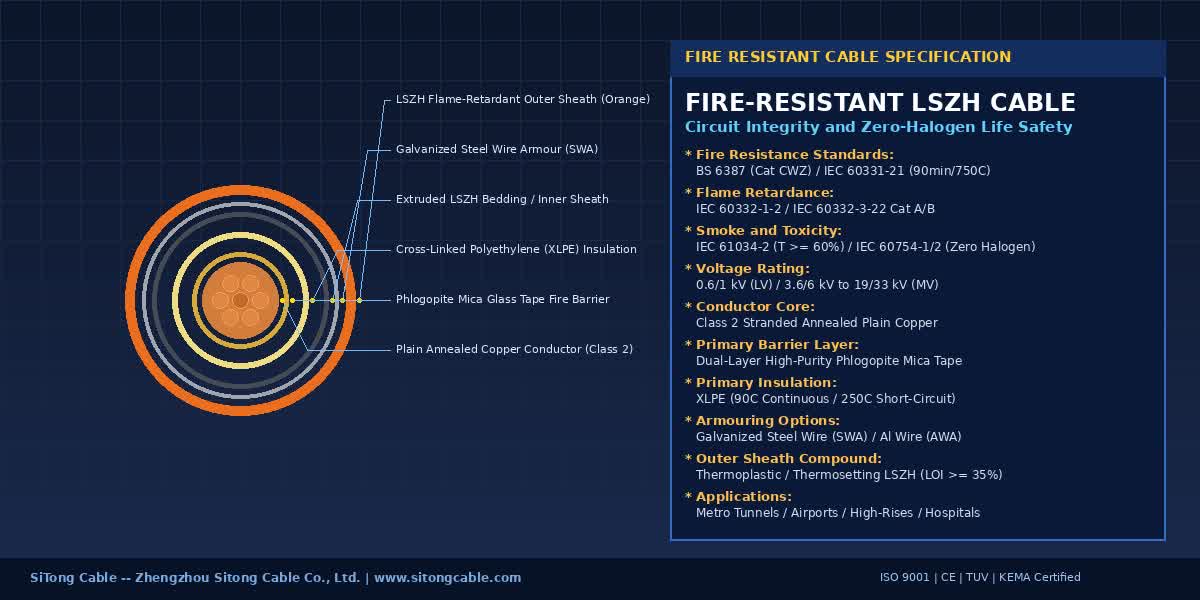
                               CABLE CROSS-SECTION ANATOMY

               [=============================================]  (1) LSZH Outer Sheath (Orange)
                [===========================================]   (2) Galvanized Steel Wire Armour (SWA)
                 [=========================================]    (3) Extruded LSZH Bedding / Inner Sheath
                  [=======================================]     (4) Cross-Linked Polyethylene (XLPE)
                   [=====================================]      (5) Dual-Layer Phlogopite Mica Glass Tape
                    ( * * * * * * * * * * * * * * * * * )       (6) Class 2 Plain Annealed Stranded Copper
3.1 Conductor: Plain Annealed Electrolytic Copper (IEC 60228)
SiTong Cable utilizes high-purity (≥ 99.99%) electrolytic tough pitch (ETP) or oxygen-free copper conductors complying with IEC 60228 Class 2 (compacted circular or shaped stranded) or Class 5 (flexible stranded for vibration-prone environments).
Copper melting point is 1085°C. At standard BS 6387 Cat C test conditions (950°C), copper operates within 135°C of its liquidus phase. Stranding geometry and precision pitch control are vital to prevent thermal elongation and mechanical sagging that could tear adjacent barrier tapes.
3.2 The Core Innovation: High-Purity Phlogopite Mica Glass Tape Barrier
The primary mechanism of electrical circuit integrity under fire is the Mica Glass Tape barrier layer applied directly over each copper conductor core.
Mica is a naturally occurring phyllosilicate mineral characterized by exceptional dielectric strength (> 25 kV/mm), thermal stability, and chemical inertness. In cable manufacturing, two primary mica varieties are used: 1. Muscovite Mica ($KAl_2(AlSi_3O_{10})(OH)_2$): Retains structural integrity up to ~600°C–700°C before releasing chemically bound hydroxyl water. 2. Synthetic / Calcined Phlogopite Mica ($KMg_3(AlSi_3O_{10})(OH)_2$): Retains crystalline stability and dielectric resistance up to 1000°C–1100°C.
SiTong Cable exclusively specifies phlogopite mica paper bonded to an electrical-grade alkali-free woven glass fabric backing using a specialized high-temperature silicone resin binder.
+---------------------------------------------------------------------------------------------------+
|                           MICA TAPE APPLICATION ENGINEERING RULES                                |
+---------------------------------------------------------------------------------------------------+
| • Taping Layer Configuration: Minimum DUAL-LAYER (2-Ply) application.                            |
| • Lay Direction: Opposite concentric directions (Layer 1 Left-hand lay, Layer 2 Right-hand lay). |
| • Overlap Geometry: Each tape is applied with a calibrated overlap of ≥ 35% to 45%.               |
| • Synergy Effect: When Layer 1 experiences thermal expansion or microscopic fissure formation     |
|   during 950°C exposure, Layer 2 completely bridges the gap, preventing inter-conductor flashover.|
| • Tension Control: Servo-driven electronic tension hysteresis prevents tape wrinkling or necking. |
+---------------------------------------------------------------------------------------------------+
During fire exposure, the silicone resin binder decomposes into non-conductive silicon dioxide ($SiO_2$) ceramics, effectively sintering the mica flakes and glass cloth into an impenetrable, vitrified dielectric tube surrounding each copper core.
3.3 Primary Insulation: Cross-Linked Polyethylene (XLPE) or LSZH Polymer
Applied over the mica tape barrier via high-pressure continuous extrusion: * XLPE (IEC 60502-1): Provides outstanding baseline electrical insulation resistance ($> 10^{14}\ \Omega\cdot\text{cm}$ at 20°C), high continuous operating temperature (90°C), and short-circuit withstand up to 250°C (5s). * Cross-Linked LSZH Insulation: For projects demanding zero halogen release even within the inner insulation layer during routine cable preparation.
3.4 Inner Bedding & Fillers: Extruded Halogen-Free Flame-Retardant Compound
Extruded non-hygroscopic LSZH bedding compound wraps the laid-up cores. In multi-core cables, fibrous or extruded zero-halogen fillers eliminate longitudinal voids, preventing oxygen migration and chimney-effect flame propagation along the cable interior.
3.5 Mechanical Armouring: Galvanized Steel Wire (SWA) or Aluminum Wire (AWA)
For installations requiring mechanical impact resistance, direct burial capability, or enhanced electromagnetic screening, armouring is applied: * Steel Wire Armour (SWA): Single layer of galvanized round steel wires (BS EN 10257-1) applied over multicore cables. Provides robust tensile strength and protects the cable against crush forces and falling debris during building structural failure. * Aluminum Wire Armour (AWA): Specified for single-core cables carrying alternating current (AC) to eliminate magnetic eddy current induction and sheath overheating.
3.6 Outer Protective Sheath: Heavy-Duty LSZH Compound (Thermoplastic / Thermosetting)
The external jacket is formulated from polyolefin copolymers (such as EVA and EEA) heavily loaded with non-halogen mineral flame retardants: * Aluminum Trihydrate (ATH - $Al(OH)_3$): Endothermically decomposes at ~200°C, releasing 34.6% water vapor to cool the flame front and dilute combustible gases: $$2Al(OH)_3 + \text{Heat} \rightarrow Al_2O_3 + 3H_2O\uparrow$$ * Magnesium Dihydroxide (MDH - $Mg(OH)_2$): Endothermically decomposes at ~300°C–340°C, releasing 31% water vapor. MDH is selected for higher-temperature processing and enhanced char stability. * Limiting Oxygen Index (LOI): Formulated to achieve an LOI ≥ 34% to 38% (ambient air is ~21% $O_2$), ensuring the jacket cannot sustain combustion without continuous external flame support.
4. Smoke Density, Acid Gas Toxicity & Environmental Compliance
In catastrophic fires within confined spaces (such as mass transit tunnels and high-rise commercial facilities), over 70% of fire fatalities are caused by smoke inhalation and toxic acid gas poisoning, not thermal burns. Furthermore, acid gases ($HCl$, $HBr$) destroy sensitive electronic equipment, server rooms, and telecommunication switches across unaffected building sectors.
       STANDARD PVC CABLE COMBUSTION              LSZH FIRE RESISTANT CABLE COMBUSTION
  +-------------------------------------+    +-------------------------------------+
  | • Dense Black Smoke (T < 20%)       |    | • Translucent White Vapor (T > 80%) |
  | • Toxic Hydrogen Chloride (HCl)     |    | • Zero Halogen Acid Gases (<0.1%)   |
  | • Corrosive Acid Rain on Circuitry  |    | • Non-Corrosive pH > 4.3            |
  | • Rapid Asphyxiation Hazard         |    | • Maximum Evacuation Visibility     |
  +-------------------------------------+    +-------------------------------------+
| Environmental & Toxicity Test | Reference Standard | Mandatory Requirement | Performance Achieved by SiTong LSZH Cables |
|---|---|---|---|
| Halogen Acid Gas Content | IEC 60754-1 | Total halogen acid ($HCl, HBr, HF$) < 0.5% (5 mg/g) | 0.0% (Undetectable, Zero Halogen) |
| Acid Gas Acidity & Conductivity | IEC 60754-2 | Solution pH ≥ 4.3; Conductivity ≤ 10 µS/mm | pH ≥ 5.5 to 6.2; Conductivity ≤ 3.5 µS/mm |
| Smoke Density (3m³ Cube Test) | IEC 61034-1 / 2 | Minimum Light Transmittance ≥ 60% | Light Transmittance ≥ 82% to 92% |
| Toxicity Index (NES 713 / EN 50305) | Def Stan 02-713 | Critical Toxicity Index ≤ 5.0 | Toxicity Index ≤ 1.2 (Ultra-Low Toxicity) |
| Flame Spread on Single Wire | IEC 60332-1-2 | Flame extinction within 50–540 mm limit | Self-extinguishes within < 120 mm |
| Bunched Flame Propagation | IEC 60332-3-22 (Cat A) | Char length ≤ 2.5 meters after 40 min burn | Char length ≤ 1.2 to 1.6 meters |
5. Technical Specifications & Ampacity Rating Matrix (0.6/1kV Fire Resistant Cables)
The following engineering data represents standard 0.6/1kV multi-core copper conductor Fire-Resistant LSZH insulated, Steel Wire Armoured power cables manufactured in accordance with BS 7846 / IEC 60502-1 and BS 6387 Category CWZ.
| Nominal Conductor Area (mm²) | Conductor Stranding (No./mm) | Radial Insulation Thickness (mm) | Armour Wire Diameter (mm) | Approximate Overall Diameter (mm) | Approximate Cable Weight (kg/km) | Current Carrying Capacity in Air (A, 30°C) | Current Carrying Capacity in Ground (A, 20°C) | Max DC Conductor Resistance at 20°C (Ω/km) | Max 1-Second Short Circuit Current (kA) |
|---|---|---|---|---|---|---|---|---|---|
| 4 × 2.5 | 7/0.67 | 0.7 | 0.9 | 15.2 | 480 | 29 | 36 | 7.41 | 0.36 |
| 4 × 4 | 7/0.85 | 0.7 | 0.9 | 16.5 | 580 | 38 | 46 | 4.61 | 0.57 |
| 4 × 6 | 7/1.04 | 0.7 | 1.25 | 18.8 | 790 | 48 | 58 | 3.08 | 0.86 |
| 4 × 10 | 7/1.35 | 0.7 | 1.25 | 21.0 | 1080 | 66 | 77 | 1.83 | 1.43 |
| 4 × 16 | 7/1.70 | 0.7 | 1.25 | 23.2 | 1420 | 88 | 100 | 1.15 | 2.29 |
| 4 × 25 | Compacted | 0.9 | 1.6 | 28.0 | 2150 | 117 | 130 | 0.727 | 3.58 |
| 4 × 35 | Compacted | 0.9 | 1.6 | 30.5 | 2680 | 144 | 157 | 0.524 | 5.01 |
| 4 × 50 | Compacted | 1.0 | 1.6 | 34.2 | 3450 | 175 | 188 | 0.387 | 7.15 |
| 4 × 70 | Compacted | 1.1 | 2.0 | 39.8 | 4850 | 222 | 233 | 0.268 | 10.01 |
| 4 × 95 | Compacted | 1.1 | 2.0 | 44.5 | 6250 | 269 | 278 | 0.193 | 13.59 |
| 4 × 120 | Compacted | 1.2 | 2.0 | 48.6 | 7550 | 311 | 317 | 0.153 | 17.16 |
| 4 × 150 | Compacted | 1.4 | 2.5 | 54.5 | 9350 | 352 | 354 | 0.124 | 21.45 |
| 4 × 185 | Compacted | 1.6 | 2.5 | 60.2 | 11300 | 402 | 400 | 0.0991 | 26.46 |
| 4 × 240 | Compacted | 1.7 | 2.5 | 67.5 | 14450 | 473 | 465 | 0.0754 | 34.32 |
| 4 × 300 | Compacted | 1.8 | 2.5 | 74.0 | 17650 | 542 | 525 | 0.0601 | 42.90 |
Note: For specialized multi-conductor control cable configurations (e.g., 7-core to 37-core 1.5mm² and 2.5mm²) or fire-rated electric wire and building wire for internal conduit routing, contact SiTong Cable technical engineering for customized submittal data.
6. Engineering Applications & Zone Selection Criteria
Specifying fire-rated cables requires assessing the occupancy risk profile, evacuation complexity, and the operational criticality of connected equipment.
+---------------------------------------------------------------------------------------------------+
|                            APPLICATION INFRASTRUCTURE MATRIX                                      |
+------------------------------+------------------------------------+-------------------------------+
| CRITICAL SECTOR              | CORE SYSTEM MANDATE                | RECOMMENDED SPECIFICATION     |
+------------------------------+------------------------------------+-------------------------------+
| Metro & Underground Rail     | Tunnel emergency ventilation fans, | 0.6/1kV Cu/Mica/XLPE/LSZH/    |
| Transits (NFPA 130 / EN 50126)| trackside egress lighting, signal  | SWA/LSZH BS 6387 Cat CWZ &    |
|                              | interlocks, sump pump substations  | IEC 60332-3-22 Cat A          |
+------------------------------+------------------------------------+-------------------------------+
| High-Rise Commercial &       | Firefighter lifts, main sprinkler  | 0.6/1kV Cu/Mica/XLPE/LSZH/    |
| Supertall Towers (>50m)      | booster pumps, stairwell positive  | SWA/LSZH (BS 7846 F120 /      |
|                              | pressure blowers, central BMS      | BS 6387 CWZ / EN 50200 PH120) |
+------------------------------+------------------------------------+-------------------------------+
| International Airports,      | Public address EVACS, emergency    | Multi-core Control & Power    |
| Terminals & Hospitals        | ICU power feeds, runway guidance   | Cu/Mica/LSZH/SWA/LSZH with    |
|                              | lighting, smoke damper actuators   | IEC 61034-2 Transmittance >80%|
+------------------------------+------------------------------------+-------------------------------+
| Underground Utility Tunnels  | Substation interconnects, power    | Cu/Mica/XLPE/LSZH/SWA/LSZH    |
| & Direct Buried Corridors    | distribution, auxiliary drainage   | for heavy-duty [underground   |
|                              | and fire isolation barriers        | cable](/products/?first_category=underground_cable) networks|
+------------------------------+------------------------------------+-------------------------------+
7. Installation, Routing, Cleating & Termination Best Practices
A fire-resistant cable is only as resilient as the mechanical support system holding it in place. If cable cleats, brackets, or cable trays fail at 400°C, a 950°C-rated cable will fall into the heart of the fire zone, undergoing severe mechanical tensile shock and potential shearing.
       INCORRECT FIRE ROUTING                           CORRECT FIRE-RATED ROUTING
  [ Plastic Zip Ties / PVC Tray ]              [ Stainless Steel Cleats / Metallic Tray ]
              |                                                   |
              v (Melts at 180°C)                                  v (Withstands >1000°C)
  [ Cable Drops into Fire Zone ]               [ Cable Remains Rigidly Anchored at Ceiling ]
              |                                                   |
              v (Tension / Shear Failure)                         v (Uninterrupted Circuit Integrity)
         [ CIRCUIT TRIPS ]                                   [ 180 MIN CONTINUOUS OPERATION ]
7.1 Cable Cleats and Fixings (BS 8519 & EN 50200 Requirements)
- Material Specification: Never use plastic, nylon cable ties, or aluminum fasteners for fire-rated circuits. Use heavy-duty 316 stainless steel cable cleats or fire-rated metallic bandings.
- Spacing Constraints: For horizontal runs, metallic cleats must be spaced at intervals $\le 300\text{ mm}$ for non-armoured cables and $\le 450\text{ mm}$ for steel-wire armoured cables. For vertical risers, cleats must be spaced $\le 300\text{ mm}$ to support gravitational tensile loading during thermal expansion.
7.2 Minimum Bending Radius & Pulling Tensions
- Armoured Multi-core Cables: Minimum bending radius is $12 \times \text{Overall Diameter (OD)}$ during installation and $10 \times \text{OD}$ in fixed position.
- Single-Core AWA Cables: Minimum bending radius is $15 \times \text{OD}$.
- Caution: Over-bending or kinking a fire-resistant cable can fracture the underlying mica tape barrier layer, compromising dielectric breakdown resistance even though the exterior sheath appears undamaged.
- Maximum pulling tension: For copper conductors pulled via pulling eyes, $P_{\text{max}} = 50\text{ N/mm}^2 \times \text{Total Conductor Area}$. When pulled by cable stocking (snakes), do not exceed $1000\text{ N}$ to prevent sheath elongation and core displacement.
7.3 Firestop Transits and Wall Penetration Seals
Where fire-resistant cables pass through concrete floors, firewalls, or compartment bulkheads: * Install certified intumescent firestop transit systems or elastomeric penetration seals rated for equivalent fire-resistance duration (e.g., 2-hour or 3-hour fire barrier rating per ASTM E814 / BS 476 Part 20). * Intumescent materials expand by up to 25–40 times their original volume when exposed to temperatures $> 150^\circ\text{C}$, completely sealing void passages and preventing smoke and toxic gas migration between compartments.
7.4 Terminations, Glands & High-Conductivity Lugs
- Cable Glands: Terminate armoured cables using certified brass or stainless steel CW-type or E1W-type double-compression flameproof/fire-rated cable glands (BS 6121 / EN 62444) with integral LSZH seals.
- Armour Earthing: Ensure positive metal-to-metal continuity between the steel wire armour (SWA) and the equipment earthing terminal using heavy-duty earth tags and appropriate cable fittings and hardware.
- Conductor Termination: Terminate stranded copper conductors with high-conductivity tinned electrolytic copper cable lugs applied using calibrated hexagonal hydraulic crimping dies. Avoid thermal solder lugs in fire-rated junction boxes.
8. Manufacturing Excellence & Quality Assurance at SiTong Cable
Zhengzhou Sitong Cable Co., Ltd. (SiTong Cable / 郑州四通电缆) has established a premier global reputation as a technologically advanced manufacturer of specialized fire-rated, low-smoke zero-halogen power and control cables.
+---------------------------------------------------------------------------------------------------+
|                        SITONG CABLE MANUFACTURING & QUALITY ASSURANCE                             |
+---------------------------------------------------------------------------------------------------+
| 1. PRECISION MICA WRAPPING: Dual-head vertical taping machines with closed-loop tension control    |
|    guarantee continuous 40% tape overlap with zero wrinkling, stretching, or bare copper spots.  |
| 2. TRIPLE CONTINUOUS VULCANIZATION (CCV): State-of-the-art continuous extrusion ensures void-free |
|    concentricity (concentricity ratio ≥ 95%), preventing electrical field distortion.             |
| 3. IN-HOUSE ACCREDITED FIRE LAB: Comprehensive testing rigs performing BS 6387 CWZ (950°C burner, |
|    mechanical shock arm, water deluge) and IEC 60331-21 tests on every production batch.          |
| 4. 3-METER SMOKE DENSITY CUBE: Calibrated photometric system (IEC 61034) verifying light          |
|    transmittance > 80% on all LSZH compounds.                                                     |
| 5. HALOGEN ACID TITRATION & PH LAB: Precision analytical equipment confirming zero halogen       |
|    emissions (IEC 60754-1/2) with pH > 5.0 and conductivity < 5.0 µS/mm.                         |
| 6. GLOBAL CERTIFICATION PORTFOLIO: ISO 9001:2015, ISO 14001:2015, ISO 45001:2018, CE, TUV        |
|    Rheinland, and KEMA type test certificates for turnkey international project delivery.        |
+---------------------------------------------------------------------------------------------------+
9. Frequently Asked Questions (FAQ)
Q1: Can a standard Flame-Retardant PVC cable be used for emergency fire pumps if placed inside a steel conduit?
No. While a heavy-gauge steel conduit provides initial mechanical shielding, steel is an excellent thermal conductor. Under room fire conditions (600°C–900°C), thermal conduction rapidly raises internal conduit temperatures beyond the 180°C–220°C decomposition threshold of PVC insulation. The PVC insulation melts and decomposes into corrosive hydrochloric acid ($HCl$) gas, causing immediate phase-to-phase and phase-to-ground short circuits. Emergency fire pumps require true Fire-Resistant cables (such as BS 6387 CWZ / IEC 60331 rated cables with mica tape barriers) that maintain energized circuit integrity regardless of conduit failure.
Q2: What is the technical difference between BS 6387 Category C and Category CWZ?
BS 6387 Category C tests pure thermal resistance by subjecting the cable to a 950°C gas burner flame for 180 minutes while energized at rated voltage. In contrast, Category CWZ represents the full three-protocol suite: * Protocol C: 950°C flame alone for 180 minutes. * Protocol W: 650°C flame for 15 minutes followed by an additional 15 minutes of combined flame and direct water spray deluge (simulating firefighter hose discharge). * Protocol Z: 950°C flame accompanied by a mechanical shock bar striking the mounting frame every 30 seconds for 15 minutes (simulating structural falling debris and building collapse vibrations). Specifying "BS 6387 CWZ" ensures the cable survives all three critical real-world fire hazards simultaneously.
Q3: Why is Cross-Linked Polyethylene (XLPE) preferred over PVC as the insulation layer in Fire-Resistant LSZH cables?
XLPE offers superior thermal, electrical, and environmental characteristics compared to PVC: 1. Thermal Performance: XLPE is a thermosetting polymer with a maximum continuous operating temperature of 90°C and a short-circuit limit of 250°C (vs. PVC's 70°C continuous and 160°C short-circuit). 2. Current Carrying Capacity: Higher thermal limits permit higher continuous current loading for an equivalent conductor cross-section. 3. Zero Halogens: XLPE contains purely carbon and hydrogen bonds, producing zero halogen acid gases when thermally decomposed, whereas PVC contains approximately 56% chlorine by weight, releasing lethal $HCl$ gas upon combustion.
Q4: Are single-core armoured Fire-Resistant cables available with Steel Wire Armour (SWA)?
No. Single-core cables carrying alternating current (AC) must never be armoured with magnetic materials like steel wire (SWA) or steel tape (STA). Alternating magnetic flux lines induce continuous circulating eddy currents and hysteresis losses within the ferromagnetic steel armour, causing extreme inductive heating and catastrophic thermal breakdown of the cable sheath. Single-core AC fire-resistant cables are always armoured with non-magnetic Aluminum Wire Armour (AWA) or non-magnetic stainless steel/phosphor bronze.
Q5: What is the shelf life and ambient storage requirement for LSZH Fire-Resistant cables?
When stored in accordance with standard industrial practices—coiled on heavy-duty wooden or steel drums, sealed with watertight heat-shrink end caps, protected from direct continuous solar UV radiation and pooling water—SiTong LSZH fire-resistant cables possess an operational design lifespan exceeding 30 to 40 years. Cable storage areas should maintain an ambient temperature range between -10°C and +40°C.
10. Summary & Technical Resource Links
Selecting and deploying certified Fire-Resistant and Flame-Retardant LSZH cables is the ultimate safeguard for human life, continuous infrastructure uptime, and building structural integrity during an emergency. By specifying dual-layer synthetic phlogopite mica tape barrier technology, zero-halogen polymer sheathing complying with IEC 60754 and IEC 61034, and strict adherence to BS 6387 Category CWZ protocols, consulting engineers and EPC contractors can ensure their critical power and control systems remain fully energized when it matters most.
- 👉 Browse our Low & Medium Voltage Power Cable Range
- 👉 Explore Heavy-Duty Cable Accessories, Lugs & Hardware
- 👉 Contact SiTong Cable Engineering Team for Custom Fire-Rated Solutions
📬 Sales & Engineering Inquiries: sales@sitongcable.com | 📞 Phone / WhatsApp: +86-371-69176007
🏢 Headquarters & Manufacturing Base: Zhengzhou Sitong Cable Co., Ltd., Henan, China