Medium Voltage Cable Water Treeing Mitigation & Waterproof Design: TR-XLPE vs XLPE, Radial & Longitudinal Moisture Barriers, and IEC 60502-2 / ICEA S-94-649 Standards
Medium Voltage Cable Water Treeing Mitigation & Waterproof Design: TR-XLPE vs XLPE, Radial & Longitudinal Moisture Barriers, and IEC 60502-2 / ICEA S-94-649 Standards
Water treeing degradation in medium voltage (6 kV to 35 kV) solid dielectric power cables remains the primary cause of premature insulation failure in wet underground distribution networks, conduit systems subject to flooding, and high-groundwater industrial installations. Preventing moisture ingress and electrochemical treeing requires an engineered multi-barrier approach combining advanced tree-retardant cross-linked polyethylene (TR-XLPE) insulation, longitudinal swelling powders and tapes, and radial metallic moisture barriers.
In modern utility grids, renewable generation collector systems, and heavy industrial distribution networks, medium voltage cables are frequently installed directly in wet soil, unsealed concrete ducts, or flooded trenching. Understanding the electro-physical mechanisms of water tree propagation, selecting between TR-XLPE and alternative dielectric compounds such as EPR, and specifying adequate radial and longitudinal waterproofing architectures under international standards like IEC 60502-2, ICEA S-94-649, and CENELEC HD 620 are essential steps for power systems engineers aiming for a 40-year design lifespan.
1. The Physics and Electro-Chemical Mechanisms of Water Treeing Degradation
Water treeing is a progressive electrochemical degradation phenomenon that develops within solid extruded dielectric insulation under the simultaneous presence of moisture, continuous AC electric field stress (typically exceeding 1.0 to 2.5 kV/mm), and microscopic structural defects or chemical impurities. Unlike electrical treeing, water treeing can initiate and grow at standard operational electric field stresses without generating detectable partial discharge (PD) in its initial stages.
1.1 Initiation Mechanisms: Vented Trees vs. Bow-Tie Trees
Water trees are classified into two distinct morphological categories based on their initiation site and growth direction:
- Vented Water Trees: Initiate at the interface between the semi-conductive conductor screen or insulation screen and the polymeric insulation layer. They grow from the boundary inward into the dielectric bulk, fed continuously by external moisture reservoirs. Because vented trees have access to continuous water ingress and environmental contaminants, they exhibit sustained growth rates, frequently propagating across the entire insulation wall thickness and representing the primary trigger for insulation dielectric breakdown.
- Bow-Tie Water Trees: Initiate inside the bulk of the insulation material from microscopic voids, moisture pockets, cross-linking byproduct residues (such as acetophenone, cumyl alcohol, and alpha-methylstyrene in dicumyl peroxide cross-linking systems), or foreign micro-inclusions. Bow-tie trees grow symmetrically outward in two opposite directions parallel to the electric field lines. Because their internal moisture supply is limited by the local moisture concentration in the void, their growth usually saturates at shorter lengths (typically under 100 to 200 µm), making them less lethal than vented trees unless present in high spatial densities.
       Vented Water Tree                     Bow-Tie Water Tree
   (Interface Initiation)                    (Bulk Micro-Void)

[ Semi-Conductive Screen ]               [ Semi-Conductive Screen ]
=======▲===================             ============================
       | (Moisture ingress)
      / \                                        \   /
     /   \  (Tree growth inward)                  \ /  (Bidirectional)
    /     \                                    ---(o)--- (Micro-void)
   /       \                                      / \
                                                 /   \
===========================             ============================
[ Conductor / Outer Screen]             [ Semi-Conductive Screen ]
1.2 Progression from Water Tree to Electrical Tree Breakdown
A water tree consists of a dense network of microscopic, water-filled micro-cavities (0.1 µm to 5 µm in diameter) interconnected by crazed, oxidized sub-microscopic polymer channels. While water trees are partially conductive due to the presence of water and dissolved ionic salts, they do not exhibit macroscopic electrical arc discharge.
However, as a vented tree bridges 50% to 80% of the insulation wall, the local electric field at the needle-sharp tree tips intensifies exponentially (often exceeding 100 kV/mm). This localized field enhancement eventually triggers localized electrical micro-discharges, transforming the water tree into an electrical tree. Once an electrical tree initiates, rapid partial discharge activity carbonizes hollow discharge channels, resulting in catastrophic dielectric puncture within minutes to hours.
2. Insulation Material Technology: Standard XLPE vs. TR-XLPE vs. EPR
To resist water tree initiation and propagation, cable manufacturers have developed specialized polymer formulations. When designing or procuring cables from our Medium Voltage Power Cable range, engineers must evaluate the dielectric, thermal, and economic characteristics of standard XLPE, Tree-Retardant XLPE (TR-XLPE), and Ethylene Propylene Rubber (EPR).
| Engineering Parameter | Standard Unfilled XLPE | Tree-Retardant XLPE (TR-XLPE) | Ethylene Propylene Rubber (EPR / HEPR) |
|---|---|---|---|
| Applicable Standards | IEC 60502-2, BS 6622 | ICEA S-94-649, CENELEC HD 620 | IEC 60502-2, ICEA S-94-649 |
| Dielectric Constant ($\epsilon_r$) at 20°C | 2.25 – 2.35 | 2.30 – 2.40 | 2.80 – 3.20 |
| Dielectric Loss Factor ($\tan \delta$) at 90°C | $1.0 \times 10^{-4}$ to $3.0 \times 10^{-4}$ | $2.0 \times 10^{-4}$ to $5.0 \times 10^{-4}$ | $1.0 \times 10^{-3}$ to $3.5 \times 10^{-3}$ |
| Water Tree Inception Field ($E_{th}$) | ~1.5 kV/mm | > 3.5 kV/mm | Intrinsically High Resistance |
| Accelerated Water Treeing Test (AWTT) Life | 1.0 (Baseline reference) | 3.5× – 5.0× longer life | High resilience, higher dielectric losses |
| Max. Continuous Operating Temp. | 90°C | 90°C | 90°C – 105°C |
| Emergency Overload Temp. (1500h total) | 130°C | 130°C | 130°C – 140°C |
| Short-Circuit Withstand Temp. (5s) | 250°C | 250°C | 250°C |
| Mechanical Flexibility / Bending Ease | Moderate ($15\times D$) | Moderate ($15\times D$) | High flexibility ($10\times - 12\times D$) |
| Total Dielectric Transmission Losses | Lowest | Very Low | Moderate to High (3× to 5× higher than XLPE) |
| Relative Material Procurement Cost | 1.00 (Standard) | 1.08 – 1.15 | 1.35 – 1.60 |
2.1 How TR-XLPE Retards Water Treeing
Tree-Retardant XLPE (such as compounds utilizing Dow AXELERON™ or Borealis Supercure™ technology) incorporates proprietary permanent chemical additives—typically polar oligomers, silicone-grafted polymers, or dielectric grade voltage stabilizers. These additives modify the polymer morphology in three synergistic ways:
- Water Dipole Anchoring & Trapping: The hydrophilic polar functional groups attract and trap individual water molecules, preventing water clusters from coalescing into macroscopic liquid droplets under dielectrophoretic forces.
- Electric Field Homogenization: The additives alter local micro-permittivity at void interfaces, grading and relieving localized electric field concentrations.
- Hydrophobic Chain Stabilization: Modifying free-volume distribution reduces mechanical micro-cracking and bond cleavage under mechanical and electric stress.
As a result, TR-XLPE retains over 80% to 90% of its AC breakdown strength after 360 days of continuous Accelerated Water Treeing Testing (AWTT) in wet environments at 3 times rated phase-to-ground voltage ($3 \times U_0$), compared to un-stabilized XLPE which often loses over 60% of its initial dielectric strength under identical conditions.
3. Waterproof Cable Construction: Longitudinal vs. Radial Moisture Barriers
Material improvements alone cannot guarantee absolute protection in permanently submerged conditions or aggressive industrial water tables. A truly robust waterproof cable incorporates a multi-tiered barrier system blocking water movement along both the longitudinal axis and the radial cross-section.
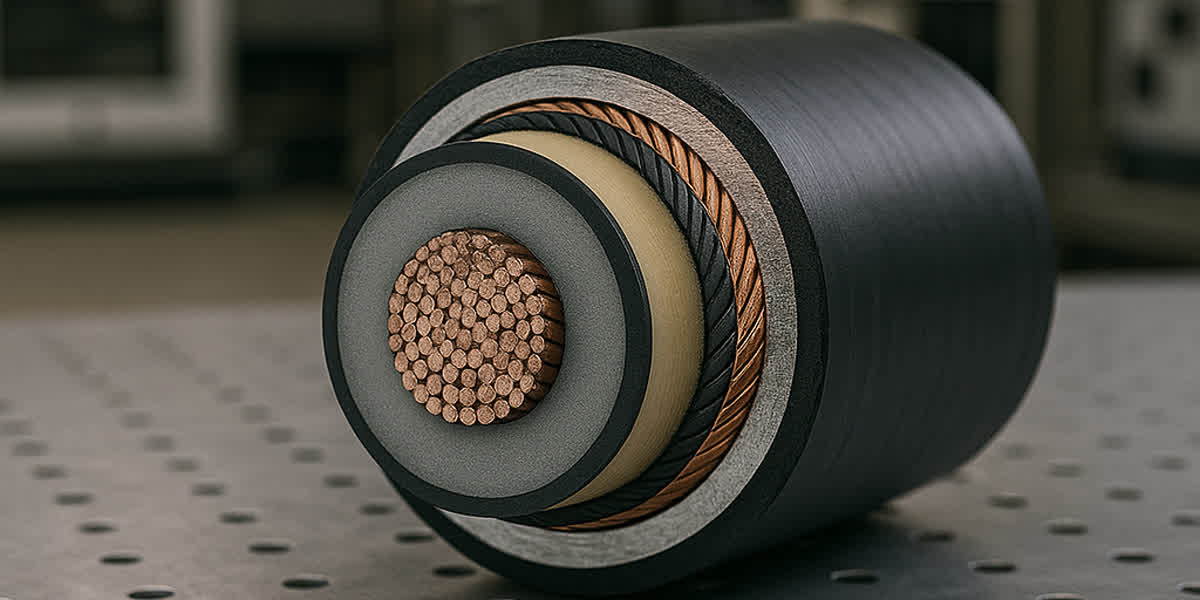
+-------------------------------------------------------------------------------+
|                      MEDIUM VOLTAGE WATERPROOF CABLE MATRIX                   |
+-------------------------------------------------------------------------------+
|  1. Stranded Phase Conductor (Cu / Al) + Longitudinal Swellable Powders/Yarns |
|  2. Extruded Semi-Conductive Conductor Screen (0.5 – 1.0 mm)                  |
|  3. Clean TR-XLPE / Dry-Cured XLPE Insulation Layer                          |
|  4. Extruded Semi-Conductive Insulation Screen (Firmly Bonded or Strippable)  |
|  5. Semi-Conductive Water-Swellable Tape (Longitudinal Water Barrier)         |
|  6. Metallic Copper Wire / Tape Screen (Fault Current Return Path)           |
|  7. Non-Conductive Swellable Cushioning Tape                                  |
|  8. Radial Moisture Barrier (APL Tape / Extruded Lead / Corrugated Aluminum) |
|  9. Overlaid High-Density Polyethylene (HDPE) or MDPE Outer Protective Jacket |
+-------------------------------------------------------------------------------+
3.1 Longitudinal Water-Blocking Technology
If an external mechanical impact damages the outer jacket, water entering the cable can travel hundreds of meters along the conductor strands or through the metallic screen air gaps via capillary action, ruining entire cable runs and reaching splices or switchgear.
- Conductor Longitudinal Blocking: In stranded compact aluminum or copper conductors, specialized super-absorbent polymer (SAP) powders or swellable synthetic yarns are applied during the conductor stranding process. When exposed to moisture, the sodium polyacrylate particles rapidly swell to over 200 to 300 times their dry volume, creating an impermeable gel plug that seals interstitial voids and stops water migration within 1 meter under 1 bar of head pressure.
- Metallic Screen Longitudinal Blocking: High-performance semi-conductive water-swellable bedding tapes are wrapped helically under and over the metallic copper screen wires. In addition to cushioning and maintaining electrical contact between the semi-conductive screen and metallic wires, these tapes swell instantly upon contact with moisture, preventing axial water propagation along the core perimeter.
3.2 Radial Moisture Barrier Technologies
To achieve a true hermetic or moisture-impermeable radial seal preventing water vapor from diffusing through polymeric jackets over decades of operation, several radial barrier designs are utilized in modern Underground Cable solutions:
| Radial Moisture Barrier Type | Construction Detail | Water Vapor Diffusion Rate | Mechanical Crush & Impact Resistance | Weight & Flexibility Impact | Recommended Installation Environments |
|---|---|---|---|---|---|
| Aluminum Polymer Laminate (APL / WLT) | Copolymer-coated aluminum tape (0.2 mm) longitudinally folded and thermo-bonded directly to an extruded MDPE/HDPE outer jacket | Virtually Zero ($\approx 0\text{ g/m}^2\cdot\text{day}$) | Moderate; relies on HDPE jacket stiffness | Lightweight, minimal bending radius increase ($15\times D$) | Wet ducts, direct buried utility distribution, flooded conduits, renewable collector grids. |
| Extruded Lead Alloy Sheath (Pb) | Continuous extruded seamless lead alloy sheath (typically 1.2 to 2.5 mm wall thickness) | Absolute Zero (Hermetic metal barrier) | High radial resistance, immune to hydrocarbon and chemical permeation | Very heavy (+40% to +80% weight), reduced flexibility ($20\times D$) | Petrochemical refineries, oil & gas tank farms, contaminated soils, permanently submerged subsea/marshlands. |
| Welded Corrugated Aluminum Sheath (CAS) | Continuously welded and corrugated aluminum tube enclosing cable core | Absolute Zero (Hermetic metal barrier) | Extreme crush and impact resistance; acts as combined screen + armor | Moderate weight, rigid bending behavior ($18\times - 20\times D$) | Heavy industrial plants, unarmored direct burial in rocky soil, vertical shafts, self-supporting spans. |
| Heavy-Duty Non-Laminated MDPE/HDPE | Extruded pure High/Medium Density Polyethylene without metallic foil | Low, but non-zero moisture vapor transmission over 10–20 years | High abrasion and puncture resistance | Lightest, highest flexibility ($12\times - 15\times D$) | Well-drained soils, dry indoor conduits, temporary or standard municipal networks without standing water. |
4. Advanced Manufacturing Processes: Triple-Extrusion and Super-Clean Handling
Water tree mitigation begins on the factory floor. At Zhengzhou SiTong Cable Co., Ltd. (SiTong Cable), medium voltage cable production utilizes state-of-the-art manufacturing controls to ensure flawless dielectric integrity:
- Triple Common-Head Extrusion (Single-Pass 3-Layer Co-Extrusion): The inner semi-conductive conductor screen, the high-purity TR-XLPE insulation, and the outer semi-conductive insulation screen are extruded simultaneously through a single triple-crosshead tool. This prevents atmospheric dust, airborne moisture, or surface micro-voids from contaminating the interfaces between layers, ensuring a microscopically smooth transition zone ($R_a < 2.0\text{ }\mu\text{m}$).
- Dry Nitrogen Curing (CCV Catenary Line): In contrast to obsolete steam vulcanization methods (which introduced microscopic water molecules into the polymer matrix during cross-linking), modern CCV lines employ dry nitrogen gas pressurized to 10–12 bar at 350°C–400°C for cross-linking, followed by pressurized cold nitrogen cooling. This guarantees void-free insulation with initial moisture content below 100 ppm.
- Clean-Room Compound Conveyance: High-voltage grade TR-XLPE pellets are transported from sealed packaging directly to extruder hoppers via closed-loop, positive-pressure HEPA-filtered pneumatic vacuum systems to eliminate foreign particulate contamination.
- Inline Optical and Ultrasonic Geometry Monitoring: Continuous X-ray and ultrasonic scanning systems monitor insulation concentricity, wall thickness, and outer diameter tolerances in real time, maintaining concentricity above 95% and eliminating localized mechanical stresses.
5. Testing Standards and Qualification Requirements
To verify the long-term water-tightness and tree-retardant performance of medium voltage cables, international testing regimes specify rigorous electrical, material, and water penetration tests:
5.1 Water Penetration Test (IEC 60502-2 Annex B & C / IEC 60840)
For longitudinally water-blocked cables, a 3-meter or 6-meter sample of complete cable is subjected to an accelerated water penetration test: * A 50 mm ring of the outer sheath and metallic screen is removed at the midpoint of the test specimen. * A 1-meter water column (0.1 bar hydrostatic pressure) is applied directly to the exposed core. * The cable is subjected to 10 heating cycles (heating the conductor to maximum operating temperature 90°C for 2 hours, holding for 3 hours, and cooling for 3 hours) in air. * Acceptance Criteria: No water shall emerge from the exposed cable ends throughout the 10 heating cycles and the subsequent 24-hour observation period.
5.2 Accelerated Water Treeing Test (AWTT according to ICEA S-94-649 / IEEE 1407)
- Cable cores are immersed in a 90°C water bath with water placed in the conductor strand interstices.
- An AC test voltage of $3.0 \times U_0$ (three times rated phase-to-ground voltage) is continuously applied for 120 days or 360 days.
- Following the ageing cycle, the cables undergo high-voltage step breakdown testing ($E_{bd}$).
- Acceptance Criteria for TR-XLPE: The retained AC breakdown strength must exceed $25\text{ kV/mm}$ (typically retaining $>80\%$ of unaged breakdown value), with average maximum water tree lengths remaining below 0.25 mm.
5.3 Partial Discharge (PD) Testing (IEC 60270 & IEC 60502-2)
Every manufactured drum length undergoes 100% routine partial discharge testing in shielded Faraday cages at our manufacturing facility. For rated voltage $U_0$, testing at $1.73 \times U_0$ must verify partial discharge levels below 2 pC (substantially exceeding the IEC limit of 5 pC), ensuring total absence of micro-voids or interfacial delamination before shipping.
6. Engineering Selection Matrix: Choosing the Right Waterproof Architecture
To assist distribution engineers and EPC project managers in specifying cable configurations for challenging soil and water conditions, refer to the following selection matrix:
[ Project Environment Evaluation ]
               |
               +---> Normal, Well-Drained Soil, Dry Conduit
               |        => Standard XLPE / MDPE Sheath (Economical)
               |
               +---> Wet Soil, Flood-Prone Ducts, High Water Table, Coastal Grid
               |        => TR-XLPE + Semi-Conductive Swellable Tape + APL Sheath / HDPE
               |
               +---> Permanently Submerged, Marshlands, River Crossing, Hydrocarbon Soil
               |        => TR-XLPE + Extruded Lead Alloy Sheath (Pb) + SWA / PE Outer Jacket
               |
               +---> Heavy Mining, Direct Burial in Crushed Rock, Extreme Mechanical Impact
                        => TR-XLPE + Welded Corrugated Aluminum Sheath (CAS) + HDPE
When connecting and terminating waterproof medium voltage cables in sub-stations and switchgear, ensure the use of rated Cable Lugs & Terminals and moisture-sealed Power Cable Fittings & Hardware. For optimal earthing and standing voltage management of metallic screens in single-core installations, consult our comprehensive Medium Voltage Cable Sheath Bonding & Earthing Guide and field pulling best practices in our Medium Voltage Cable Installation Field Guide.
7. Frequently Asked Questions (FAQ)
Q1: What is the main operational difference between TR-XLPE and standard XLPE in wet underground installations?
A: Standard XLPE is susceptible to water treeing when installed in environments where moisture and electrical stress coexist. Over 5 to 15 years, microscopic vented water trees grow through the dielectric, leading to premature electrical breakdown. TR-XLPE contains specialized chemical additives that stabilize electric fields and trap moisture at the molecular level, retarding water tree growth and extending cable operational service life beyond 40 years in continuously wet conditions.
Q2: Is longitudinal water blocking necessary if the cable has a bonded aluminum laminate (APL) radial sheath?
A: Yes. While an intact APL radial barrier prevents moisture vapor diffusion through the jacket, it cannot prevent water ingress if the outer jacket suffers external mechanical damage (such as dig-ins, backfill rock punctures, or improper pulling). Longitudinal water-blocking powders and swelling tapes confine water to within a short distance (typically < 1 meter) from the puncture site, preventing moisture from spreading through the entire cable run or reaching expensive terminations and joints.
Q3: When should an engineer specify an Extruded Lead Sheath instead of an Aluminum Polymer Laminate (APL) sheath?
A: Extruded lead alloy sheathing provides an absolute, impervious chemical and moisture barrier that resists not only water but also aggressive hydrocarbons, organic solvents, hydrogen sulfide, and acids common in petrochemical refineries, industrial chemical plants, and heavily contaminated soils. In contrast, APL is ideal for utility power distribution, renewable energy farms, and civil infrastructure where hydrocarbon contamination is not present.
Q4: Does Tree-Retardant XLPE increase dielectric transmission losses compared to standard XLPE?
A: TR-XLPE has a marginally higher dielectric loss factor ($\tan \delta \approx 2.0 - 5.0 \times 10^{-4}$) compared to pristine virgin XLPE ($\tan \delta \approx 1.0 - 3.0 \times 10^{-4}$), but this difference is negligible at medium voltage distribution levels (6 kV to 35 kV). The dielectric losses of TR-XLPE are roughly 5 to 10 times lower than EPR insulation ($\tan \delta \approx 1.0 - 3.5 \times 10^{-3}$), making TR-XLPE significantly more energy-efficient for utility feeders.
Q5: How is water penetration performance verified on factory acceptance tests (FAT)?
A: Under IEC 60502-2 (Annex B) and ICEA S-94-649, a test piece of the complete cable is prepared with a 50 mm ring cut in the outer jacket. A 1-meter water head (0.1 bar hydrostatic pressure) is applied to the core, and the cable undergoes 10 thermal load cycles (heating to 90°C and cooling). Passing FAT requires zero moisture emergence at the cable ends throughout the test sequence.
8. Summary and Procurement Support from SiTong Cable
Preventing water treeing and moisture-induced catastrophic outages requires a disciplined engineering strategy that aligns insulation compound selection, radial and longitudinal barrier architecture, and high-precision triple-extrusion manufacturing.
Zhengzhou SiTong Cable Co., Ltd. (SiTong Cable) supplies fully certified medium voltage waterproof power cables (6/10kV, 8.7/15kV, 12/20kV, 18/30kV, 26/35kV) engineered to IEC 60502-2, ICEA S-94-649, BS 6622, and AS/NZS 1429.1 standards. With German dry-curing CCV lines, 100% routine partial discharge testing (< 2 pC), and custom barrier configurations (APL, Lead, CAS, and TR-XLPE), we deliver guaranteed reliability for utility grids, renewable energy farms, and industrial infrastructure worldwide.
👉 Browse our Medium Voltage Power Cable range
👉 Explore our Heavy-Duty Underground Cable range
👉 Medium Voltage Cable Sheath Bonding & Earthing Guide
👉 Contact our Engineering Support Team
📬 Sales & Engineering Inquiries: sales@sitongcable.com | 📞 International Phone: +86-371-69176007